Many homeowners and landscape designers are not satisfied with the off-the-shelf corten steel screens available on the market.
You might want a custom pattern that complements your garden plants, a geometric design that complements the lines of your architecture, or multiple panels joined together to form a cohesive composition.
At the same time, you might worry: While a custom pattern looks great, will it still provide the privacy you need?
Here’s the answer: Weathering steel screens support custom laser-cut patterns.
Common customization options include botanical motifs, geometric compositions, abstract art, house numbers, and corporate logos.
Customization involves more than just changing the pattern; it also requires confirming panel dimensions, metal connection structures, and installation interfaces to ensure the finished product is functional and suitable for long-term outdoor use.
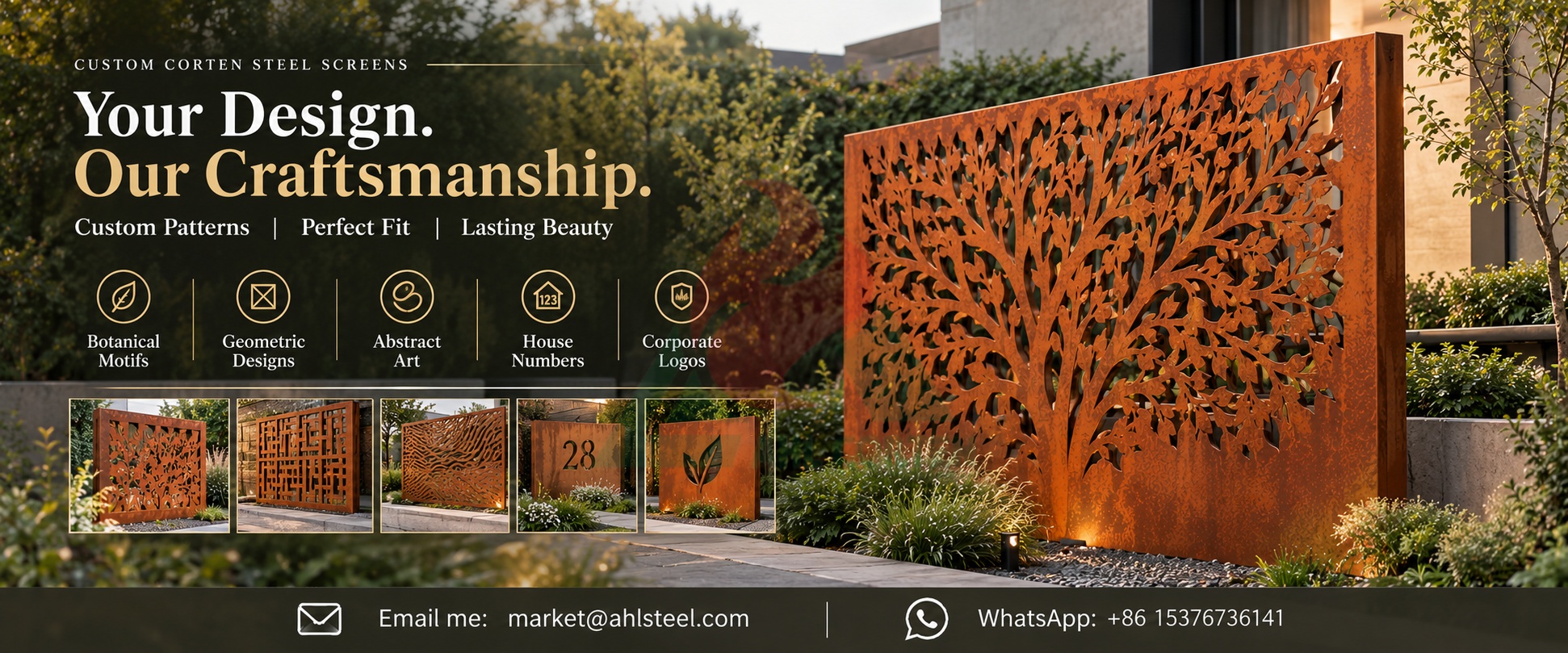
What Laser-Cut Patterns Can You Customize on Corten Steel Screens?
The laser cutting process can create a wide variety of openwork designs on weathering steel sheets, allowing you to choose based on landscape themes, architectural styles, and brand requirements.
1. Plant and Nature-Inspired Patterns
Branches, leaves, flowers, vines, and grass textures are among the most popular choices for garden projects.
These patterns allow metal screens to blend naturally with the surrounding greenery, softening the harshness of the steel.
When finalizing a design, be sure to distinguish between the cut-out sections and the solid metal sections—the two will completely alter the final visual effect.
Suitable for: private gardens, patios, flower bed borders, and natural-style landscapes.
2. Geometric and Abstract Patterns
Lines, grids, circles, triangles, symmetrical patterns, and abstract, irregular shapes are well-suited for modern minimalist and industrial-style gardens.
A single panel can serve as a standalone decorative element, while multiple panels can be assembled to create a continuous, unified visual composition.
For multi-panel screens, ensure consistency in pattern proportions, spacing, and orientation to prevent misalignment when assembled.
Suitable Settings: Modern gardens, commercial complexes, hotels, and sales office landscapes.
3. LOGOS, House Numbers, and Original Artwork
Laser cutting can also produce corporate logos, house numbers, project names, and original hand-drawn designs.
Custom metal privacy screens featuring logos in commercial projects serve both as spatial dividers and as brand displays.
⚠️ Important Reminder: Before submitting a design, confirm that you own the copyright or have authorization to use it.
Isolated areas within letters or enclosed shapes require metal connecting bridges; otherwise, small pieces may fall off after cutting.
What Can Be Customized Besides the Pattern?
A custom rusted steel screen involves more than selecting a decorative design. The panel dimensions, structural details, and installation interfaces also influence the finished product.
| Customization Item |
What to Confirm |
Why It Matters |
| Panel dimensions and shape |
Width, height, outline and panel divisions |
Fits the intended installation area |
| Pattern scale and position |
Size, direction, margins and alignment |
Prevents unwanted stretching or cropping |
| Multi-panel composition |
Repeating patterns or continuous artwork |
Maintains visual consistency |
| Thickness and edge structure |
Steel thickness, folded edges, frames and supports |
Matches the intended application |
| Mounting details |
Bolt holes, mounting tabs, posts or frame connections |
Reduces on-site modifications |
| Surface condition |
Supplied steel condition or agreed pre-weathered finish |
Clarifies the expected appearance on delivery |
For example, a decorative screen installed between two existing posts may require different mounting details from a freestanding garden divider.
AHL offers customization discussions covering panel dimensions, patterns, and installation arrangements. The available options should be confirmed against the selected product, technical drawings, and quotation.
How Do You Choose a Design for Privacy, Light, and Garden Views?
An attractive design doesn’t necessarily meet privacy needs. When selecting a design, it’s important to distinguish between decorative needs and privacy needs.
1. Decorative Screens and Privacy Screens Have Different Priorities
The primary purpose of decorative screens is to create a scenic view and enhance the artistic atmosphere; they have minimal privacy requirements.
Privacy screens, on the other hand, are designed to block views from specific directions—such as those from neighbors or walkways.
An intricate openwork pattern that looks stunning in a rendering may provide good coverage when viewed head-on, but from a different angle or a greater distance, the view may still be visible through it.
2. Before Selecting a Design, Clarify the Following:
The primary viewing location of the screen, where people will stand to view it, and which directions you need to block views from.
The openwork ratio is only a reference; it cannot solely determine the level of privacy.
The openwork ratio refers to the proportion of the openwork area relative to the total area of the panel.
It can be used to compare different designs, but the openwork ratio alone cannot determine the effectiveness of privacy protection.
The final screening effect is also closely related to the size of the openings, their placement, viewing angle, distance, and background color.
3. Consider Daytime and Nighttime Conditions
During the day, natural light passing through the openwork creates beautiful patterns of light and shadow.
At night, if a light is turned on on one side of the decorative metal privacy screen, light will pass through the gaps, making it easier to see the interior space from the other side.
For projects with high privacy requirements, lighting plans must be considered simultaneously during the design phase.
When it is difficult to judge the effect from drawings, a small sample can be produced for on-site testing.
Are There Limits to Laser-Cut Corten Steel Designs?
Laser cutting is highly capable, but not all patterns are suitable for direct fabrication into outdoor weathering steel screens.
Patterns must be evaluated comprehensively in conjunction with panel size, steel plate thickness, and connection structures.
1. Fine Details Require Suitable Metal Connections
Solid metal connecting bridges maintain the integrity of the entire panel between the openwork patterns.
Connecting ribs that are too thin, slender unsupported shapes, and isolated small graphics are prone to deformation or breakage during transportation and installation.
Complex illustrations and intricate lines often require simplification and adjustment to be converted into producible cutting drawings.
2. Pattern Complexity Must Match Panel Size and Thickness
There is no universal standard for minimum line width.
The minimum allowable detail varies depending on sheet thickness, panel size, and cutting equipment.
While some patterns can be cut by machines, the finished product may be too fragile for long-term outdoor exposure to wind and sun.
For complex patterns, it is essential to have the factory conduct a manufacturability review before finalizing the design.
3. Perforated Panels ≠ Complete Load-Bearing Structural Systems
Perforated decorative panels serve only as the decorative component of a screen and do not constitute a complete freestanding fence system.
For freestanding floor-to-ceiling decorative steel screens, local wind loads, post specifications, foundations, and mounting methods must also be evaluated.
Even if the perforations allow for ventilation, it cannot be assumed that the structure is wind-resistant; structural calculations are mandatory for tall screens and coastal projects.
Complete Process for Custom Laser-Cut Weathering Steel Screens
This process will help you minimize communication misunderstandings and smoothly turn your design into a finished product.
- Provide your ideas: sketches, reference images, and photos; discuss style and intended use
- Confirm specifications: panel dimensions, quantity, thickness, and installation requirements
- Layout review: The factory provides the cutting layout; check for connecting bridges, hole positions, and panel numbers
- Drawing Approval: Verify dimensions, orientation, seams, and mounting holes; production begins only after signed approval
- Production and Quality Inspection: Manufacture according to approved drawings; conduct final inspection upon completion
- Packaging and Shipping: Ensure proper protection and include installation instructions
Tip: Have a design concept in mind? You can send a sketch or reference image directly, and the factory will help you create a manufacturable cutting layout.
Start Your Custom Weathering Steel Screen Project
A high-quality, laser-cut weathering steel screen can simultaneously serve as a space divider, provide privacy, and add artistic decorative elements to your landscape.
Whether it’s a screen featuring botanical patterns for a private garden, geometric partitions for modern commercial spaces, or a branded feature wall for hotels and retail stores, we can customize it for you.
AHL offers custom laser cut metal privacy screens; patterns, dimensions, and installation plans are all negotiable, subject to technical review and a formal quote.
Send us your design concepts, panel dimensions, quantity, and installation method to receive a personalized quote.
Frequently Asked Questions
Can I Use My Own Design for a Weathering Steel Screen?
Yes. Please provide a hand-drawn sketch, reference image, or design file, and our factory will evaluate whether it is suitable for laser cutting and outdoor use.
Can Company Logos and House Numbers Be Laser-Cut Onto the Panels?
Yes. Please ensure you have the copyright to the design. For enclosed letters and graphics, connection bridges must be included to prevent small pieces from falling off.
Can I Place a Custom Order If I Only Have a Photo or Hand-Drawn Sketch?
These can be used as references. However, the images will need to be converted into vector drawings for processing, which may incur a drafting service fee.
Can a Single Design Span Multiple Panels to Create a Continuous Image?
Yes. Before production, confirm the panel sequence, seam spacing, and design alignment to avoid misalignment when panels are joined.
How Should I Choose a Design to Ensure Privacy?
Focus on the viewing angle, the distance between people and the steel screen fence, and the location of cutouts. The open area ratio is only a reference and cannot guarantee privacy on its own.
Will Complex, Intricate Patterns Make the Screen More Fragile?
Designs with overly fine details or narrow connecting ribs are prone to warping. The factory will simplify the design based on panel thickness to ensure outdoor durability.
Will I Receive Drawings for Confirmation Before Production?
The standard customization process includes drawing review. Production will not begin until dimensions, patterns, and mounting holes have been confirmed.
Can I Customize Both the Panel Dimensions and the Mounting Hole Locations?
Yes. Please provide the required width and height, mounting method, and information regarding the posts or wall structure, and we will design the mounting points accordingly.
Can I Request a Sample Before Placing a Large Order?
Whether a sample can be arranged depends on the design and manufacturing process. For large-volume projects, please consult us in advance regarding sample options.