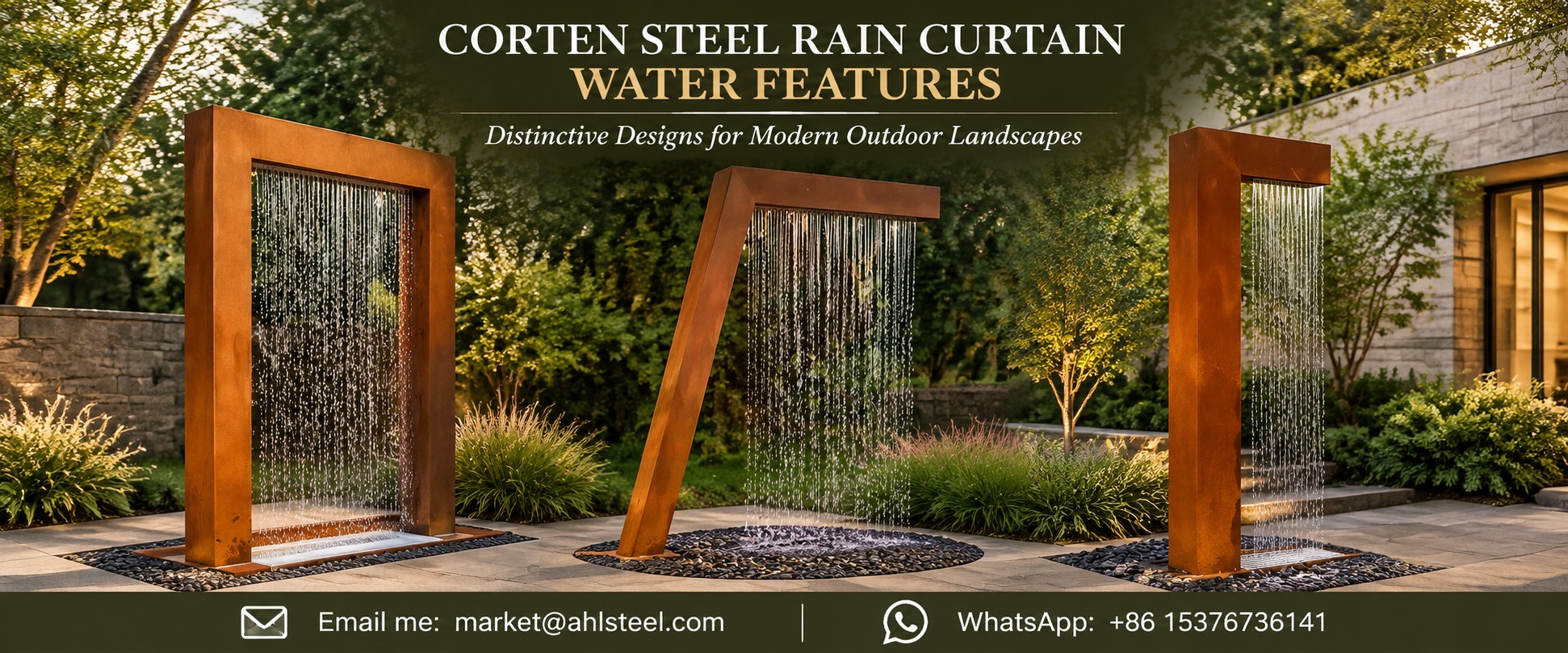
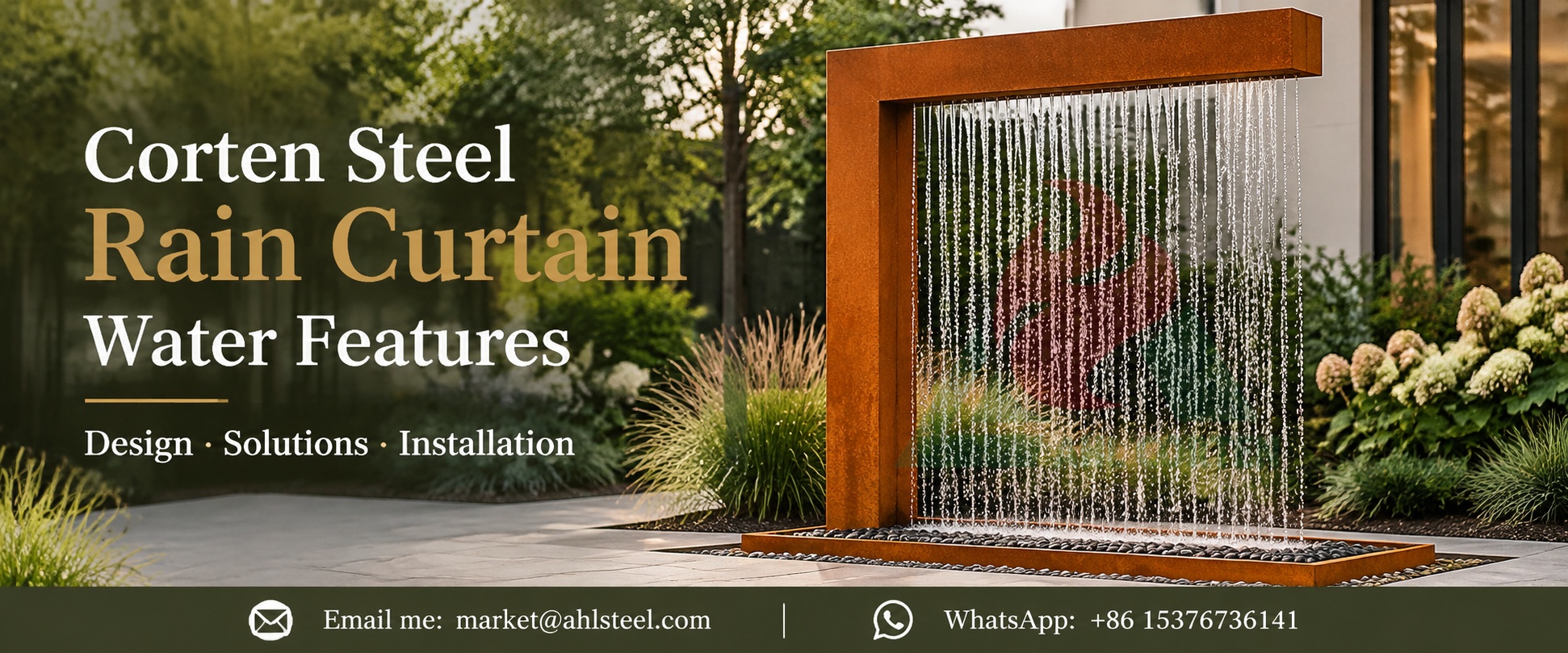
Corten steel rain curtain water features are highly atmospheric landscape elements for gardens and commercial landscapes. Water flows evenly from the top outlet, forming either fine, delicate rain-like strands or a continuous, seamless water curtain. Combined with the unique warm, rusted texture of weathering steel, they blend seamlessly with stone, natural timber and plants.
Many buyers tend to confuse rain curtain water features with ordinary fountains, focusing solely on their external appearance whilst overlooking supporting systems such as water outlets, water circulation, collection troughs and load-bearing structures.
Whether for private garden renovations or landscape projects for hotels and show homes, comprehensive planning is required that takes into account the site’s spatial layout and the desired water flow effect. This article provides a detailed explanation of each aspect, covering principles, styles, dimensions, pump systems, installation and maintenance.
Want the Latest Catalog for Corten Steel Water Features? Contact Us!
How Does a Rain Curtain Water Feature Work?
The entire rain curtain water feature operates as a recirculating water system, comprising a water storage tank, a submersible pump, water supply pipework, a top water distribution outlet and a lower collection trough.
The pump delivers water from the storage tank to the top water distribution structure, where the water cascades downwards from the outlet, flows back into the collection trough and returns to the storage tank, continuing the cycle.
The effect of the falling water is entirely determined by the design of the outlet: designs with closely spaced perforations create a effect of fine, individual raindrops, whilst a one-piece overflow creates a continuous, smooth water curtain.
Both the width of the outlet and the density of the perforations can be customised prior to production; determining the desired effect in advance ensures the finished product meets expectations.
Why Choose Corten Steel for Outdoor Water Features?
When exposed to wind and sun, weathering steel gradually develops a stable, rust-brown oxide layer, imparting a naturally rugged architectural texture that creates a striking contrast with the gentle flow of water and the warm brown steel structure.
This stable rust layer requires an environment of alternating wet and dry conditions to continue forming. There is a crucial misconception here: whilst weathering steel is resistant to atmospheric weathering, this does not mean it can be submerged in water for extended periods.
The inner walls of water tanks and components in constant contact with water require separate protective treatment. The external decorative surfaces of corten steel water feature and the internal structures that are constantly submerged in water cannot be treated according to the same set of corrosion protection standards.
Rain Curtain vs. Traditional Garden Fountains
Traditional fountains typically feature upward-projecting water jets, bowl-shaped overflows or water emerging from sculptures, with the visual focus directed upwards.
The core feature of a rain curtain water feature is a vertical, flat curtain of falling water, emphasising linearity and visual composition.
In landscape design, the roles of the two are also entirely different.
Rain curtains can be used to frame views, serve as background partitions or delineate spaces; fountains are generally placed at the centre of a site, acting as independent sculptural focal points.
Rain curtain water features place higher demands on supporting systems; the height of the frame, the range of the falling water and the water collection system must all be perfectly matched, with none of these elements being dispensable. The L-shaped recirculating rain curtain is a typical example of an integrated, architecturally designed solution.
4 Popular Corten Steel Rain Curtain Design Ideas
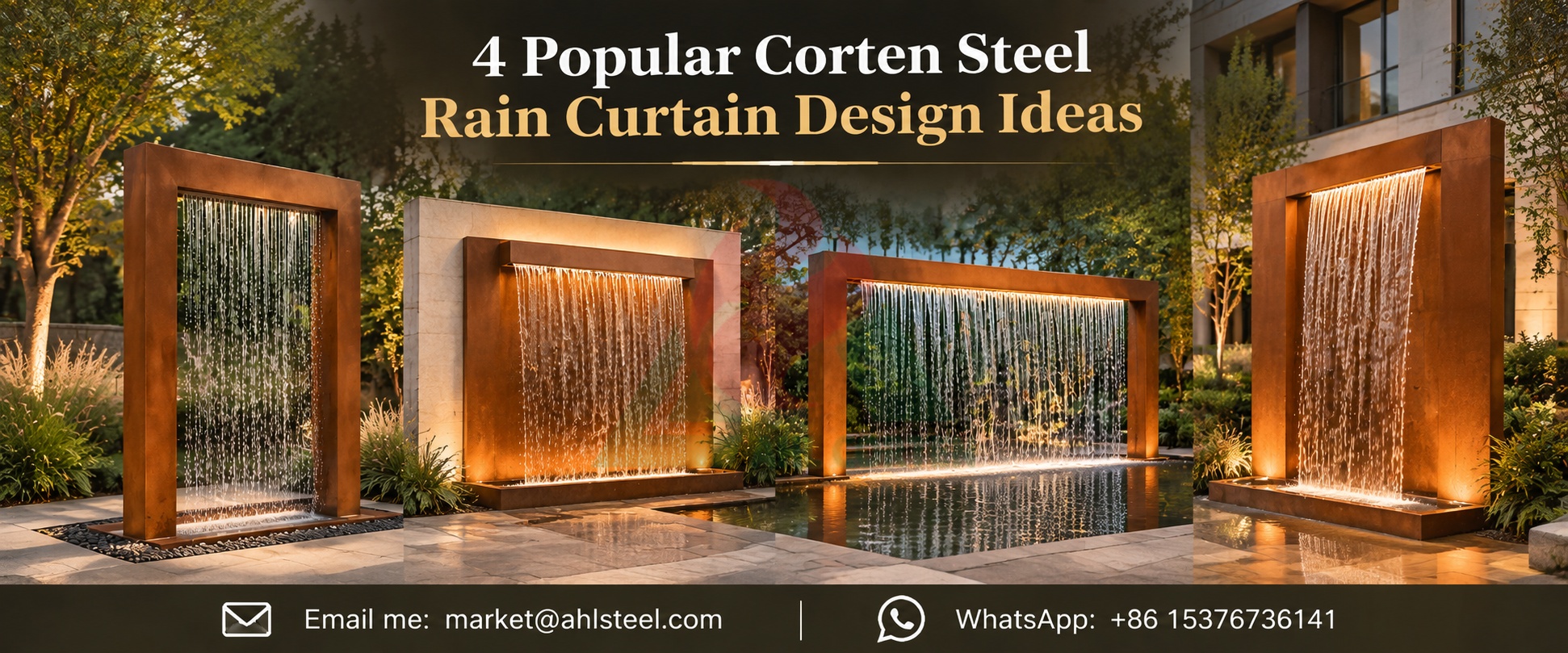
1. Freestanding Rain Curtain Water Features
Freestanding frame designs are ideal for patios, garden relaxation areas and along landscape axes, serving as a visual focal point. The portal-style frame does not completely obstruct the view, maintaining a sense of openness, whilst the flow and sound of the water create a tranquil atmosphere.
Common designs include L-shaped and arch-shaped configurations. When selecting a design, do not focus solely on appearance; it is essential to verify the supporting structure, the location of the water tank and access for future pump maintenance.
2. Wall-Mounted Corten Water Curtain Designs
Installed directly against a wall, these are suitable for garden feature walls, hotel entrances and the external façades of sales offices.
This style is ideal for compact spaces as it does not occupy floor space.
**Important Note**: These must not be fixed directly to standard decorative walls; it is essential to assess the wall’s load-bearing capacity, waterproofing, access for pipe maintenance and the drainage channel configuration in advance.
3. Corten Rain Curtains with Reflecting Pools
A wide pool is situated beneath the rain curtain; the falling water creates layered reflections on the water’s surface, offering an excellent view when viewed from indoor windows.
When planning, consideration must be given to the landscape effect during both pump operation and shutdown. The depth and water level within the pool must be compatible with the water circulation system, and the pump flow rate must be calculated based on the desired waterfall effect.
4. Custom Architectural Water Features
In large-scale projects, the width, height and tank dimensions of the rain curtain can be aligned with paving modules and building façades, serving as an extension of the architecture.
AHL supports customisation of frame styles, outlet widths and perforation density. Prior to customisation, please provide drawings and reference videos demonstrating water flow effects to confirm technical feasibility and finalise the list of supporting equipment.
Want the Latest Catalog for Corten Steel Water Features? Contact Us!
How to Choose the Right Size for a Corten Steel Rain Curtain
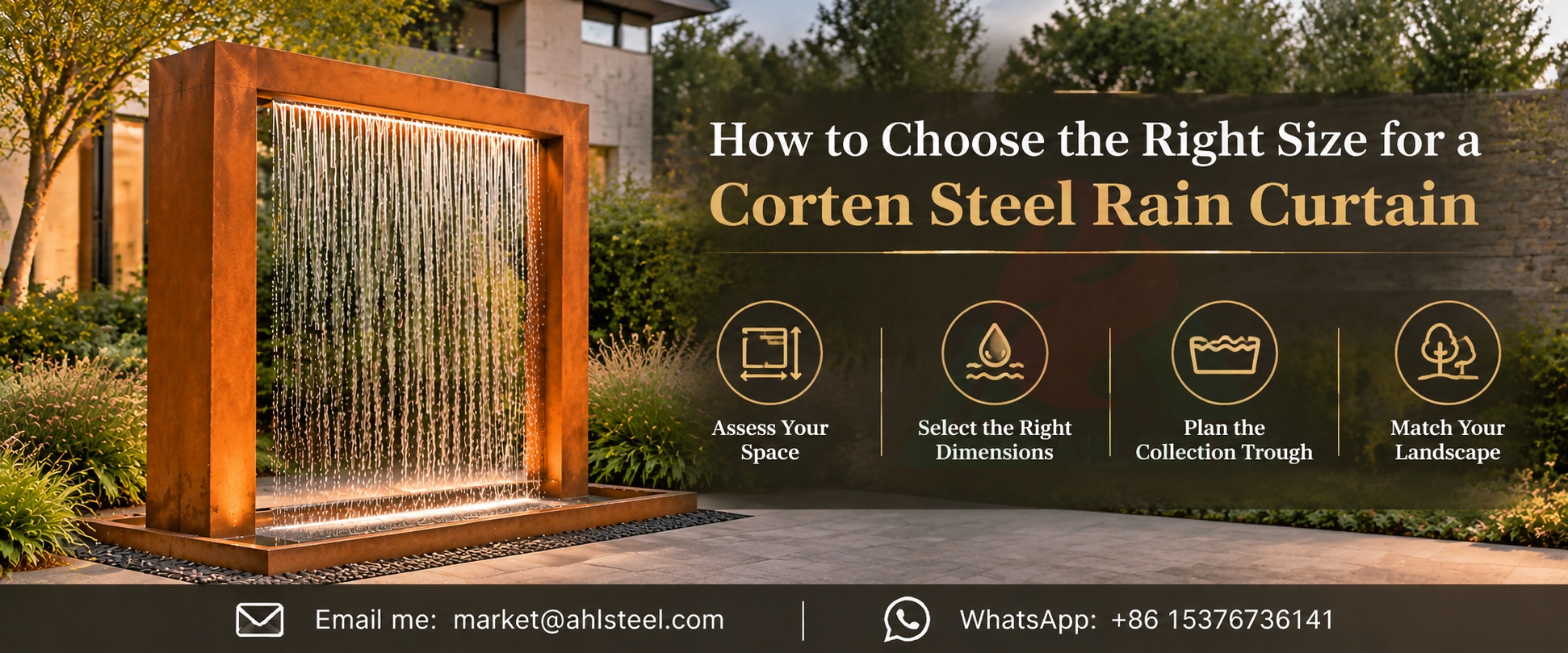
1. Consider Available Garden or Patio Space
In addition to the space occupied by the water feature itself, space must be set aside for the catchment trough, pipework, pump maintenance and pedestrian access.
For balcony and roof garden projects, it is essential that a professional calculates the total load when the feature is filled with water; one must not rely solely on the weight of the empty steel frame.
2. Choosing the Right Water Curtain Width and Height
Many buyers confuse several dimensions: the total width of the outer frame is not the same as the effective width of the water flow; nor is the total height of the frame the same as the actual drop height of the water.
The width of the water outlet determines the required water flow rate; the drop height determines the pump head. When widening or raising a water feature, one cannot simply scale up the outer casing; the entire hydraulic system must be recalculated.
3. Consider the Water Collection Trough Dimensions
Pay particular attention to the internal clear dimensions of the collection trough, the operating water level and the effective water storage volume.
At the same time, plan for splash protection and return water solutions. AHL’s water curtain solutions often utilise concealed drainage; the collection system forms part of the overall design and cannot be retrofitted at a later stage.
4. Match the Water Feature to the Surrounding Landscape
For small courtyards, prioritise controlling the overall scale to ensure comfortable pedestrian space; for hotel entrances and commercial plazas, select the appropriate model by taking into account viewing distance, operating hours and maintenance complexity.
When requesting a quotation, please include photographs of the site and a plan drawing; this makes it easier to select the correct specifications than relying solely on product renderings.
Want the Latest Prices for Corten Steel Water Features? Contact Us!
Water Pump and Circulation System Requirements
1. Selecting the Appropriate Water Pump
When selecting a water pump, one must not rely solely on the maximum flow rate stated on the nameplate; the pump must be matched according to the **total dynamic head**.
The total dynamic head comprises the vertical lift height plus the pipework resistance caused by pipes and fittings.
For large metal water fountains of the same width, different outlet configurations require different flow rates; one cannot simply apply a simplified formula such as ‘a fixed flow rate per metre’. Suppliers must confirm the operating parameters based on the specific outlet design.
2. Designing an Efficient Water Distribution System
The water distribution chamber must ensure that the water flow is evenly distributed across the entire width of the outlet, avoiding situations where the flow is strong on one side whilst the other side has no water.
Confirm the water distribution structure, pipework layout and the locations of cleaning and maintenance access points in advance.
Whether a rain-drop effect or a continuous water curtain is desired forms the core basis for the design of the water distribution structure; renderings alone cannot guarantee the actual water discharge effect.
3. Reservoir Capacity and Water Management
Confirm the effective volume of the water tank, the minimum safe water level for the pump and the water replenishment plan.
The water returning to the tank via the pipework after shutdown must also be included in the calculation of the tank’s capacity.
If the steel structure, pump and reservoir are supplied by different vendors, be sure to request a water circulation schematic to clarify the boundaries of each party’s responsibilities.
4. Lighting Options for Night-time Effects
Underwater LED lights may be installed to illuminate the cascading water curtain at night, creating a more atmospheric effect.
Confirm in advance the luminaire models, protection ratings, transformer locations and maintenance procedures. Lighting is an optional extra and is not included by default in the steel structure quotation.
How to Install a Corten Steel Rain Curtain Water Feature
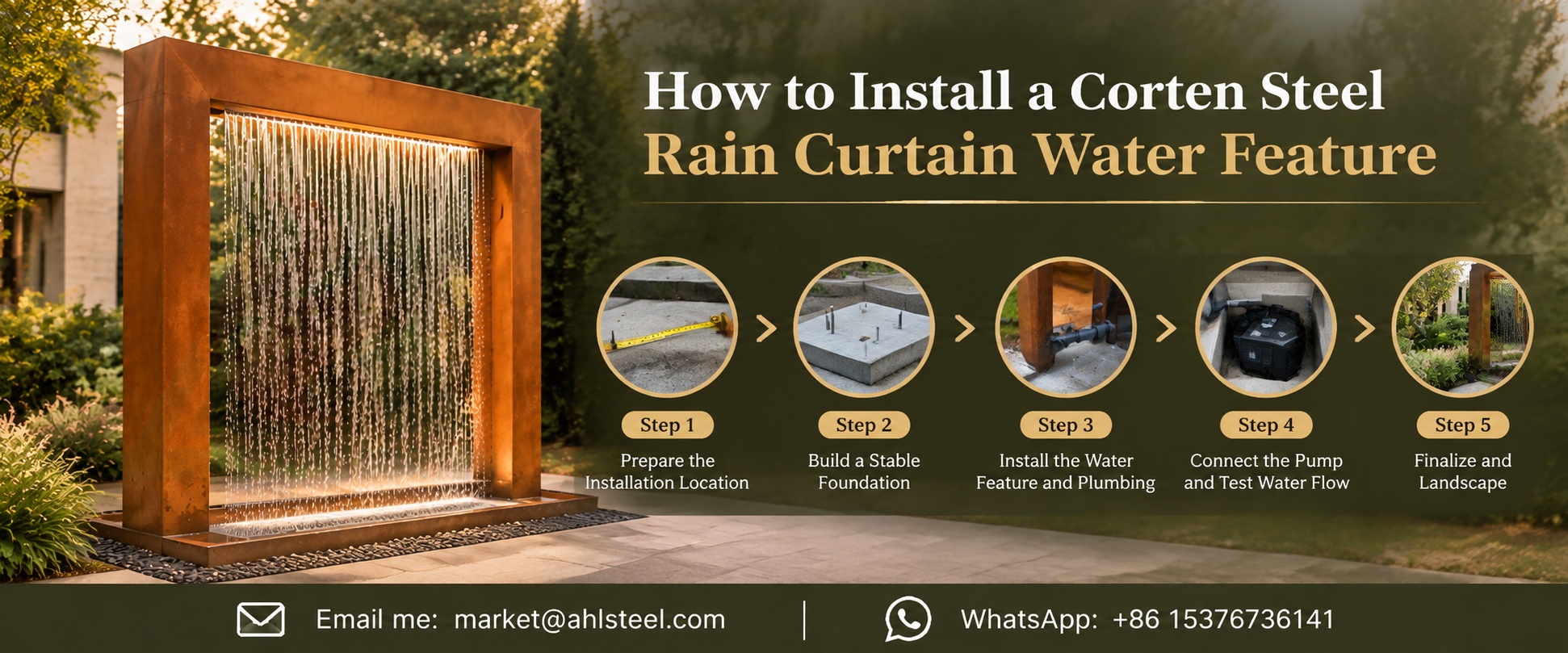
Step 1 – Prepare the Installation Location
Confirm the installation location, access routes, and the positions of water supply, drainage and power points. Check for underground utilities before excavation.
For wall-mounted and large freestanding models, verify the load-bearing capacity of the supporting structure in advance and check all installation drawings.
Step 2 – Build a Stable Foundation
The foundation and anchor bolt design must be tailored to the product’s weight, soil conditions and full load; there is no universal standard foundation.
Control the elevation precisely to ensure the frame, water outlets and collection troughs are aligned; plan the hoisting route in advance before large components arrive.
Step 3 – Install the Water Feature and Plumbing
Secure the main frame in accordance with the drawings; position the water storage tank and lay the pipework, ensuring sufficient access space is maintained around all access hatches.
Inspect and approve protective coatings and waterproofing structures in contact with water before sealing the surface; do not seal potential hazards beneath the finish.
Step 4 – Connect the Pump and Test Water Flow
Electrical work must be carried out by a qualified electrician in accordance with local regulations.
Fill the system with water for a trial run, checking for leaks, the evenness of water distribution, and whether the return flow is smooth.
If the water display is unsatisfactory, prioritise adjusting the flow rate and pipe resistance; do not blindly replace the pump with a higher-capacity model.
Step 5 – Complete Final Adjustments and Landscaping
Before laying paving or planting, conduct a comprehensive test of the entire system once more.
Record equipment models, operating parameters and maintenance procedures, and hand over the drawings and operating manuals to the client to facilitate future maintenance.
Want the Latest Prices for Corten Steel Water Features? Contact Us!
Maintenance Tips for Corten Steel Rain Curtain Water Features
1. Keep Water Circulation and Outlets Clean
The outlets on rain curtains have very small holes and can easily become blocked by fallen leaves and silt. Clean the inlet filter and pump housing regularly.
For porous rain drop designs, confirm the supplier’s cleaning procedure in advance to ensure maintenance can be carried out without dismantling the main frame wherever possible.
2. Prevent Water Stagnation and Blockages
As the water tank is designed to hold water, the focus of maintenance is not on eliminating standing water, but on preventing foul odours and blockages in the pipework.
Drain and clean the system regularly in accordance with the manufacturer’s instructions; in cold regions, a separate winter frost protection plan must be drawn up.
3. Understanding the Natural Development of Corten Steel Patina
The rate at which the rust-coloured surface develops depends on the local climate and cycles of dry and wet conditions.
In the early stages, rainwater may wash away brownish-red rust water from new installations, posing a risk of staining. Plan overflow and splash paths in advance, avoiding light-coloured paving, and do not promise that stains will be completely absent.
4. Inspect Pumps and Electrical Components Regularly
Carry out regular inspections of pumps and cables in accordance with the equipment manual.
Whilst the weathering steel casing is weather-resistant, this does not mean that the pumps, pipes or wiring can withstand freezing temperatures; in cold regions, the pipes and tanks must be drained during winter and properly protected.
Want the Latest Prices for Rusted Steel Water Features? Contact Us!
Why Choose AHL Corten Steel Water Features?
AHL offers a range of tried-and-tested rain curtain water feature solutions, suitable for private gardens, terraces, hotels and commercial landscaping projects.
We offer customisation of height, width and the density of water outlet openings, complete with a concealed drainage system.
We can simultaneously provide pump selection, filtration system integration and technical installation guidance. Quotations will itemise steel structure fabrication, pumps, lighting and accessories, as well as packaging and transport; the scope of supply can be confirmed in writing according to specific project requirements.
FAQ
1. How Does a Corten Steel Rain Curtain Water Feature Work?
The pump draws water from the storage tank and delivers it to the top outlets, from where the water falls into the collection trough to be recirculated. The water flow pattern (raindrops or a full water curtain) is determined by the structure of the outlets.
2. What Size Rain Curtain Water Feature Is Best for a Garden?
There is no universal standard; this requires a comprehensive assessment of the footprint, viewing distance, water fall range and maintenance space. Please provide the site dimensions to the supplier for a design evaluation.
3. How Much Water Does a Rain Curtain Water Feature Require?
It is important to distinguish between two concepts: the storage capacity of the tank and the circulation flow rate of the pump. These are different parameters; when requesting a quote, ask the supplier for both figures.
4. What Type of Pump Is Required for a Water Curtain?
Match the flow rate to the total dynamic head (lift height + pipe pressure loss); do not base your decision solely on the visual size of the water feature.
5. Can Corten Steel Water Features Be Used Outdoors All Year Round?
Outdoor installation does not equate to continuous operation throughout the year. In regions with low temperatures, there is a risk of the structure cracking due to freezing; it is essential to carry out winter drainage and anti-freeze procedures. Confirm climatic suitability with the manufacturer in advance.
6. Does Corten Steel Leave Rust Stains?
During the initial stage of rust formation, rainwater runoff may carry brown-coloured water, posing a risk of staining; ensure proper drainage and water diversion are planned during the design phase.
7. Can I Customise the Size of a Corten Steel Rain Curtain?
AHL supports customisation of width, height and outlet styles; please confirm structural feasibility, ancillary equipment and transport conditions before placing an order.
8. How Do You Maintain a Corten Steel Water Feature?
Regularly clean the outlets and filters, inspect pipework and electrical components, and monitor water quality. Drain and maintain the feature as required during the rainy season and winter; distinguish between the external rust layer and the internal water-contact protection.
Create a Unique Outdoor Water Feature with AHL
For a high-quality rain curtain water feature, the steel structure, water distribution system, water tank and pump must be designed as an integrated system; they cannot be procured as separate, piecemeal components.
If you are planning a landscaping project, please provide site plans, photographs, your desired water flow effects and the dimensions of the available space.
We will provide you with product drawings, dimensional plans, pump specifications and an itemised quotation; production will only commence once water-resistant protection, maintenance space and frost protection measures have been confirmed.