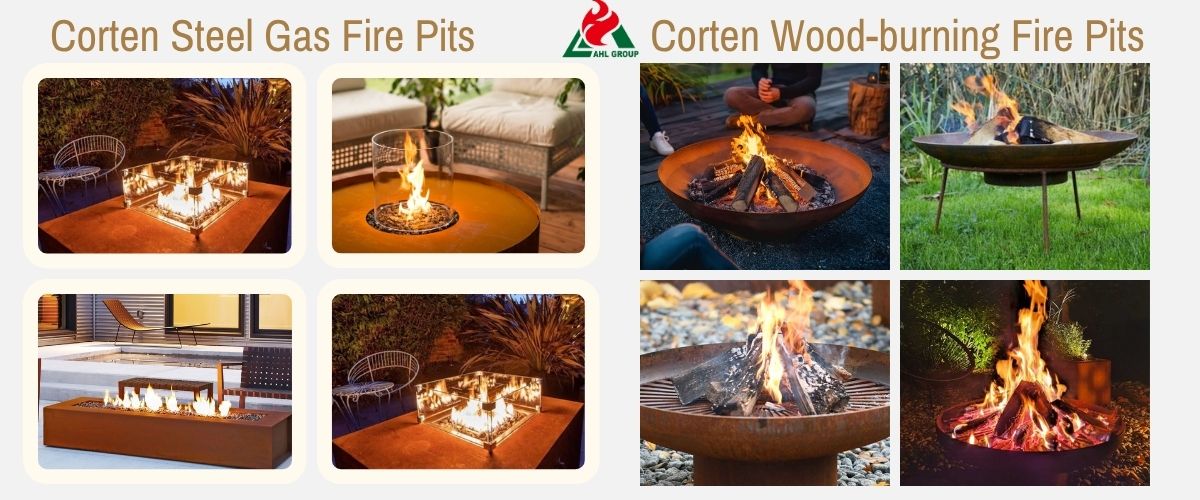
There are two main types of support structures for weathering steel fire pits: models with legs and models with a one-piece base. Many buyers and landscape designers tend to make decisions based solely on appearance.
Let’s start by clarifying a key point: there is no inherent superiority or inferiority between the two structures. Models with legs aren’t necessarily more stable, nor do models with a one-piece base necessarily burn better. Stability, ease of movement, and combustion performance all depend on the structural design of the entire product.
This article focuses primarily on wood-burning corten steel fire pits; for gas-fired models, additional evaluation of the burner, gas supply system, and installation specifications is required, and the selection criteria will differ.
Want a Custom Corten Fire Pit? Contact Us!
The Key Differences Between 2 Types of Corten Steel Fire Pit Designs
1. What Is a Corten Steel Fire Pit with Legs?
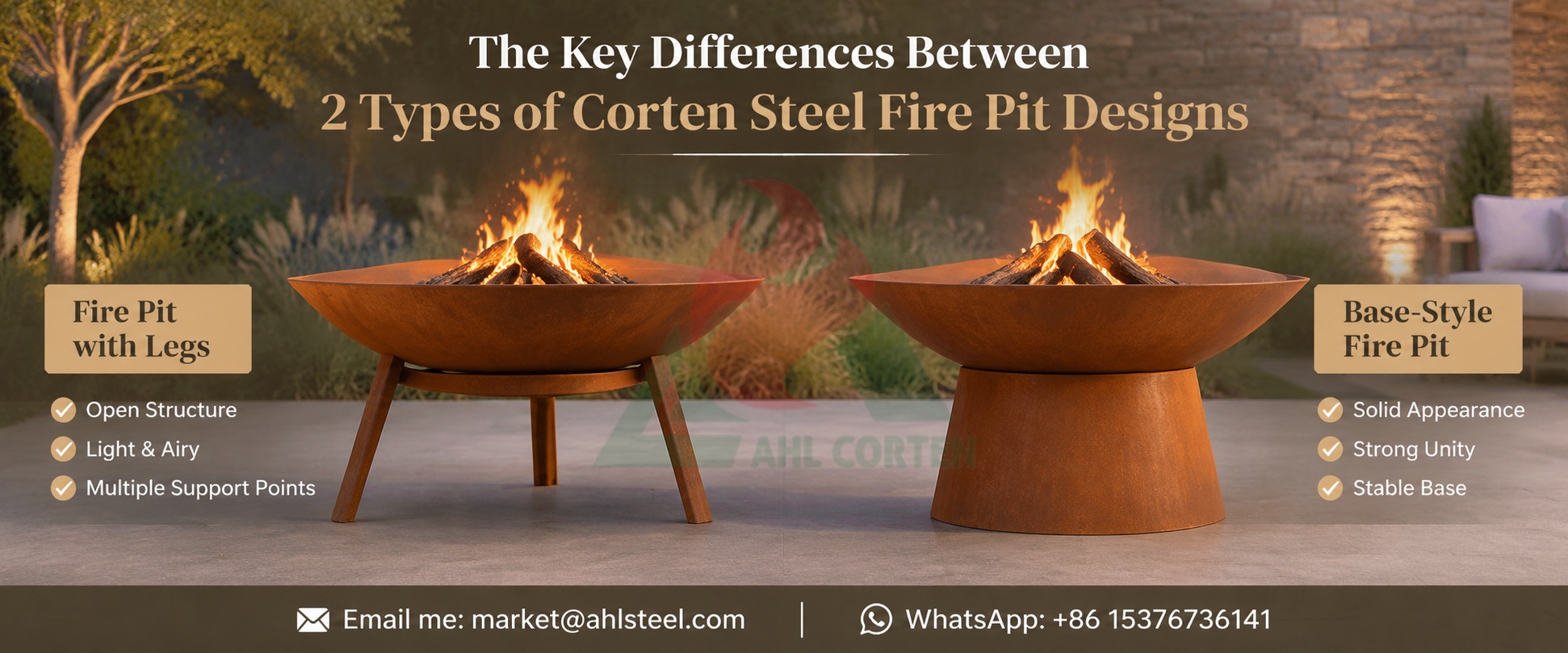
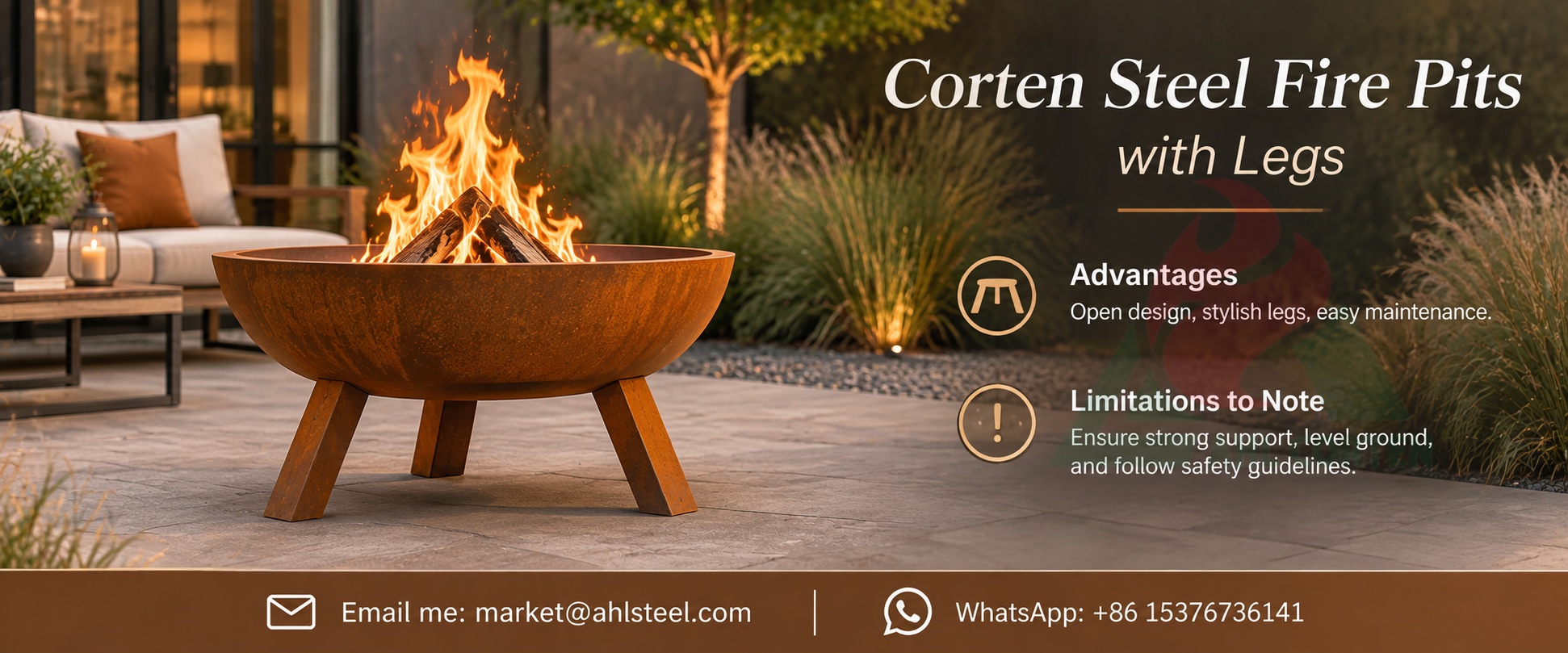
A leg-style fire pit features independent legs or an open frame beneath the fire pit bowl to support the firebox. The legs can be straight, angled, or designed as artistic frames, with open space left beneath the firebox. AHL’s product catalog offers both leg-style and base-style wood-burning fire pits; when purchasing, do not rely solely on the product title—be sure to verify the actual dimensions and structural drawings.
2. What Is a Base-Style Weathering Steel Fire Pit?
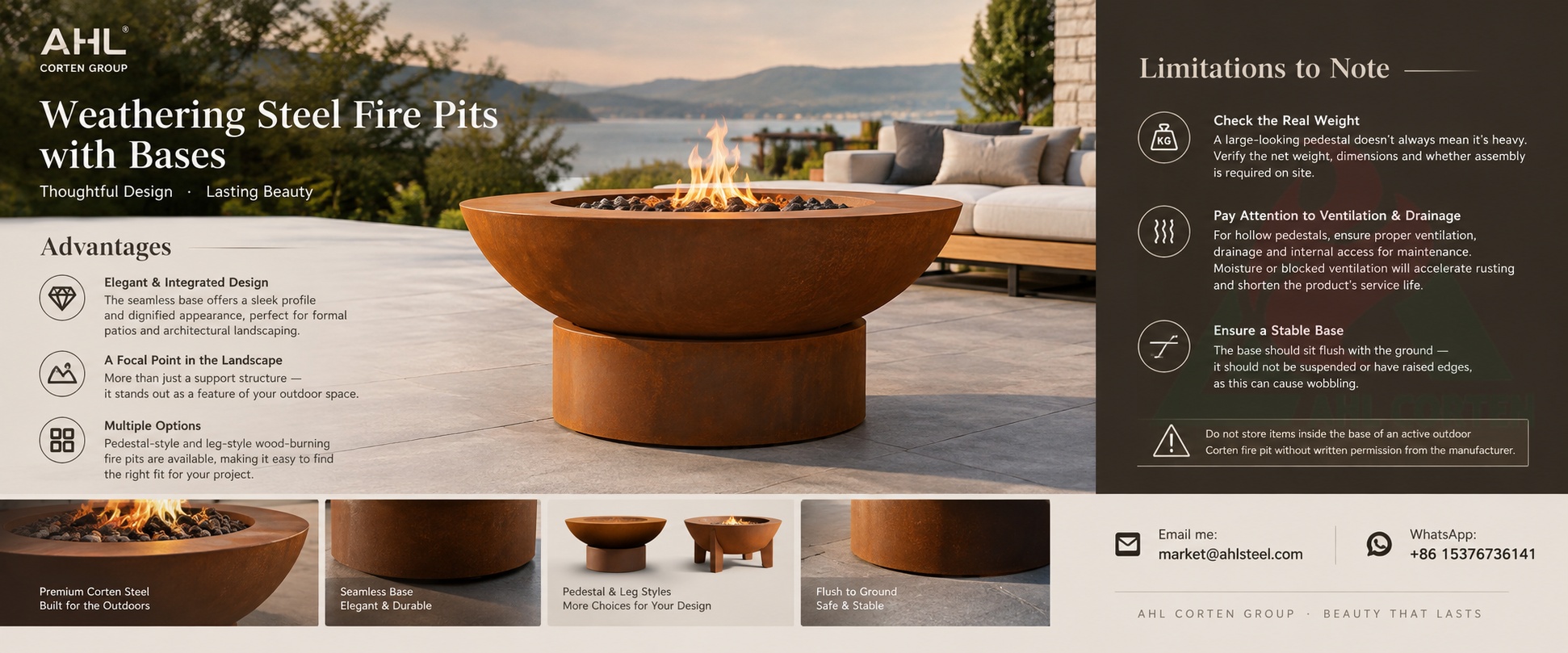
Base-style fire pits rely on pedestals or bases to support the firebox above; the base can be cylindrical, conical, or a square box. “Base” does not necessarily mean a solid, single piece. Before placing an order, review the drawings to confirm whether the base is hollow, side-opening, removable, or welded as a single unit with the firebox.
3. Structural Comparison at a Glance
- Support Type: Independent legs / Open frame | Integrated pedestal base
- Visual Effect: Open space beneath the firebox, creating a light and airy feel | Cohesive, solid appearance with a strong sense of unity
- Grounding Method: Multiple contact points with the ground | Contact configuration determined by the base’s shape
- Key Inspection Areas: Leg pads, connection joints, leg span when extended | Base bottom edge, welded joints, internal access hatches
- Installation Tips: Each leg must rest on a level, load-bearing surface | The entire contact surface of the base must bear the load evenly
Note: These are merely two design categories and do not represent a ranking of performance. Always evaluate based on the product drawings and installation instructions.
Want the Latest Catalog for Corten Steel Fire Pits? Contact Us!
Corten Steel Fire Pits with Legs: Advantages and Limitations
1. Advantages
The leg structure reduces the wholesale corten steel fire pits’s sense of heaviness, allowing ground paving and landscaping to show through from below, making it ideal for modern and industrial-style gardens. The legs come in a wide variety of designs, enabling the creation of multiple distinct appearances without modifying the firebox, which is beneficial for retail inventory and product line expansion. The open-bottomed design allows for visual inspection of the base and provides access for ash removal and maintenance; the specific level of convenience depends on the height and design of the legs.
2. Limitations to Note
Stability depends on the width of the spread legs, the size of the footpads, and the strength of the welded joints. If the leg span is narrow, the footpads are too small, or the connections are weak, even the most aesthetically pleasing design may wobble.
Ground conditions are critical; the product must be placed on a level, hard, non-combustible surface.
⚠️ Important Safety Reminder: The elevated design does not mean the product can be placed directly on a wooden platform, nor does it exempt you from maintaining a safe clearance distance. You must strictly follow the product manual and local fire safety regulations, ensuring a sufficient safety distance between the wood-burning Corten fire pit and buildings or combustible materials.
Want to Get Your Own Rusty Metal Fire Pit? Click to Customize!
Weathering Steel Fire Pits with Bases: Advantages and Limitations
1. Advantages
The seamless, integrated base features a sleek and elegant profile with a dignified appearance, making it ideal for formal patios and architectural landscaping projects. It serves as a focal point of the landscape in its own right, rather than merely a support structure.
Some hollow bases offer additional functionality, but please note: under no circumstances should items be stored inside the base of an active outdoor Corten fire pit without written permission from the manufacturer. Within the AHL product line, both pedestal-style and leg-style wood-burning fire pits are available, allowing designers to easily compare and select the best option.
2. Limitations to Note
A large-looking pedestal does not necessarily mean it is heavy. When purchasing, verify the net weight, individual dimensions, and whether on-site assembly is required. For hollow pedestals, pay close attention to ventilation, drainage, and internal access for maintenance. Prolonged exposure to moisture or blocked ventilation will accelerate rusting and shorten the product’s service life. Also, ensure the base sits flush with the ground—it should not be suspended or have any raised edges, as this can cause wobbling.
Want to Create a Unique Backyard Steel Fire Pit? Contact Us!
5 Key Comparison Factors to Help You Make an Informed Choice
1. Appearance and Design Style
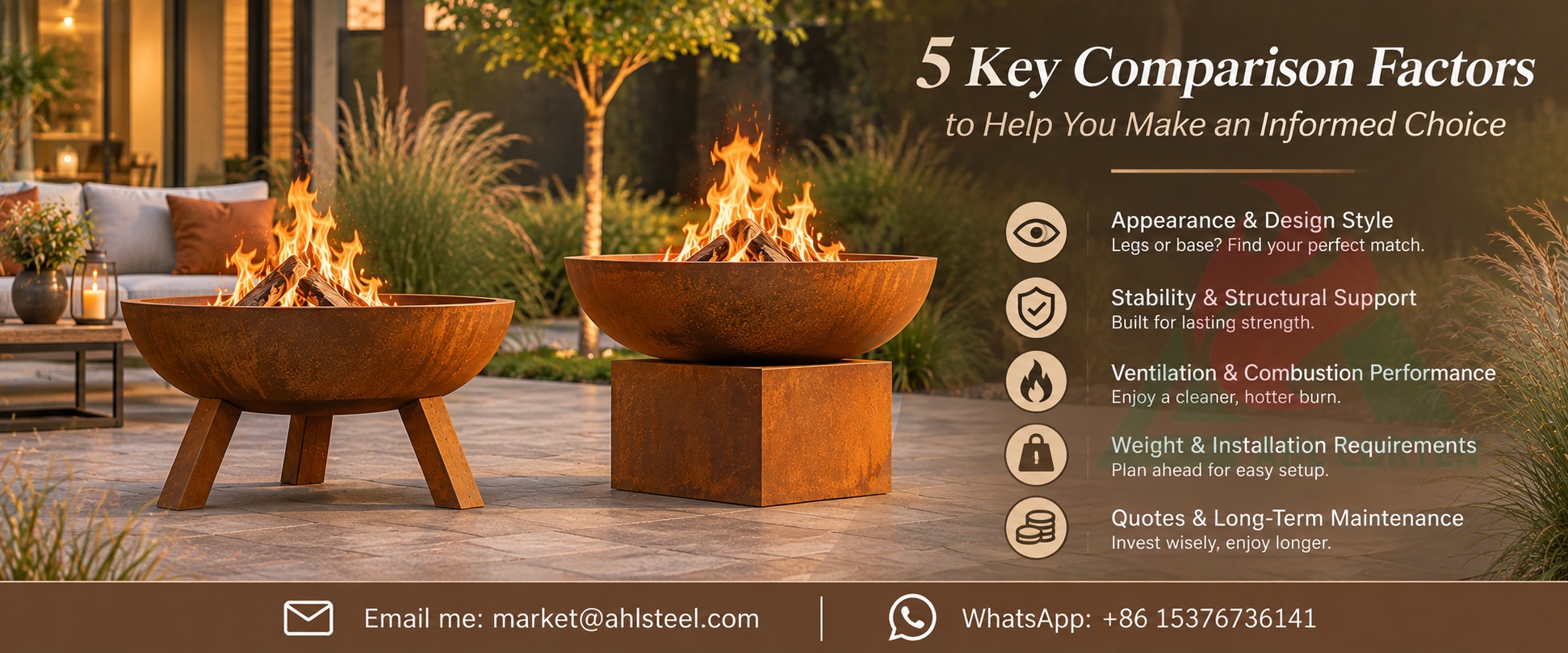
Leg-style models emphasize the separation between the firebox and the ground, creating a visually light and airy look. Base-style models emphasize a unified, solid, and substantial appearance, creating a stronger sense of ambiance. Both styles can suit modern, vintage, and commercial settings; the key lies in proportions, surrounding flooring, and soft furnishings. Avoid relying solely on isolated product renderings; instead, refer to real-life photos taken at actual scale whenever possible.
2. Stability and Structural Support
Don’t fall into the misconception that more legs or a larger base automatically equate to stability. Confirm with the supplier the support’s ground contact area, connection methods, rated load capacity, and installation requirements. Regardless of the style, the unit must be placed on a level, stable surface.
3. Ventilation and Combustion Performance
An open base does not automatically ensure an adequate oxygen supply for combustion; base-style models can also feature dedicated air intake channels. The quality of combustion depends primarily on the integrated design of the firebox, grate, air inlets, and ash collection system. Judging combustion performance based solely on the support structure is insufficient; the entire ventilation pathway must be verified.
4. Weight and Installation Requirements
Models with legs can still be quite heavy, while those with hollow bases may be lighter. Be sure to verify the total weight after assembly, including the heaviest individual component, and the handling plan. Plan the transport route from the unloading point to the installation location in advance, and confirm the ground surface material and safety clearances—do not wait until landscaping is complete to verify these details.
5. Quotes and Long-Term Maintenance
When comparing quotes, ensure specifications are comparable: inner diameter of the firebox, steel plate thickness, bending and welding processes, surface patina treatment, packaging, and shipping costs. Regarding maintenance, both styles require regular inspection of connection joints, drainage holes, and hard-to-reach areas prone to moisture buildup. Water accumulation and blocked ventilation are two common issues; no model is completely maintenance-free.
Want to Get Your Own Rusty Metal Fire Pit? Click to Customize!
Matching Corten Fire Pit Styles to Outdoor Settings
1. Small Patios and Private Yards
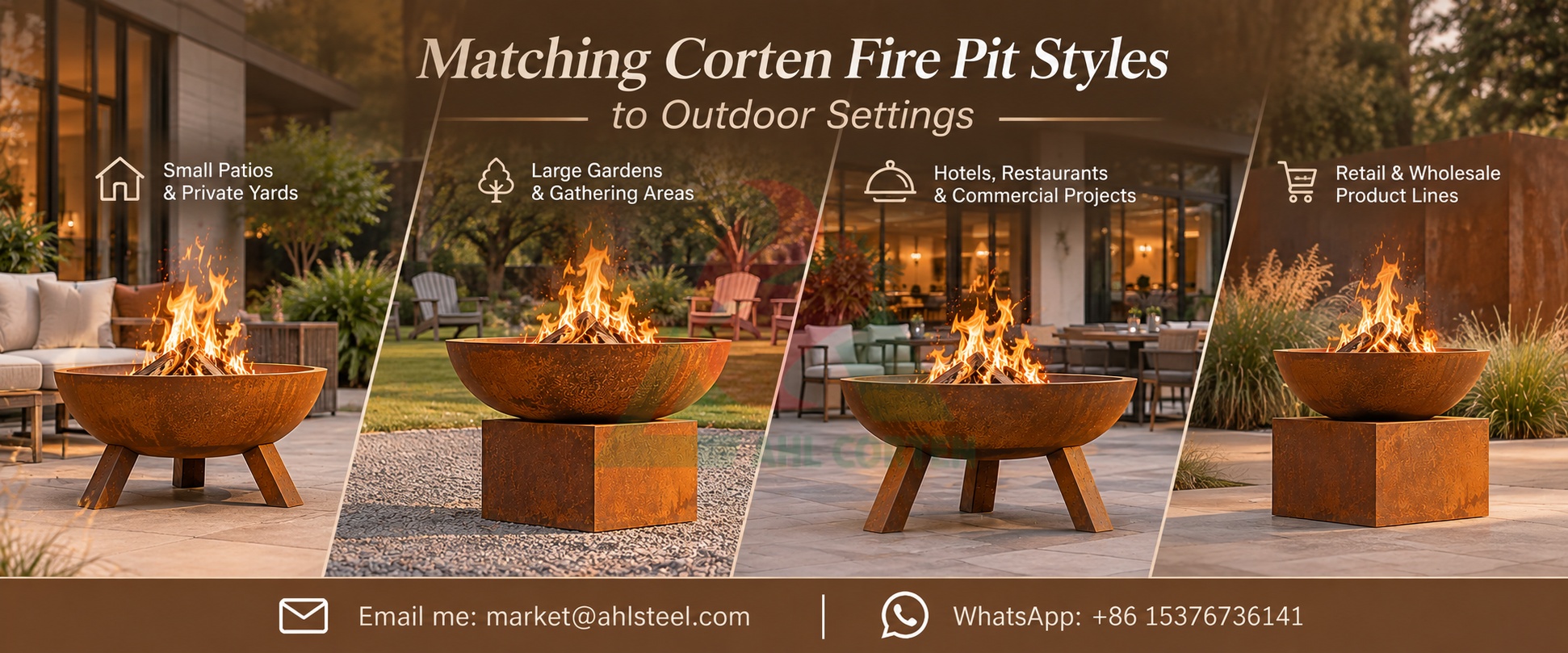
If you prefer a light, airy look, choose a compact leg-style model; if you prefer a sturdy, substantial feel, a small base-style model is equally suitable. Prioritize confirming that the site meets safety distance regulations—a smaller size does not mean safety distances can be reduced.
2. Large Gardens and Outdoor Gathering Areas
In open recreational spaces, models with a base can firmly anchor the entire seating arrangement; models with wide-span legs create an open, relaxed visual focal point. Before finalizing the style, plan seating and pedestrian pathways first, then verify the permitted fuel capacity and usage guidelines.
3. Hotels, Restaurants, and Commercial Landscape Projects
The first step for commercial projects is to secure a fire permit, conduct a site safety assessment, and establish a daily management plan. In addition to aesthetics, evaluate guest traffic flow, on-site supervision, maintenance access, and fire-extinguishing procedures. Commercial settings must have a designated person on duty, and all flames must be completely extinguished before leaving.
4. Retail and Wholesale Product Lines
If market demand is sufficient, two different structures can be stocked simultaneously to cater to diverse customer tastes. Each SKU must clearly indicate dimensions, weight, installation instructions, and fuel type to minimize after-sales issues caused by vague labels such as “portable” or “heavy-duty.”
Want to Get Your Own Rusty Metal Fire Pit? Click to Customize!
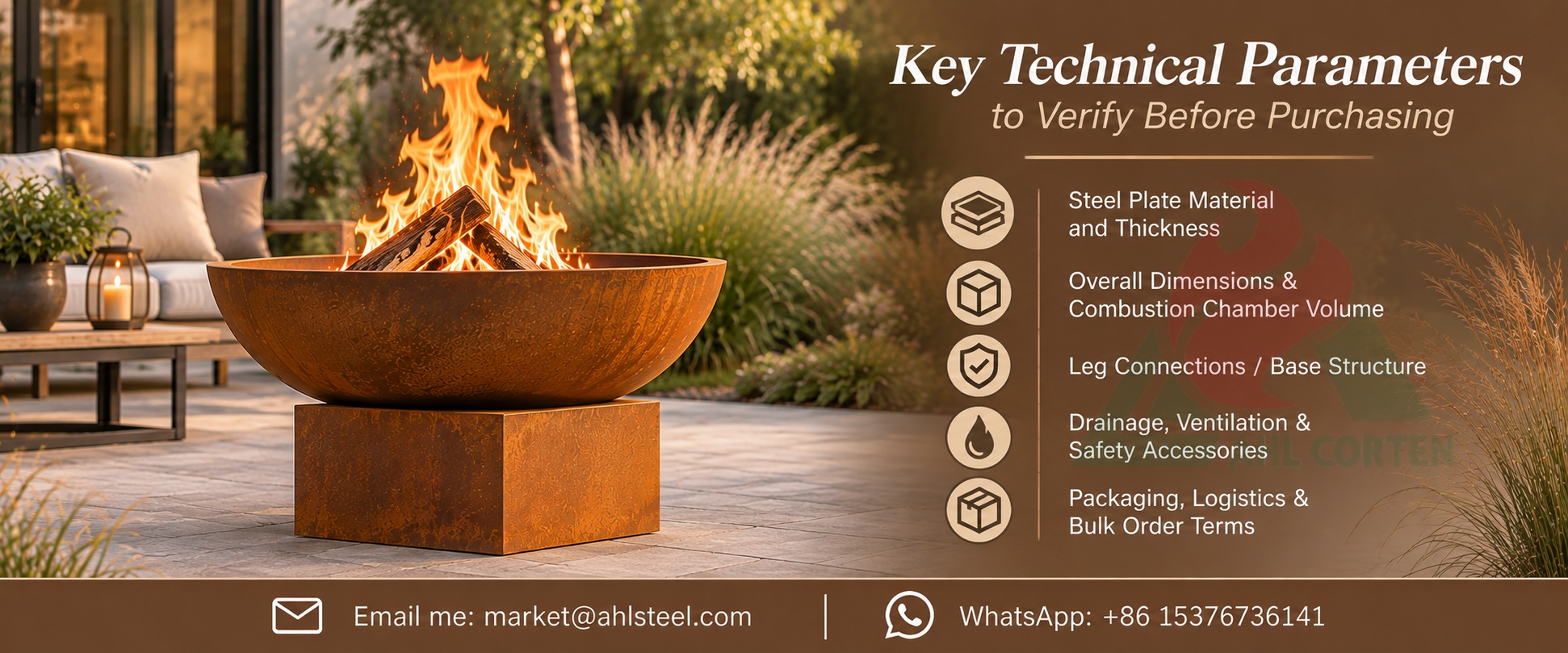
List of Technical Parameters to Verify Before Purchasing
1. Steel Plate Material and Thickness
Confirm the plate thickness and material grade for the combustion chamber, legs, and base separately. The thickness standards for the decorative casing must not be equated with those for the combustion chamber. There is no universal thickness; suppliers must provide a tailored solution based on dimensions, fuel type, and operating conditions.
2. Overall Dimensions and Effective Combustion Chamber Volume
Verify the outer diameter, total height, footprint, and combustion chamber depth. Distinguish between the product’s external dimensions and the actual internal combustion space. For B2B projects, be sure to request official dimensional drawings; do not rely solely on images for assessment.
3. Leg Connections / Base Structure
Confirm whether the firebox and support components are permanently welded or designed as a removable structure. Determine whether fasteners can be replaced individually and whether periodic tightening inspections are required.
4. Drainage, Ventilation, and Safety Accessories
Confirm the rainwater drainage solution, ash removal method, and combustion air intake channels, and verify whether a fire screen is included. For wood-burning fire pits, it is recommended to install a fire screen to block flying sparks; also, keep a close eye on children to avoid risks. Drainage holes are intended solely for rainwater drainage and must not be used to collect high-temperature ashes or embers.
5. Packaging, Logistics, and Bulk Order Terms
For wholesale orders, focus on confirming: net weight and gross weight, outer box dimensions, assembly components, minimum order quantity, delivery time, factory-finished rusted surface condition, unloading protection, warranty, and spare parts availability. Calculate the total cost upon delivery; do not rely solely on the factory price.
Want to Get Your Own Rusty Metal Fire Pit? Click to Customize!
Why Choose AHL Corten Steel Fire Pits?
1. Wide Selection of Styles
The AHL wood-burning fire pit series offers both leg-supported and base-mounted models, allowing designers and buyers to directly compare different design options.
2. Confirmable Material Thickness
Clear specifications are provided for the thickness of the firebox and support components for each product. Thicknesses vary by model and are not interchangeable; please confirm individually before placing an order.
3. Customization Services Available
We support customization of dimensions and logos; however, structural modifications such as changes to legs or bases require separate technical review and cannot be assumed to be automatically approved.
4. B2B Wholesale Supply
We provide formal quotes to retailers and contractors, clearly outlining MOQs, production lead times, packaging, and delivery terms.
6. Project Technical Support
We can provide drawings, technical specifications, and assembly instructions. Please confirm the scope of supply and included accessories before placing an order.
Want to Get Your Own Rusty Metal Fire Pit? Click to Customize!
Contact Us to Select a Weathering Steel Fire Pit Suitable for Your Project
The leg-mounted and base-mounted models are simply two different design options; neither is inherently superior. Selection should be based on a comprehensive evaluation of site conditions, technical specifications, ease of maintenance, and safety standards—not just appearance.
Are you selecting weathering steel fire pits for your outdoor product line? Please contact AHL to request a product catalog and compare the leg-mounted and base-mounted models. Provide your target dimensions, purchase quantity, and intended use to receive finalized technical specifications, packaging options, and wholesale quotes. Be sure to confirm the product configuration in writing before placing a formal order.
FAQ
1. Are Fire Pits With Legs More Stable Than Those With a Base?
Not necessarily. Stability depends on the support layout, assembly methods, and ground conditions; both styles must be placed on a level, solid surface.
2. Which Rusted Steel Fire Pit Is Best for a Small Backyard?
Prioritize meeting safety clearance and access requirements for the space. The leg-style model has a lighter visual appearance, but its compact size does not reduce the required safety clearance.
3. Does a Base-Style Fire Pit Require Ventilation Holes?
Ventilation design is determined by the complete product solution; ensure that the designated ventilation openings remain unobstructed. Do not drill holes yourself without the manufacturer’s permission.
4. Are Fire Pits With Legs Easier to Move?
Not necessarily; legs do not automatically mean portability. Consider the net weight, whether the unit can be disassembled, and the handling plan; moving the fire pit while it is burning is strictly prohibited.
5. What Steel Plate Thickness Is Suitable for Outdoor Fire Pits?
Solutions must be tailored based on dimensions, structure, and usage scenarios. Confirm the thickness of the firebox and support components separately; do not apply generic values.
6. Can the Legs or Base of a Fire Pit Be Customized?
Please consult us regarding technical feasibility. AHL supports customization of dimensions and logos, but modifications to the support structure require a separate technical evaluation.
7. For Commercial Outdoor Spaces, Which Structure Is More Suitable?
There is no fixed answer. A comprehensive assessment based on site approvals, operational procedures, maintenance access, and local regulations is required—appearance alone is not the deciding factor.