Selecting the right corten steel planter often comes down to a critical structural detail beneath the soil line: whether to choose a bottomless open-bottom planter or an enclosed bottomed container. While both options deliver the same iconic, warm rust-patina aesthetic on the surface, their functional performance varies dramatically based on where they are installed.
A bottomless planter functions as an open-base raised bed designed to integrate directly with natural soil, whereas a bottomed planter features a structural floor with engineered drainage outlets suited for hardscapes, paved courtyards, and elevated decks.
Choosing between these two designs isn’t a matter of appearance alone—it hinges entirely on your installation surface, root depth requirements, and surrounding drainage control to ensure long-term structural integrity and plant health.
Quick Answer: Which Design Should You Choose?
Choose a bottomless planter for suitable garden soil; choose a bottomed planter when you need contained planting on paving, terraces or other hard surfaces. Check drainage in both cases: an open base cannot compensate for poorly draining ground, and a bottomed container needs functioning drainage outlets.
| Selection Factor |
Bottomless Planter |
Bottomed Planter |
| Typical location |
Garden beds and permeable ground |
Patios, courtyards and terraces |
| Root space |
Roots may extend into suitable soil below |
Roots remain within the container |
| Drainage |
Depends on underlying ground |
Depends on growing medium, outlets and discharge route |
| Soil containment |
Ground supports the planting medium |
Base holds the planting medium |
| Main limitation |
Poor ground drainage or unsuitable underlying soil |
Restricted root volume and increased filled weight |
| Best buyer priority |
Ground-connected planting |
Controlled container placement |
Rooftops and balconies require a separate assessment of filled weight, support and drainage; choosing a bottomed design does not automatically make the installation suitable.
Want the Latest Catalog for Corten Steel Planters? Contact Us!
What are Bottomless Corten Steel Planters?
How Bottomless Planters Work
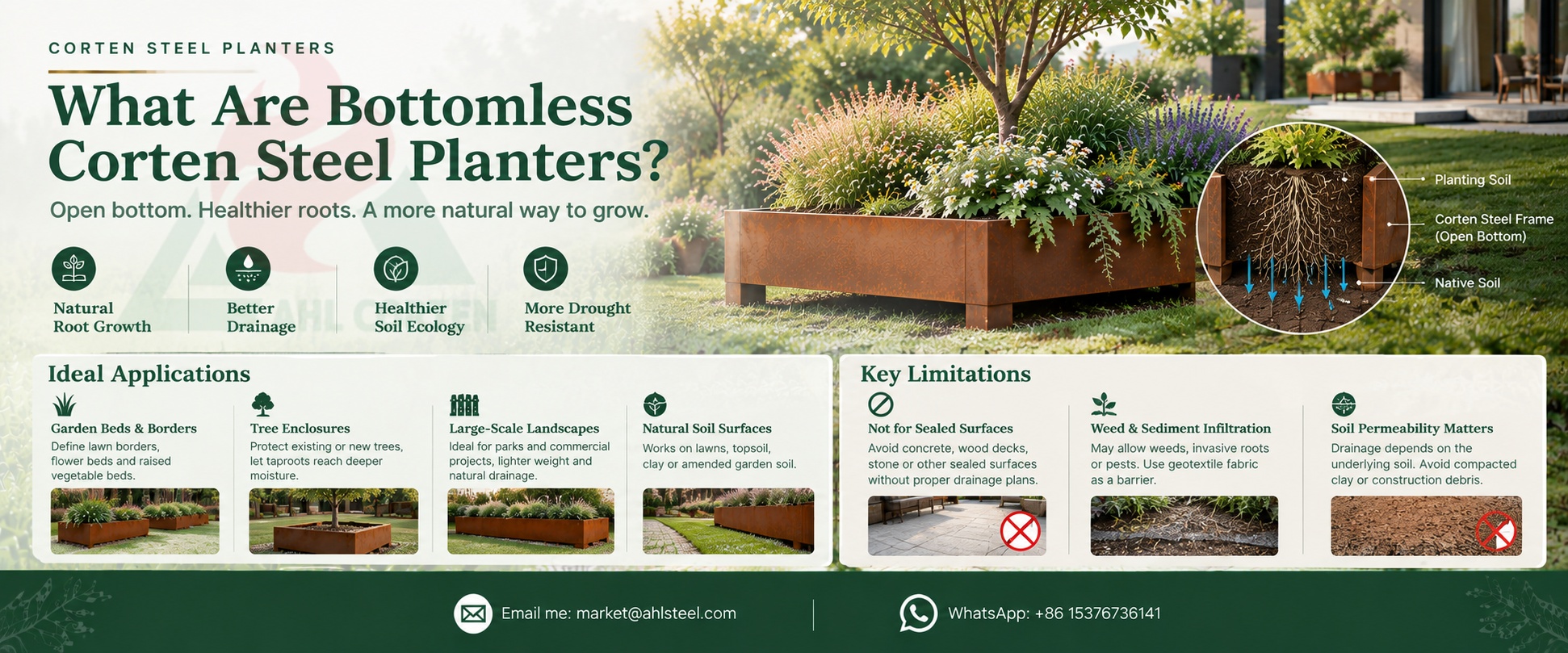
Open-bottom Corten steel planters (weathering steel planters) feature an open-frame structure without a bottom steel plate and are placed directly on the ground.
This design connects the planting soil inside the planter with the native soil, allowing excess irrigation water and rainwater to naturally seep into the ground, preventing water from pooling. In environments with good soil permeability, plant roots can penetrate the steel framework and grow deep into the ground.
This unrestricted growing space significantly enhances the plants’ drought resistance, improves soil ecology, and effectively prevents the problem of root-bound plants commonly found in traditional containers.
Ideal Applications for Bottomless Planters
- Ground-Level Garden Beds and Borders: Ideal for defining lawn borders, flower beds, and raised vegetable beds on natural ground.
- Tree Enclosures and Feature Plantings: Used to protect existing or newly planted trees, allowing taproots to penetrate deep into the ground to access deep-seated moisture.
- Large-Scale Outdoor Landscape Fencing: Suitable for large residential or commercial park projects, significantly reducing overall material weight and utilizing natural surface drainage.
- Natural Soil Surfaces: Specifically designed for installation on lawns, topsoil, uncompacted clay, or amended garden soil.
Key Limitations
- Incompatible with Sealed, Hard Surfaces: Should not be placed directly on concrete patios, elevated balconies, wood-plastic composite decking, or stone surfaces without a rigorous drainage and stormwater management plan.
- Risk of Weed and Sediment Infiltration: The open bottom may allow native weeds, invasive lawn roots, or subterranean pests to penetrate the planting soil; it is typically necessary to lay weed-blocking geotextile fabric at the bottom to create a barrier.
- Limited by the Permeability of the Underlying Soil: Overall drainage efficiency ultimately depends on the geological conditions beneath the planter; if placed directly on highly compacted clay or construction debris, water may still pool around the roots.
Want the Latest Catalog for Corten Bottomless Planters? Contact Us!
What are Bottomed Corten Steel Planters?
How Bottomed Planters Work
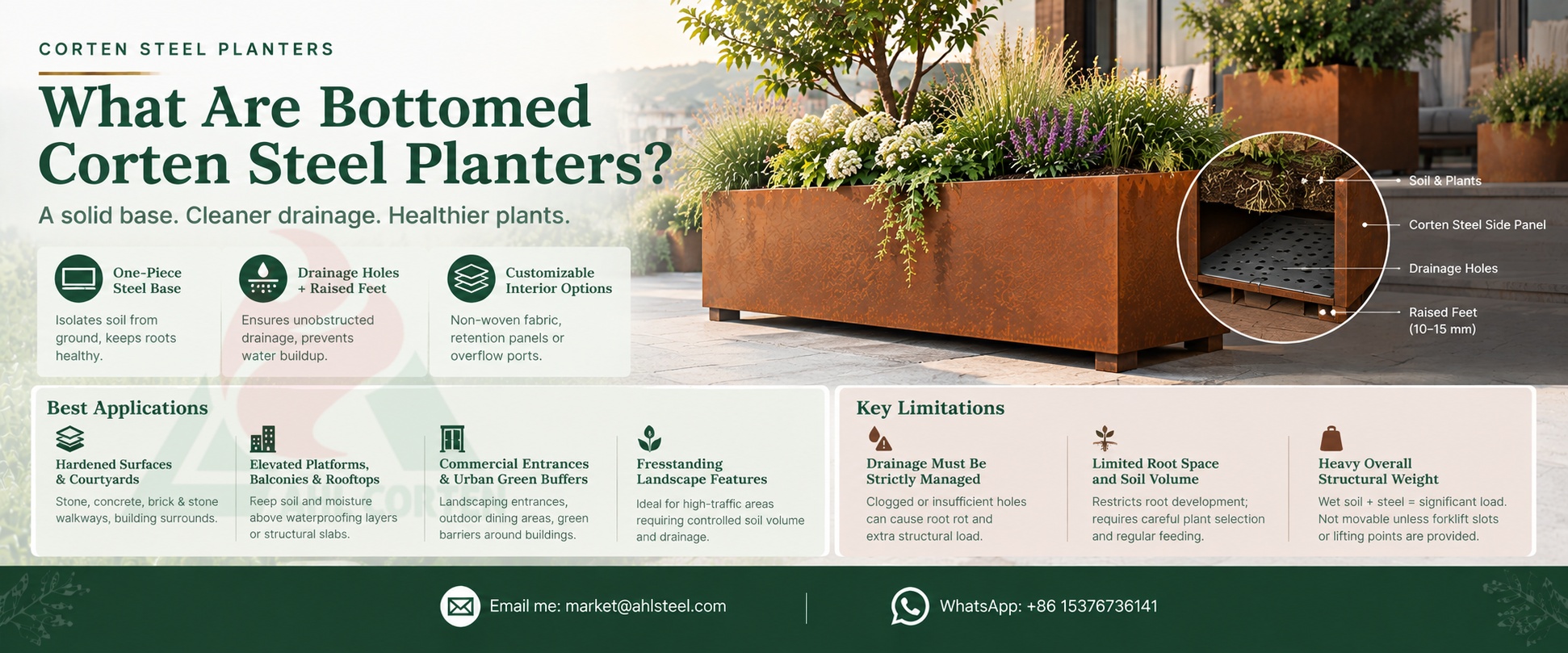
Solid-Base Coton steel planters are self-contained container systems equipped with a one-piece steel base plate that completely isolates the internal growing medium from the external ground. To ensure healthy plant root systems, the base plate features precision laser-cut drainage holes and is fitted with integrated raised feet (10 mm–15 mm) or bottom support channel steel.
This raised design suspends the planter’s base plate, ensuring unobstructed drainage and preventing water accumulation at the bottom. Depending on project requirements, the interior of the planter can also be customized with water-filtering non-woven fabric, water-retention and drainage panels, or overflow collection ports.
Best Applications for Bottomed Planters
- Hardened Surfaces and Courtyards: Specifically designed for stone courtyards, concrete plazas, brick and stone walkways, and surfaces surrounding buildings.
- Elevated Platforms, Balconies, and Rooftop Gardens: Suitable for high-rise buildings or rooftop structures where soil and moisture must be completely contained above the waterproofing layer or structural slab.
- Commercial Entrances and Urban Green Buffers: Ideal for landscaping main entrances, delineating outdoor dining areas, or creating modular green barriers around buildings.
- Freestanding Landscape Features: Suitable for high-traffic focal areas requiring precise control of soil volume and orderly drainage.
Key Limitations
- Drainage Must Be Strictly Managed: Since the steel base plate creates a sealed space, if drainage holes become clogged or are insufficient, the planter will turn into a “tray,” causing plant roots to rot and significantly increasing the structural load.
- Limited Root Space and Soil Volume: Plant root development is strictly limited by the internal dimensions of the planter, thus placing higher demands on plant selection and regular nutrient supplementation.
- Heavy Overall Structural Weight: The weight of wet soil combined with heavy-duty corten steel plates generates significant operational loads; once filled with soil, the planter cannot be moved at will unless forklift slots or lifting points have been provided.
Want the Latest Catalog for Corten Bottomed Planters? Contact Us!
When Is a Bottomless Planter the Better Choice?
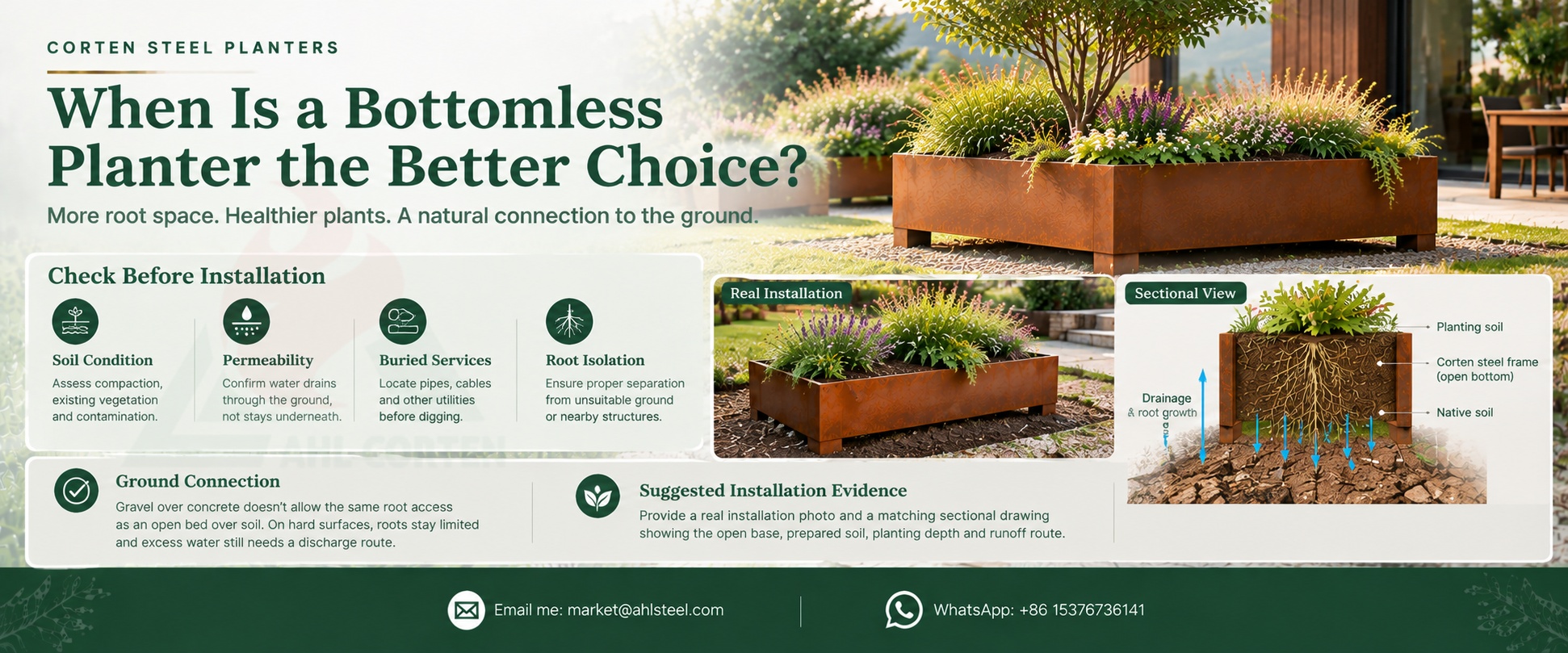
A bottomless Corten steel planter is often a practical choice for raised planting beds, vegetable gardens and ground-level landscape borders installed directly over suitable soil. Its open base allows roots to grow beyond the added planting medium into the ground beneath, potentially providing more rooting space than a fully contained planter. This benefit depends on the condition of the underlying soil—not simply on leaving the base open.
Before installation, check:
Soil condition: Assess compaction, existing vegetation and any suspected contamination.
Permeability: Confirm that water can drain through the underlying ground rather than collect beneath the bed.
Buried services: Identify underground pipes, cables and other services before excavation or driving stakes.
Root isolation: Determine whether the plants need separation from unsuitable ground or nearby structures. Suspected contamination requires an appropriate assessment and containment approach, not simply a thin landscape-fabric liner.
Ground connection is the key distinction. Gravel laid over concrete does not provide the same root access as an open bed installed over soil. On a hard surface, roots remain limited by the available planting depth, and excess water still needs a deliberate discharge route.
Suggested Installation Evidence
Include a genuine installation photograph and a matching sectional drawing showing the open base, prepared soil, planting depth and runoff route. The drawing should reflect the actual installation rather than imply that every site drains in the same way.
Want the Latest Catalog for Corten Bottomless Planters? Contact Us!
When Is a Bottomed Planter the Better Choice?
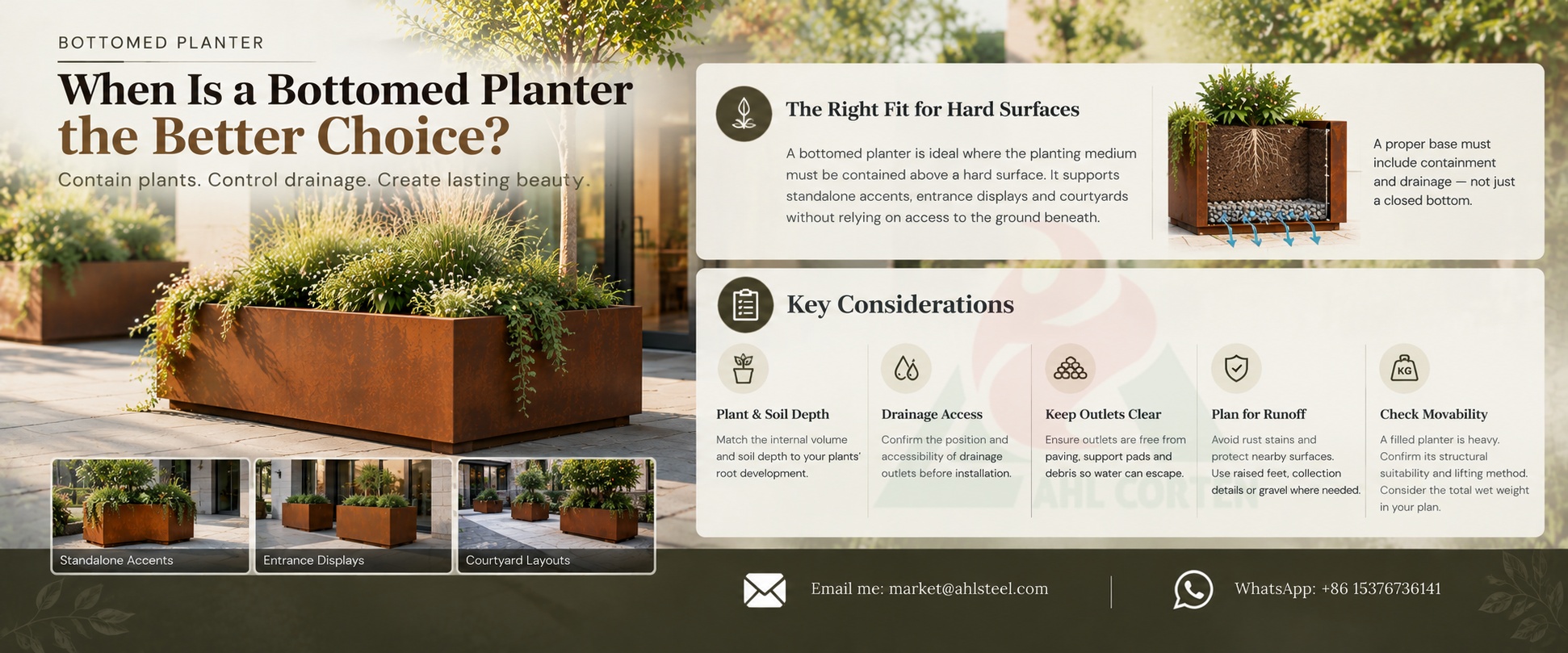
A bottomed Corten steel planter is generally more suitable where the planting medium must be contained above a hard surface. It can support standalone accent planting, entrance displays and courtyard layouts without relying on access to the ground beneath. However, the base must form part of a complete containment and drainage design—not simply close the bottom of the planter.
When specifying a bottomed planter:
Match the internal volume and soil depth to the selected plants, allowing for their expected root development.
Confirm the position and accessibility of drainage outlets before installation.
Keep outlets clear of paving, support pads and debris so excess water can escape.
Plan where discharged water will go, particularly near entrances, walls and sensitive paving.
A base does not prevent rust runoff or protect paving by itself. Rainwater washing over the exterior and water leaving the drainage outlets can still carry rust-coloured deposits onto nearby surfaces. Where appropriate, use raised feet, collection details or a drainage route toward gravel or another suitable area.
Do not assume a filled planter is easily movable. Confirm its loaded weight, structural suitability and intended lifting or handling method before specifying it for a layout that may need repositioning. Total wet weight should be considered as part of the installation plan.
Want the Latest Catalog for Corten Bottomed Planters? Contact Us!
FAQ: Bottomless vs. Bottomed Corten Steel Planters
1. What Is the Difference Between a Bottomless and a Bottomed Planter?
A bottomless planter has an open base that allows contact with the ground beneath. A bottomed planter contains the growing medium within a built-in base and requires drainage outlets to release excess water.
2. When Should I Choose a Bottomless Corten Steel Planter?
Choose a bottomless planter for raised beds, vegetable gardens or landscape borders installed directly over suitable soil. Check the underlying soil conditions, drainage and buried services before installation.
3. When Is a Bottomed Corten Steel Planter the Better Option?
A bottomed planter is generally more suitable for patios, entrances, courtyards and other hard surfaces where the growing medium must remain contained. Its internal volume and drainage arrangement should suit the selected plants and installation location.
4. Can Plant Roots Grow Into the Ground Beneath a Bottomless Planter?
Yes, roots can extend into the underlying soil if it is accessible and suitable. Compacted, poorly drained or contaminated ground may limit that benefit, so an open base alone does not guarantee healthy root growth.
5. Can I Place a Bottomless Planter On Concrete or Paving?
Only with an appropriate containment and drainage plan. Concrete blocks access to the soil beneath, so the planter must provide sufficient rooting depth within the bed and a clear route for excess water.
6. Does Gravel Beneath a Planter Provide the Same Benefit as an Open Soil Base?
No. Gravel over concrete does not create a connection to the ground beneath. It may form part of a drainage arrangement, but roots remain restricted by the hard surface and the available planting depth.
7. Do Bottomed Corten Steel Planters Need Drainage Holes?
Yes, conventional outdoor planting requires a way for excess water to escape. Confirm the outlets before installation and keep them clear of paving, support pads and debris.
8. Will a Bottomed Corten Planter Prevent Rust Stains on Paving?
No. The base contains the growing medium, but exterior runoff and drainage water can still carry rust-coloured deposits. Plan the discharge route and consider suitable separation or collection details near sensitive paving.
9. Can a Filled Corten Steel Planter Be Moved Easily?
Not necessarily. Soil and water add substantial weight. Before moving a filled planter, confirm that its structure, lifting points and handling method are designed for the loaded condition.
10. What Information Should I Provide When Requesting a Custom Planter Quote?
Provide the planter dimensions, selected plants, installation surface, preferred base type and drainage destination. Include site photographs or drawings, and explain whether the planter will retain soil, connect to existing ground or need to be moved after filling.
Want the Latest Catalog for Corten Planters? Contact Us!