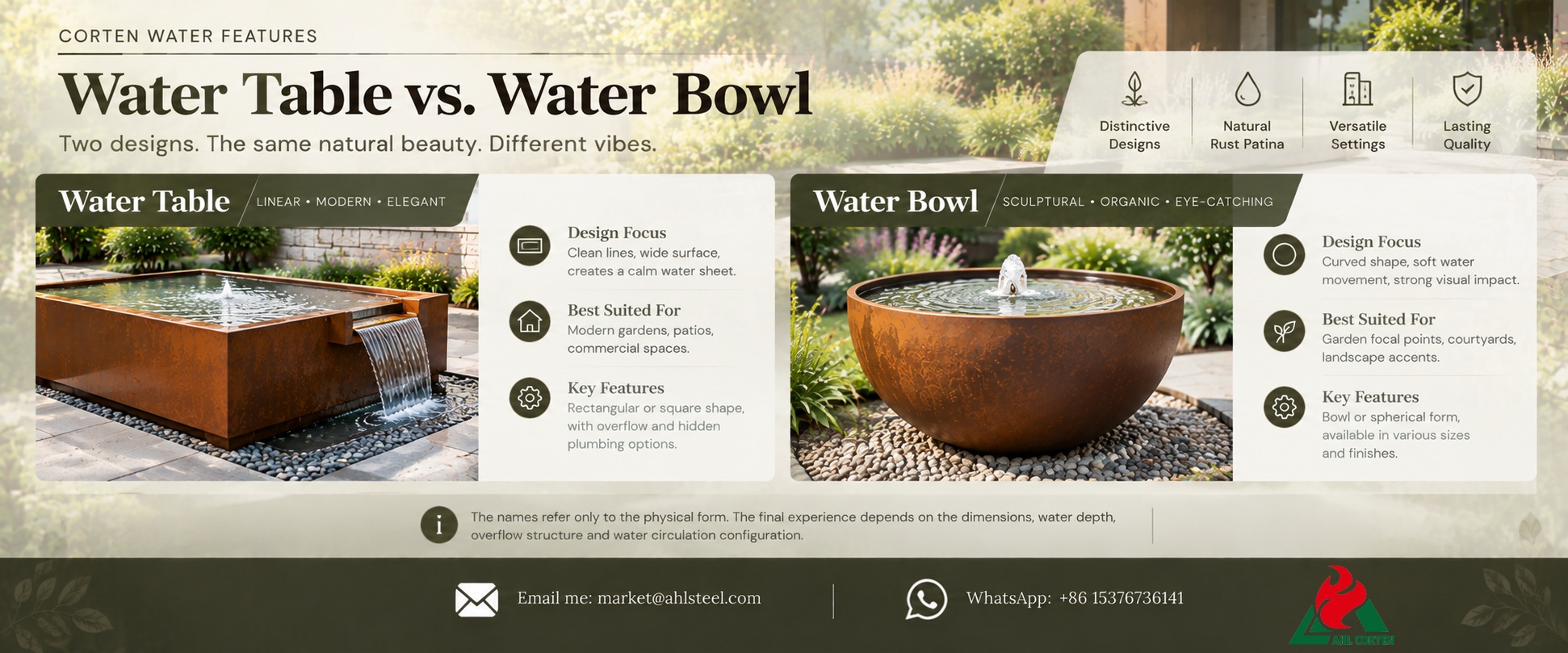
Corten water features are popular landscape installations in modern gardens and commercial patios. Many buyers struggle to distinguish between a “Water Table” and a “Water Bowl.”
Both can create a circulating water effect and will develop a unique rust-colored patina over time. However, their design language, visual focus, and suitable settings are completely different.
The names refer only to their physical form and do not indicate pump power, the sound of flowing water, or maintenance difficulty. The final experience depends on the dimensions, water depth, overflow structure, and water circulation configuration.
This guide compares their design features, suitable settings, installation requirements, and maintenance tips to help you choose the right weathering steel water feature for your garden.
What is a Corten Steel Water Table?
Design and Aesthetic Features
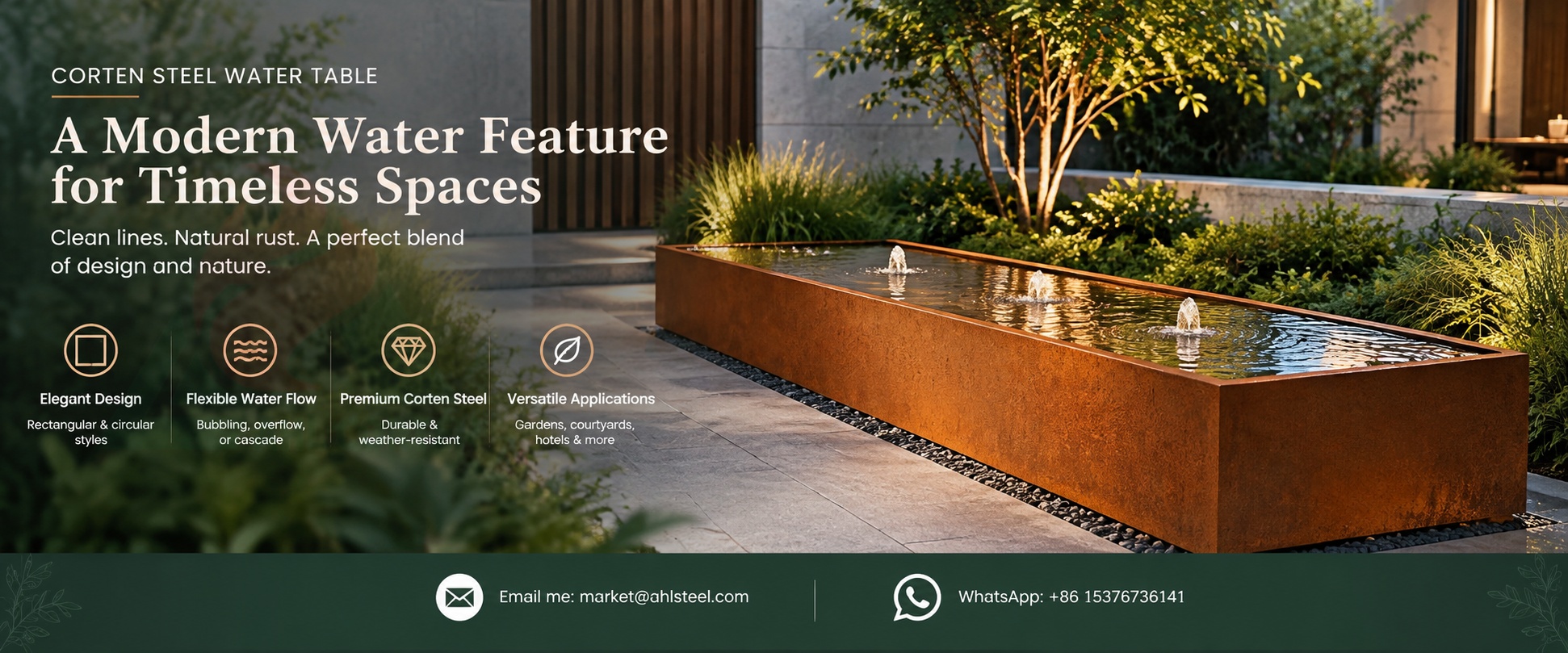
The core design of an outdoor water table is to create a wide, relatively shallow, horizontal water surface. It has an architectural aesthetic, with the water surface itself forming a flat visual plane rather than a concave, curved container.
Square and rectangular styles are the most common, well-suited for straight walkways, grid-pattern paving, and neatly arranged planting areas. Circular water tables are also available on the market, maintaining the same horizontally expansive visual effect. A wide range of sizes is available, from small square models to large, elongated designs, ensuring even small gardens can find a suitable option.
Water Flow Effects
Corten garden water tables offer a wide variety of water flow options. These can include gentle bubbling from the outlet, a gentle overflow across the entire surface, a single-sided overflow cascade, or a multi-tiered cascade flowing into a lower reservoir. Some commercial models integrate fountain heads and LED lighting and do not feature a full-circle overflow.
The water surface effect can be flexibly adjusted: when the water level is steady, it’s ideal for reflections; when water flows from the spout, it continuously creates ripples. Don’t judge the noise level based solely on the name—the sound of flowing water depends on the spout structure and return water design; a wide tabletop does not necessarily mean a loud splash.
Suitable Applications
Prioritize rusted steel water tables if you’re looking for effects like the following:
- Modern private gardens featuring primarily geometric paving
- Inner courtyards or atriums viewable from multiple angles
- Public landscapes such as hotel terraces and commercial entrances
- Architectural landscapes requiring a low, horizontal visual focal point
Its advantage lies in its ability to echo the straight lines of surrounding paving and walls, blending seamlessly into the site rather than standing out as a stark, sculptural element.
What Is a Corten Steel Water Bowl
1. Design Features
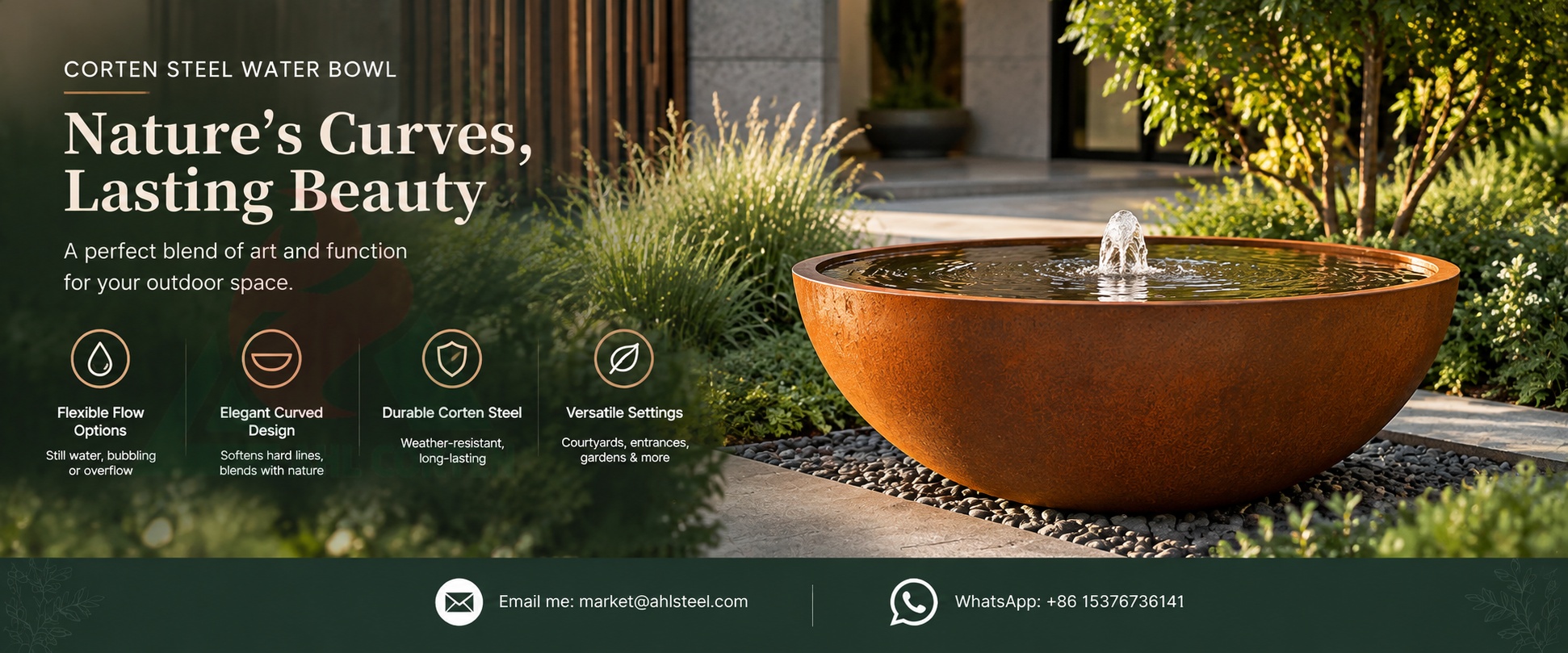
The water feature bowl primarily features a curved, concave basin-like structure. The concave basin itself serves as the central sculpture, with the visual focus concentrated on the container’s shape, creating a striking contrast with the flat water feature platform.
Its gentle curves help soften the sharp, straight lines of hard landscaping and blend naturally into natural-style planting borders. Please note: The term “bowl” does not necessarily imply a small size. When purchasing, be sure to verify the diameter, height, and total weight when filled with water—do not be misled by the name.
2. Water Flow Effects
Water feature bowls offer flexible and diverse design options. They can be used as static, still-water displays, or equipped with an internal circulating fountain. Alternatively, water can overflow along the rim and flow into a separate reservoir below.
The water flow effect is determined by the water depth, the height of the pot’s rim, the normal water level, and the overflow structure. The visual impact differs significantly between models with a central bubbling feature and those with a full-circle overflow; be sure to confirm the design before placing an order.
3. Suitable Settings
Water feature pots are best suited for the following settings:
- Small courtyards or patios that require a standalone visual focal point
- Entrance areas, where curved shapes contrast with angular architecture
- Gardens dominated by plants with a relaxed, natural style
- Landscape designs where the container’s shape itself is a key design element
Compact water feature basins offer flexible placement options, but don’t forget: space must be set aside in advance for the reservoir, piping, and future maintenance access.
Corten Water Table vs. Water Feature Bowls: 6 Key Differences
| Comparison Factor |
Corten Water Table |
Corten Water Bowl |
| Overall shape |
Broad, horizontal, often geometric |
Rounded or basin-shaped |
| Visual effect |
Architectural and linear |
Sculptural and organic |
| Water surface |
Often broad and shallow |
Concentrated within a basin |
| Space requirements |
Needs sufficient room to appreciate its horizontal proportions |
Can work well as a standalone focal point |
| Water movement |
May feature surface flow or edge overflow |
May feature recirculation or rim overflow |
| Design flexibility |
Strong fit for modern, structured landscapes |
Fits modern, naturalistic, and mixed-style gardens |
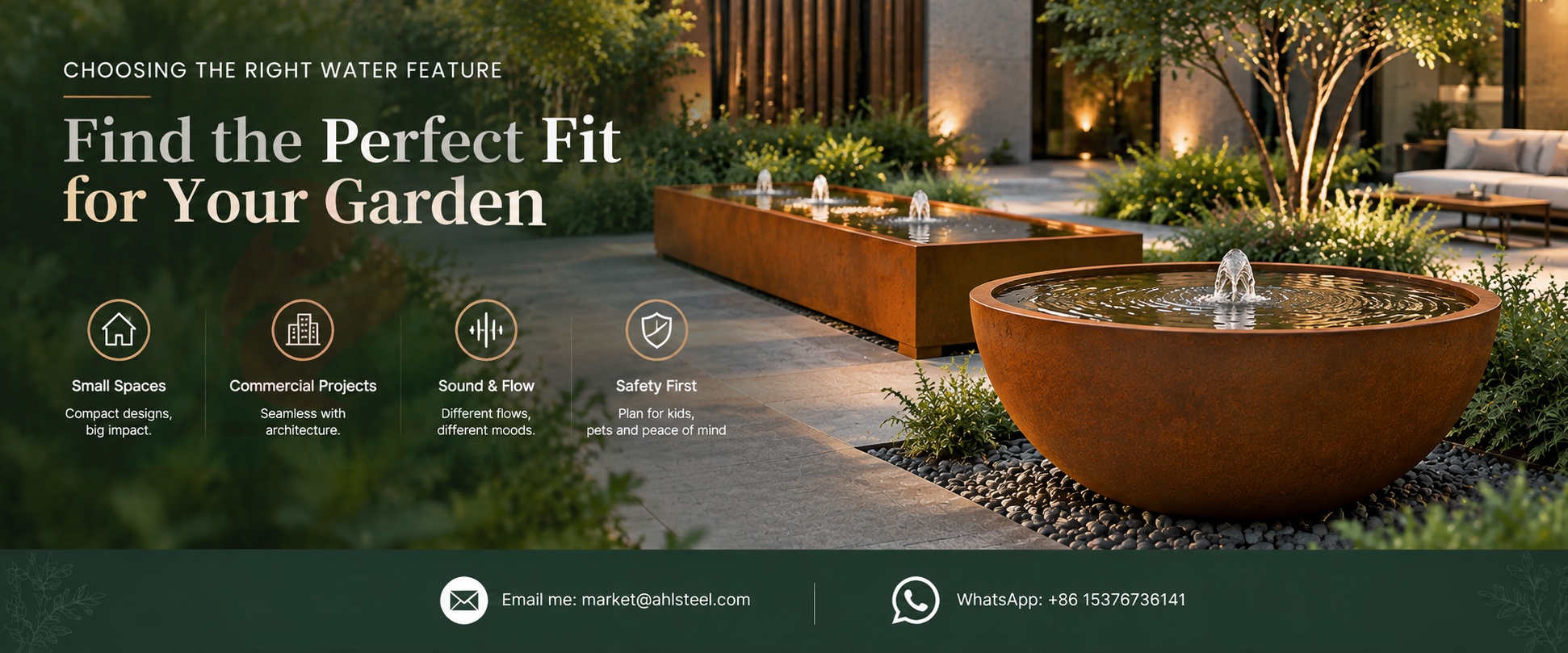
The above are merely general design trends, not strict standards. There are also round water feature bases and small water feature bases with fountains available on the market. The final result is determined by the dimensions, the water circulation system, and the installation plan—not by the product name.
How to Choose the Best Option for Your Garden?
1. Small Courtyards and Patio Spaces
Don’t just look at the size of the exposed steel structure—be sure to factor in the total footprint of the entire installation. Allow for walkways, viewing distance, access for pump maintenance, and space for an external water reservoir.
Compact water bowls can easily serve as focal points without overwhelming the space. If you want the water feature to align with the ground paving or seating areas, a small horizontal water feature platform is also a great option—small gardens aren’t limited to Corten steel water bowls.
A practical tip: Sketch the outline of the water feature on the ground and assess the scale from multiple angles—such as the front door, seating areas, and main walkway—before deciding on a style.
2. Modern Landscapes and Commercial Projects
A Corten water table can extend the straight lines of paving, building facades, and formal planting areas, unifying the landscape with the architecture. Water feature bowls, on the other hand, are ideal for creating deliberate contrast, serving as visual focal points at entrances or within flower borders.
For commercial projects, it’s essential to plan maintenance access routes in advance. No matter how seamless the exterior design may be, if it’s difficult to open and clean the pump later on, long-term maintenance will become extremely troublesome.
3. Seeking the Soothing Sound of Flowing Water
Don’t choose a design based solely on appearance. The noise produced by flowing water is not necessarily related to its shape. Water discharge methods—such as gentle bubbling, trickling streams, or circular overflow—produce completely different auditory experiences. The height of the drop, flow rate, water collection structure, and chamber shape all influence the sound. Prioritize watching sample videos, and if possible, listen to them in person.
4. Gardens with Children or Pets
Neither type of water feature comes with built-in safety features. You’ll need to assess accessible water surfaces, climbable edges, slippery surrounding ground, wire protection, and the stability of the reservoir cover. For yards with young children, prioritize designs with no exposed standing water, or install professional safety covers, and ensure constant supervision.
All electrical components for water features must be specifically designed for outdoor use. Have a licensed electrician perform the permanent wiring installation, and ensure a ground-fault circuit interrupter (GFCI) is installed. Always disconnect the power before performing maintenance.
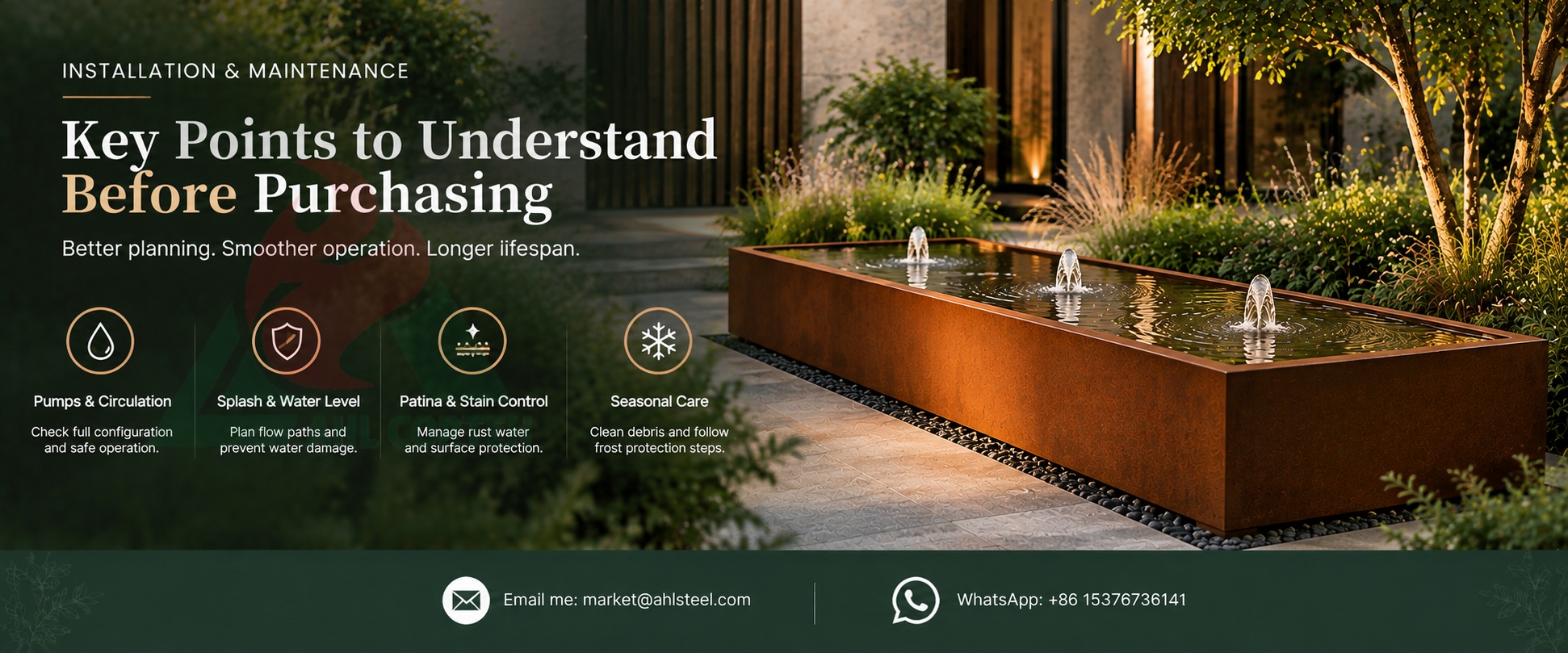
Installation and Maintenance: Key Points to Understand Before Purchasing
1. Pumps and Water Circulation Systems
Before placing an order, confirm the complete configuration list and verify that it includes the following components: pump, flow control valve, reservoir, waterproof liner, piping, fountain connectors, overflow fittings, lighting, and transformer.
Confirm how the pump is removed and cleaned. Submersible pumps must operate at the specified water level; running dry is strictly prohibited, as it can cause immediate damage to the equipment.
2. Splash Protection and Water Level Management
Plan in advance the flow paths for splashing water, rainwater overflow, and maintenance drainage. Direct water flow away from light-colored finishes, wooden structures, and building foundations to prevent damage from prolonged exposure to moisture.
Circulating water features still require regular water replenishment. If the water level is too low, it will trigger a low-water fault in the pump. It is recommended to familiarize yourself with water level monitoring and low-water protection solutions.
3. Weathering Steel Patina and Rust Stain Management
A stable rust patina on weathering steel forms through alternating cycles of dry and wet conditions. Areas that remain continuously submerged in water for extended periods will struggle to develop a protective patina naturally and require additional anti-corrosion and waterproofing treatments.
During the initial weathering stage, rainwater runoff may carry yellowish-brown rust water, which can easily stain light-colored stone and concrete. Plan for drainage and surface protection in advance. Pre-patination treatment can improve the initial appearance but cannot completely eliminate the risk of staining.
4. Seasonal Frost Protection and Maintenance
Regularly remove fallen leaves and silt, and clear fountain nozzles and pump inlets. Clogging from debris is the most common cause of water feature malfunctions; ensure maintenance access routes remain fully accessible at all times.
In cold, freezing regions, a one-size-fits-all approach does not apply to all models. For some models, the water level must be adjusted; for others, the pump must be removed and stored indoors to prevent freezing. Strictly follow the instructions in the manual for your specific model.
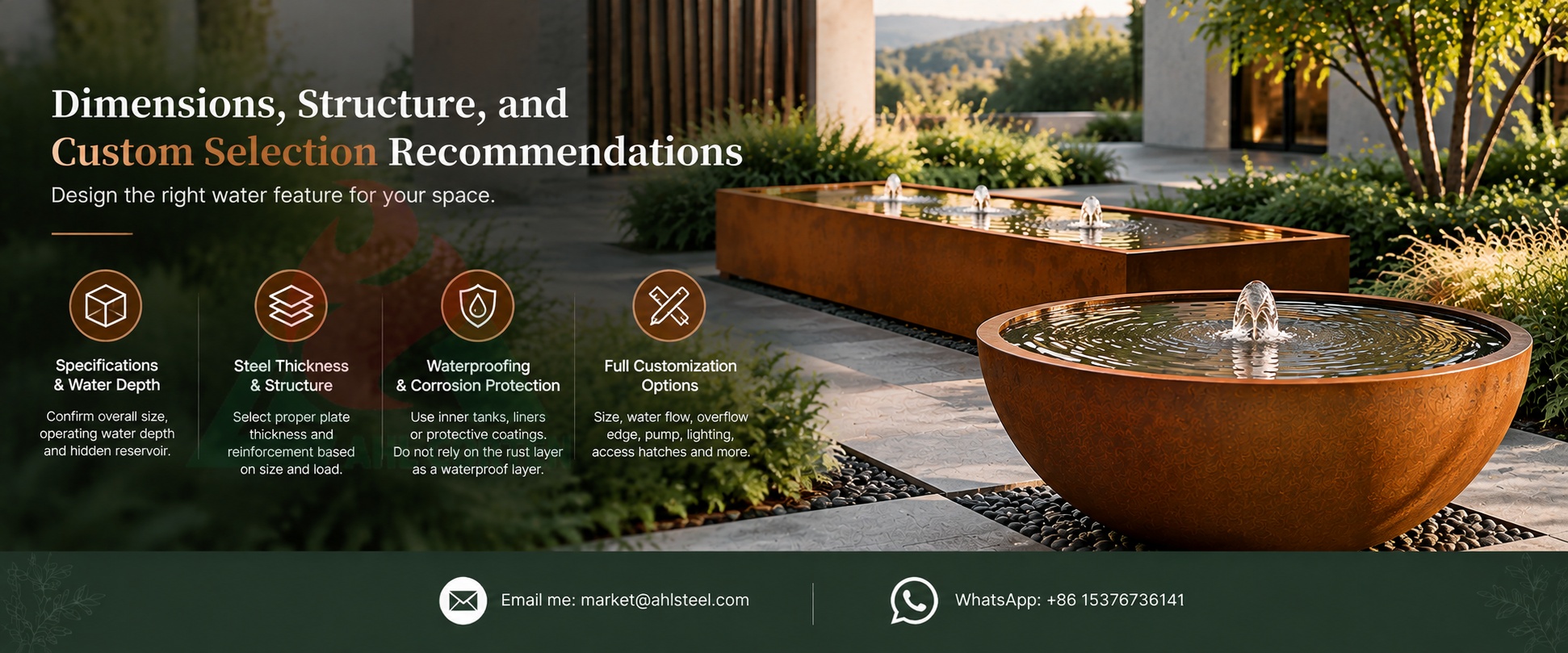
Dimensions, Structure, and Custom Selection Recommendations
1. Specifications, Water Depth, and Hidden Water Reservoir
Length, width / diameter, total height, and operating water depth must be confirmed separately. The upper countertop or basin visible to the naked eye does not represent the size of the water reservoir below.
When purchasing, request cross-sectional drawings from the manufacturer to confirm: normal water level, overflow level, built-in water storage chamber, pump location, access hatches, supports, and pipeline connections. Compare the entire system rather than relying solely on external dimensions.
2. Steel Plate Thickness and Structural Reinforcement
Do not assume that a single steel plate thickness is suitable for all water features. Confirm with the fabrication plant the criteria for plate selection: span, water depth load, reinforcement structure, and support scheme.
When calculating loads, use the total weight when fully filled with water as the basis, not the weight of the empty steel shell. For elevated or oversized water features, a separate structural assessment is mandatory; standard model parameters cannot be directly referenced.
3. Waterproof Enclosures and Corrosion Protection
Water-retaining structures come in several types: standalone inner tanks, waterproof liners, protective coatings, or steel structures that hold water directly. Weathering steel patina should not be treated as a waterproof layer; areas subject to long-term submersion require additional protection.
Confirm inspection and maintenance procedures for welds, seams, and areas subject to long-term submersion, and verify compatibility between cleaning agents, water quality conditioners, and liner materials.
4. Customization Considerations
Customization involves more than just adjusting external dimensions; it also includes simultaneously determining: proportions and appearance, fountain water discharge patterns, overflow edges, pump specifications, access hatches, reservoir designs, lighting, drainage piping, and requirements for hoisting, transportation, and installation. Obtain drawings and a clear scope of supply before production to avoid missing parts later on.
Frequently Asked Questions
1. What Is the Main Difference Between a Water Table and a Water Feature Basin?
Horizontal water feature platforms feature a wide, horizontal water surface with a strong architectural aesthetic; water feature basins feature a curved basin shape with a prominent sculptural aesthetic. These are merely classifications based on appearance; their water circulation systems can be similar. Horizontal water feature platforms are also available in circular designs.
2. Are Weathering Steel Water Tables Suitable For Small Gardens?
Yes, compact, small-sized square water features are available on the market. In addition to the external dimensions, you’ll need to allow space for maintenance and piping; as long as the overall footprint is suitable, installation is possible.
3. Do Water Feature Basins Always Require a Pump?
If you’re only creating a static, still-water display, a pump isn’t necessary. However, if you want a gushing fountain or an overflow circulation effect, you’ll need a circulation pump and a reservoir. Confirm whether these components are included before placing your order.
4. Which Type Is Easier To Maintain?
The design itself does not determine the amount of maintenance required. Factors such as ease of pump maintenance, the amount of fallen leaves, the structure of the spray nozzles, and frost protection requirements have a greater impact. Comparing maintenance instructions and access for servicing is more important than worrying about the specific design.
5. Can Water Features Hold Water Directly In The Steel Shell?
Some models are designed this way, but you cannot assume that all steel shells are suitable for long-term submersion. Areas subject to continuous submersion cannot develop a patina normally; you must confirm the presence of a liner, coating, or separate water-retention structure.
6. Will Metal Water Features Stain Surrounding Paving?
Rusty water during the early stages of patina formation poses a staining risk, particularly for light-colored stone and concrete. Implement drainage channels, isolation measures, and protective measures in advance.
7. Can Corten Water Feature Platforms and Basins Be Customized?
Yes, they can be customized, but you cannot limit customization to just the shape. The design must include water levels, waterproofing structures, pump access hatches, overflow routes, support systems, and installation requirements. Confirm the drawings and feasibility before commissioning.
Summary: Should You Choose a Water Feature Platform or a Water Feature Bowl?
If you prefer an open, flat water surface and clean architectural lines, prioritize a horizontal water feature platform. If you want a curved, sculptural container to serve as a standalone visual focal point, prioritize a water feature bowl.
The shape is just the first step. Pump maintenance, waterproofing and water storage, splash control, and freeze protection—these are the key factors that determine the long-term user experience.
Are You Ready to Choose an Outdoor Corten Water Feature That’s Right for You?
Looking for a weathering steel water feature to complement your project? Contact the AHL Weathering Steel Team to customize a horizontal water feature platform or water feature bowl. We’ll work with you to determine the dimensions, surface finish, water circulation plan, and complete fabrication solution based on your site.