In modern high-end gardens, minimalist landscaping, and outdoor landscape design, metal edgings have become a key detail for enhancing the overall aesthetic quality. They can precisely delineate lawns, gravel, flower beds, and paved areas, creating clean, crisp lines that significantly elevate the sophistication of the garden.
The vast majority of homeowners and landscape designers face the same material selection dilemma: should they choose corten steel edgings for their gardens, or the more cost-effective mild steel edging strips?
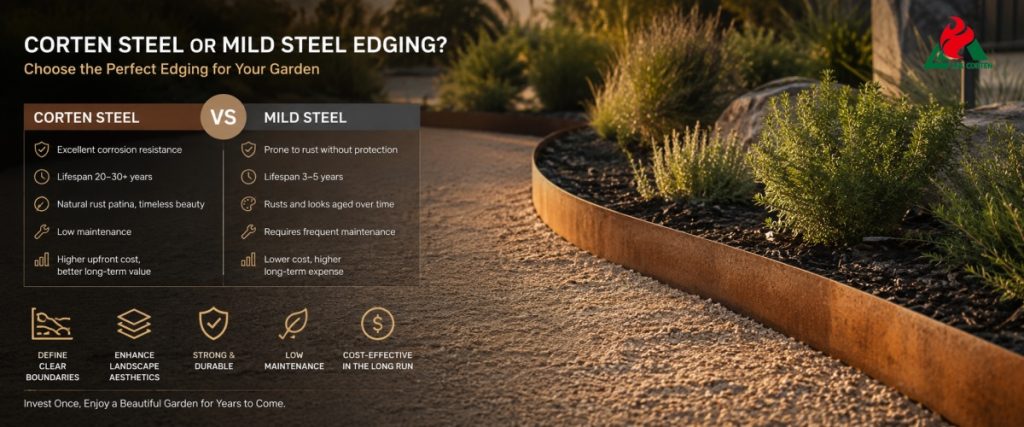
Both materials serve similar basic functions—securing soil, defining boundaries, and shaping garden lines. However, over the long term, there are significant differences between them in terms of aesthetic evolution, lifespan, and maintenance costs.
For many, the core dilemma boils down to a single question: Is the higher-priced weathering steel worth the investment? Will the more affordable mild steel lead to endless headaches down the road?
This article will provide an in-depth, multi-dimensional comparison covering material properties, lifespan, aesthetics, strength, maintenance, cost, and suitable applications—helping you choose the perfect metal edging material for your garden that you won’t regret.
Want the Latest Catalog of Garden Edging? Contact Us!
Core Principles of Weathering Steel vs. Ordinary Steel
1. Corten Steel Edgings: A High-End Alloy Designed for Harsh Outdoor Environments
Weathering steel, also known as corten steel, derives its name from its two core advantages: corrosion resistance and high tensile strength. It is a special alloy steel developed specifically for outdoor applications.
Built upon the foundation of ordinary carbon steel, it incorporates alloying elements such as copper, chromium, and nickel, resulting in a unique self-healing patina mechanism.
When exposed to air, rain, and moist soil over time, a dense, stable layer of rust naturally forms on the surface of weathering steel. This rust layer adheres tightly to the steel substrate, acting like protective armor to completely seal out moisture and air, preventing further corrosion of the steel beneath.
Even in harsh outdoor environments such as coastal salt fog, high humidity and rainfall, or acidic soil, weathering steel maintains stable performance, with corrosion resistance 2 to 8 times greater than that of ordinary steel.
2. Ordinary Steel Edging: Basic Industrial Carbon Steel, Relying on Post-Treatment Protection
Ordinary carbon steel is the most basic industrial-grade steel. It has a low carbon content and contains no corrosion-resistant alloying elements, meaning the raw material lacks inherent outdoor weather resistance.
Ordinary steel rusts when exposed to water and air, but its rust layer is loose, porous, and extremely prone to flaking off. Once the rust layer peels away, the underlying steel substrate remains exposed, leading to a vicious cycle of repeated rusting, corrosion, and thinning.
For this reason, standard corten steel edgings cannot be used directly outdoors for extended periods. They must rely on post-production surface treatments—such as hot-dip galvanizing, powder coating, or applying anti-rust paint—to barely extend their outdoor service life. Once the coating is damaged, corrosion will spread rapidly.
A Comprehensive Head-to-Head Comparison: Corten Steel vs. Standard Steel Edging
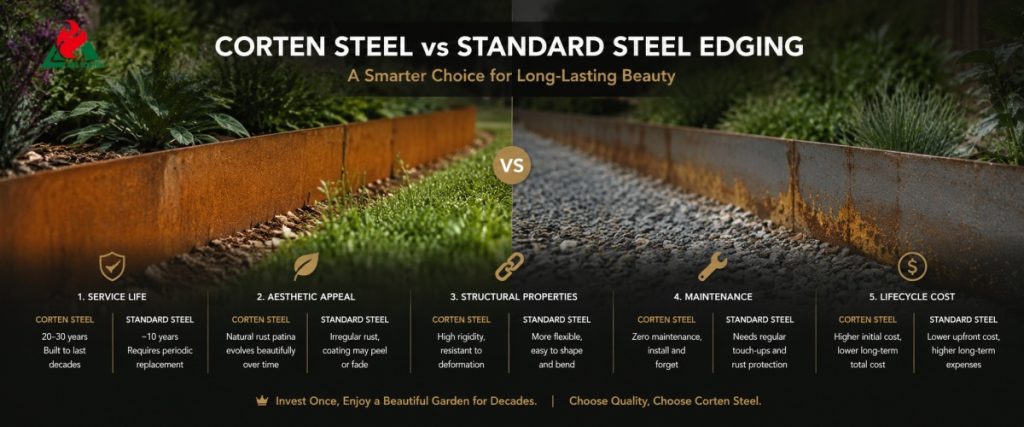
1. Service Life: 30 Years of Durability with a Single Installation vs. Periodic Replacement
Corten Steel Edging: Standard 3mm thickness, with a stable service life of 20–30 years. Once the initial oxidation process is complete, the rust layer fully solidifies, significantly slowing the corrosion rate. It can virtually match the lifespan of the garden structure, truly delivering decades of worry-free use with a single installation.
Standard Steel Edging: Unprotected standard steel of the same 3mm thickness has an outdoor service life of only about 10 years. The steel will continue to thin at a rate of approximately 10 microns per year, with even faster deterioration in acidic, damp soil. If a 5mm thickened version with hot-dip galvanization is chosen, the service life can be extended to over 20 years, but it still cannot avoid eventual aging issues.
2. Aesthetic Appeal: High-End, Uniform Texture vs. Natural, Rustic, Mottled Texture
Rusted Steel Edging: Controlled and sophisticated color evolution. After installation, it gradually changes color, transitioning from bright orange and reddish-brown to a warm, vintage bronze hue. The overall color is uniform and consistent, with a sophisticated, refined texture, making it ideal for modern minimalist, light luxury gardens, and high-end villa landscaping styles.
No manual coloring is required throughout the process; the texture, naturally developed over time, pairs perfectly with high-end stone, pressure-treated wood, and greenery, significantly elevating the overall sophistication of the garden.
Standard Steel Edging: Features random, irregular rust patina with no consistent pattern, typically appearing as light orange-yellow rust stains, exuding a natural, rustic charm. Ideal for rustic, eco-natural, and vintage-inspired gardens. Custom powder coatings in black or mocha can be applied in advance to precisely control the initial appearance, but the coating may peel or fade as it ages.
3. Structural Properties: High Rigidity & Deformation Resistance vs. High Flexibility & Ease of Shaping
Corten Steel Edging: With a tensile strength of up to 480 MPa, it offers exceptional rigidity and outstanding resistance to compression and deformation. Even the 3mm thin version can withstand soil lateral pressure, frost heave, and impacts from lawn mowers, maintaining straight, neat boundary lines year-round without bending or warping.
Standard Steel Edging: With a tensile strength of approximately 400 MPa, it meets basic structural strength requirements but is slightly less rigid than weathering steel. Its advantage lies in greater flexibility; the 5mm thickened version is easier to bend and shape, making it ideal for complex garden designs such as winding curves, circular tree pits, and irregularly shaped flower beds.
4. Daily Maintenance: Zero Maintenance & Peace of Mind vs. Ongoing Maintenance & Repair
Corten Garden Edging: A truly “install-and-forget” material. No paint or rust-proof coating touch-ups, and no regular maintenance required. It relies on natural cycles of moisture and dryness to complete the oxidation and curing process, requiring virtually zero maintenance after installation—ideal for busy modern households.
Standard Steel Edging: Requires ongoing, meticulous maintenance. Before installation, a rust-proof primer and asphalt paint must be applied to prevent soil corrosion. During daily use, any chips or scratches in the coating must be touched up promptly; otherwise, the exposed steel will rust rapidly and spread, leading to localized corrosion and damage.
5. Total Lifecycle Cost: High Initial Investment vs. High Long-Term Hidden Costs
Rusted Steel Edging: The unit purchase price is higher, due to the use of precious metal alloys and precision laser cutting processes. However, when viewed over a 20- to 30-year lifespan, the annual operating costs are extremely low due to zero maintenance, zero replacements, and zero repairs, making it highly cost-effective in the long run.
Standard steel edging strips: Initial procurement costs are lower, making them suitable for cost-sensitive projects. However, they carry significant hidden costs over time, including labor costs for periodic touch-ups, the expense of complete replacement every 8 to 10 years, and costs for garden renovation and repairs. The total long-term expenses far exceed those of weathering steel.
Want a Free Quote on Corten Steel Edging? Contact us!
Precise Scenario Matching: Choosing the Right Materials for Different Gardens to Avoid Pitfalls
1. Scenarios Where Corten Steel Edging Should Be Your First Choice
High-end villa gardens, modern minimalist landscapes, and gardens for long-term residential use that prioritize clean lines, a cohesive aesthetic, and a landscape that looks brand-new year-round.
Coastal salt fog regions, areas with high rainfall and humidity, and gardens with acidic soil—where environmental corrosion is severe—as ordinary steel is highly prone to rapid aging and failure.
Homeowners seeking low-maintenance, hassle-free solutions that last a lifetime, who want to avoid frequent renovations and upkeep.
2. Scenarios Where Standard Steel Edging Strips Are the Preferred Choice
Courtyards with a natural, ecological aesthetic or rustic-chic style, where a mottled, natural, raw rust texture is preferred.
Large commercial parks, municipal green spaces, and temporary landscape projects with limited initial budgets, where replacement or renovation within 8–10 years is acceptable.
Garden designs featuring extensive irregular curves, circular tree pits, and meandering flower beds, requiring steel that can be flexibly bent into shape.
General Installation and Maintenance Tips for Metal Edging
1. Key Points for Standard Installation
The bottom of the edging must fit snugly against the soil layer with no gaps or overhangs to prevent water and soil accumulation, thereby reducing the risk of localized corrosion.
Use specialized steel nails for reinforcement and anchoring to withstand winter soil heave and daily external pressure, preventing shifting or loosening.
Use a string line for alignment during installation to ensure straight, smooth lines, maximizing the refined, minimalist aesthetic of the metal edging.
2. Tips for Preventing Rust Stains
Both types of steel produce rust water during the initial oxidation phase, which can leave stubborn stains when it drips onto light-colored stone or concrete surfaces.
Incorporate a concealed drainage slope to direct runoff water toward vegetated soil areas, or maintain a safe distance from high-end paving.
For high-end projects, factory-pre-weathered weathering steel products can be selected; these form a stable surface immediately upon installation, eliminating rust water contamination at the source.
3. Key Details for Drainage and Corrosion Prevention
Long-term water accumulation or complete submersion disrupts the steel’s natural wet-dry cycle, accelerating corrosion and aging.
Optimize the drainage design of the subbase during construction to prevent water from pooling and causing dampness at the base of the edging strips, effectively extending the service life of both types of steel.
Want to Create a Unique Corten Lawn Edging? Contact Us!
Clarifying Three Common Misconceptions
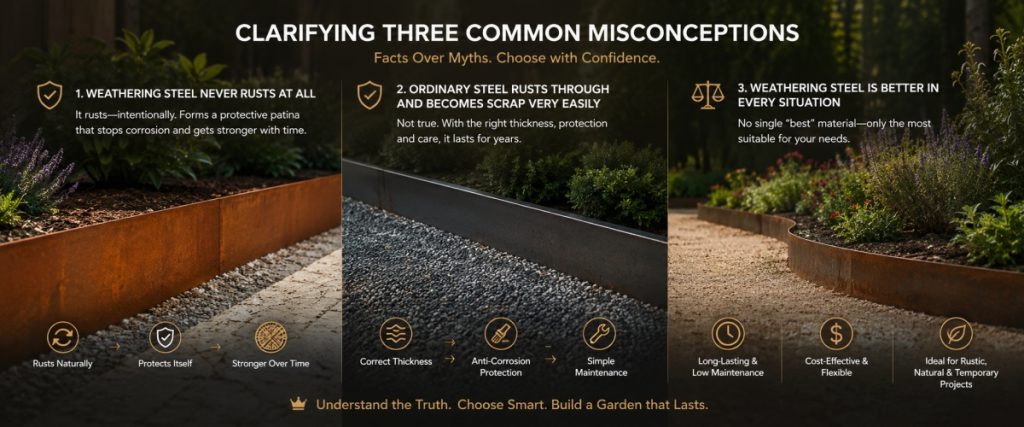
Misconception 1: Weathering Steel Never Rusts At All
This is the most common misconception. Weathering steel does not “never rust”; rather, it rusts in a controlled manner—rusting without decaying.
Through initial natural rusting, it forms a dense protective layer that encapsulates the internal steel, transforming rusting into a process of self-repair and self-protection. The longer it is used, the more stable and textured it becomes.
Misconception 2: Ordinary Steel Rusts Through and Becomes Scrap Very Easily
Ordinary steel is not a short-lived material. Standard 3mm-thick ordinary steel can be used reliably for 10 years without issue, and 5mm-thick specifications, when paired with professional protective measures, can last for over 20 years.
As long as you choose the right thickness, perform proper initial anti-corrosion treatment, and carry out simple periodic maintenance, ordinary steel can fully meet the needs of most standard garden applications.
Misconception 3: Weathering Steel Outperforms Ordinary Steel In Every Scenario
There is no single “best” material; only the most suitable solution. Weathering steel excels in longevity, texture, and maintenance-free properties, while ordinary steel wins in terms of cost-effectiveness and design flexibility.
For commercial projects with limited budgets, gardens seeking a rustic, natural aesthetic, or temporary landscape projects, ordinary steel is the more practical and cost-effective choice.
Want a Custom Corten Steel Edging? Contact Us!
Why Choose AHL High-End Corten Steel Edging?
With over 20 years of experience in the manufacturing of weathering steel outdoor landscaping products, AHL deeply understands the core requirements for high-end garden edging: consistent aesthetics, structural stability, and lifelong maintenance-free performance.
Unlike inferior recycled steel products on the market, AHL weathering steel edging offers multiple key advantages:
- Pure Materials and Precision Craftsmanship for Consistent Performance: Made from high-purity weathering steel alloys—we never use recycled scrap steel—and processed with industrial-grade laser cutting, our steel maintains uniform rigidity. It resists impact and deformation, ensuring straight lines for decades.
- Natural self-healing, truly zero maintenance: No chemical coatings or sealing treatments are required. The steel forms a dense protective layer through natural cycles of moisture and dryness, making it suitable for all types of harsh outdoor environments. It shows no signs of aging or peeling even after long-term use.
- Customizable, high-end texture: Custom pre-weathering is available at the factory, so the product displays a vintage bronze color immediately upon installation. No lengthy curing period is needed, and the color remains uniform and sophisticated, making it suitable for all types of high-end landscape designs.
- Exceptionally High Long-Term Return on Investment: With an ultra-long, stable service life of 20–30 years, it eliminates the hidden costs of repeated replacements, renovations, and maintenance, making it a long-term investment for high-end garden landscapes.
Want to Get Your Own Corten Edging? Click to Customize!
Quick Decision Guide: Choose the Right Garden Edging Material in 3 Seconds
Choose Weathering Steel Edging Strips If You Need:
✅ Over 20 years of long-lasting, stable performance—install once and enjoy lifelong peace of mind
✅ A uniform, premium antique bronze finish that complements minimalist, light-luxury, and high-end gardens
✅ Outdoor environments with high corrosion risk, such as coastal areas, high-humidity zones, or acidic soil
✅ Zero maintenance and upkeep, saving time and costs on future garden care
Choose Standard Steel Edging If You Need:
✅ Strict control over initial project budgets and cost-saving requirements for large-scale installations
✅ Creating a rustic, natural, and wild garden landscape style
✅ Extensive use of irregular curves and circular shapes requiring flexible bending and shaping of steel
✅ Short-term landscape displays, transitional gardens, or situations where mid-term renovation or replacement is acceptable
Corten Steel Edging: Summary and Purchase Recommendations
There is no absolute superiority or inferiority between weathering steel edging strips and standard steel edging strips; they simply suit different scenarios.
Weathering steel is a long-term, high-end investment option. While it involves a higher initial cost, it delivers decades of maintenance-free, visually striking, and highly stable landscape results, making it the top choice for high-end private gardens and landscapes in harsh environments.
Standard steel is a cost-effective, practical option. With its flexible shaping capabilities and low initial cost, it is ideal for projects with limited budgets, those seeking a natural, rustic aesthetic, and short-term landscape projects.
A high-quality garden landscape is never defined by the most expensive materials, but rather by precise material selection, professional installation, and meticulous design details.
Looking to create a high-end garden border that remains timeless and as good as new for decades? Discover the AHL Premium Corten Steel Edging Series and customize a long-lasting, exquisite garden landscape solution tailored just for you. Contact us now!