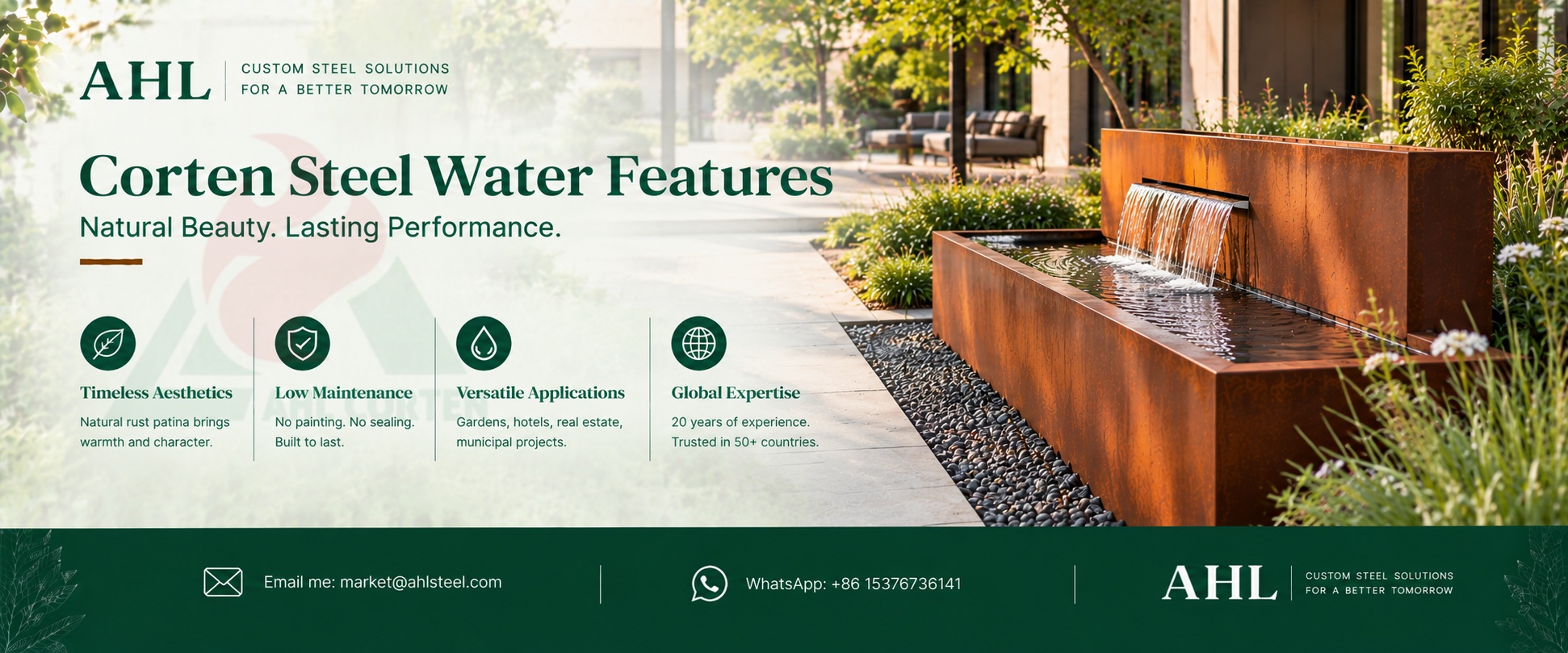
Whether in a tranquil corner of a private garden, as a visual landmark in a hotel plaza, or as a central feature in a commercial complex—corten steel water features are becoming the material of choice for high-end landscape designers worldwide.
They seamlessly blend industrial ruggedness with the fluidity of flowing water. The naturally formed reddish-brown patina delivers a timeless, sophisticated aesthetic without the need for artificial coloring. More importantly, it is virtually maintenance-free—which is precisely why it has rapidly gained popularity in hotel, real estate, and municipal projects.
However, nearly all buyers face the same “rust-related” concerns when making decisions:
- Corten steel rusts naturally. If it’s submerged in water for long periods, will it rust through in just a few years?
- With constant water flow, will the pool water turn into a murky pool of rusty water?
- Will rust particles flake off and permanently stain the surrounding marble or light-colored paving?
Without professional answers to these concerns, projects may face delays at best, or have their designs scrapped at worst—directly leading to budget overruns.
With 20 years of manufacturing experience and a global presence in over 50 countries, the AHL Group offers a clear conclusion:
In the vast majority of outdoor settings, corten water fountains require absolutely no painting or full sealing. Blindly applying paint will undermine the steel’s core self-healing rust-prevention capabilities.
Of course, in special scenarios such as coastal areas with high salt fog, acidic water, or adjacent light-colored high-end paving, scientific localized sealing is necessary. This article will clearly outline the applicable boundaries for both approaches, helping you make precise decisions and eliminate the risk of rework.
Want the Latest Catalog for Corten Steel Water Features? Contact Us!
Should Corten Steel Water Features Be Painted or Sealed?
- Structural Rust Prevention Requirements: No painting or sealing is required; standard rust-preventive paint is unnecessary.
- Aesthetic Control and Special Application Requirements: Apply localized treatments as needed; this is not a black-and-white decision, but rather requires a customized solution based on the water body, environment, and ground materials.
Reasons Why Most Applications Do Not Require Painting or Sealing
To understand the rationale behind not requiring protection, one must first understand the rust prevention mechanism of weathering steel (using the high-grade SPA-H weathering steel adopted by AHL as an example).
Rusting in ordinary carbon steel is irreversible damage, whereas rusting in weathering steel is a form of self-protection. When exposed to natural air and alternating dry and wet conditions, steel’s surface spontaneously forms a dense, stable layer of rust—known as a passivation layer.
This rust layer acts like a metal armor, firmly enveloping the steel substrate to block oxygen and moisture, thereby preventing further corrosion of the internal steel at its source.
Applying ordinary anti-rust paint or sealing compounds indiscriminately can cause two major irreversible problems:
It cuts off the steel’s contact with the air, hindering the formation of the protective rust layer and directly depriving the steel of its self-healing ability.
Under the effects of water erosion and UV exposure, artificial coatings will inevitably crack and peel within 1–2 years. Once rainwater seeps into the cracks in the coating, it creates an oxygen-deprived, high-humidity micro-battery effect, triggering crevice corrosion and pitting, which accelerates localized damage to the steel.
Want the Latest Catalog for Corten Steel Water Features? Contact Us!
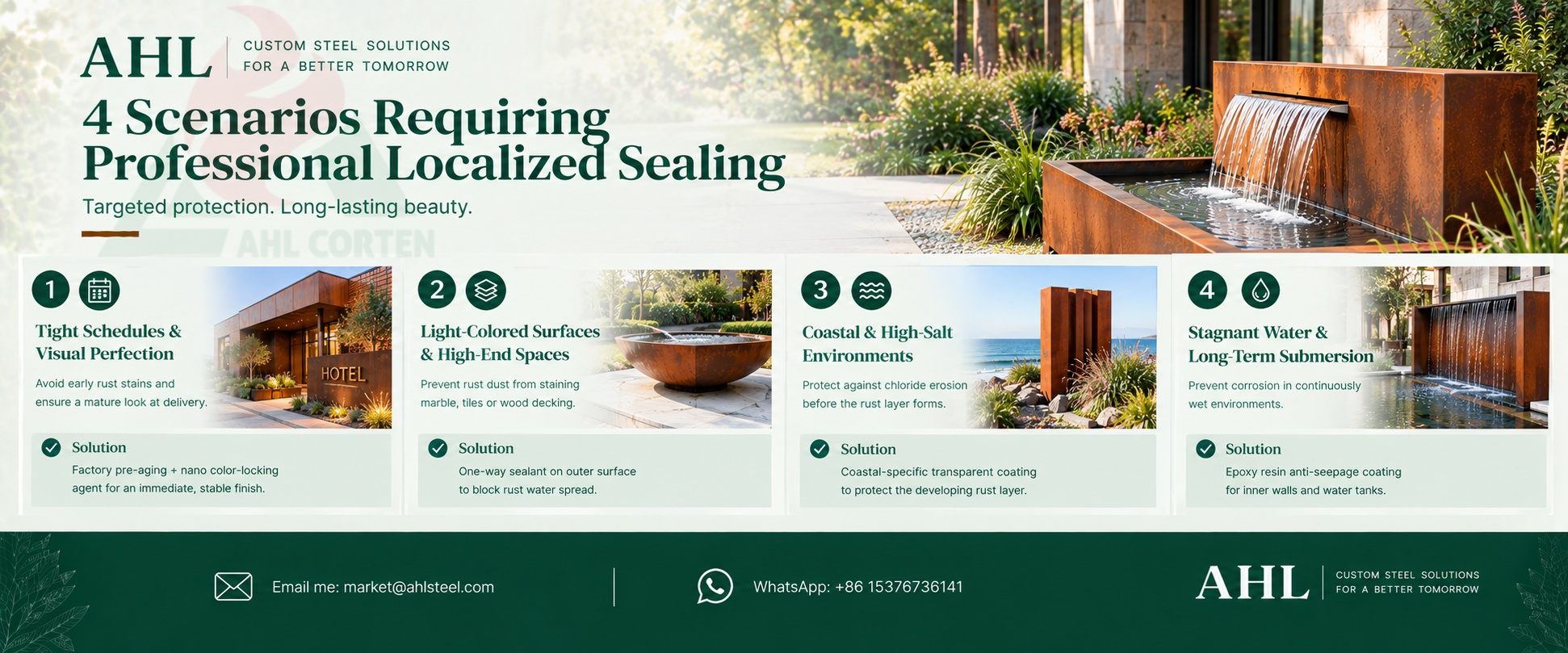
4 Scenarios Requiring Professional Localized Sealing
Although full-surface painting is more harmful than beneficial, in certain commercial projects and special construction scenarios, specialized chemical sealants can serve as an auxiliary protective measure. Note that the use of ordinary anti-rust paint is strictly prohibited.
Scenario 1: Tight Construction Schedules Requiring Optimal Visual Appearance Upon Completion
High-end hotel and commercial plaza projects have fixed opening dates and cannot wait for the steel’s natural patina cycle of 6–12 months, nor can they tolerate the yellowish, mottled rust stains that appear in the early stages.
Solution: The steel undergoes pre-aging treatment at the factory and is sprayed with a highly breathable, non-obstructive nano color-locking agent. Upon completion, it immediately displays a mature reddish-brown rust layer that is resistant to chalking in the short term.
Scenario 2: Adjacent to Light-Colored, High-End, Stain-Prone Surfaces
When metal sculpture fountains are installed above white marble, light-colored high-end tiles, or solid wood boardwalks, trace amounts of rust dust generated during initial oxidation can easily cause permanent yellow stains.
Solution: Apply a one-way sealant to the dry panels on the outer side of the water feature to prevent rust water from spreading with rainwater, thereby protecting the high-end surfaces.
Scenario 3: Extreme Coastal Environments with High Salt Fog and Humidity
In areas within 5 kilometers of the coastline, high levels of chloride ions in the air will continuously erode the protective rust layer before it has fully formed.
Solution: Apply a transparent protective coating specifically designed for coastal environments to protect the immature passivated rust layer.
Scenario 4: Stagnant Water Areas with Long-Term Water Accumulation and No Dry-Wet Cycle
In locations such as corten water curtain walls, collection troughs and underground water storage tanks, steel is completely submerged in water for extended periods, preventing the natural dry-wet cycle and significantly reducing its rust resistance.
Solution: Apply an epoxy resin anti-seepage coating to the inner walls of the water tank to create a dry-wet barrier and prevent steel corrosion.
Want the Latest Catalog for Rusted Steel Water Features? Contact Us!
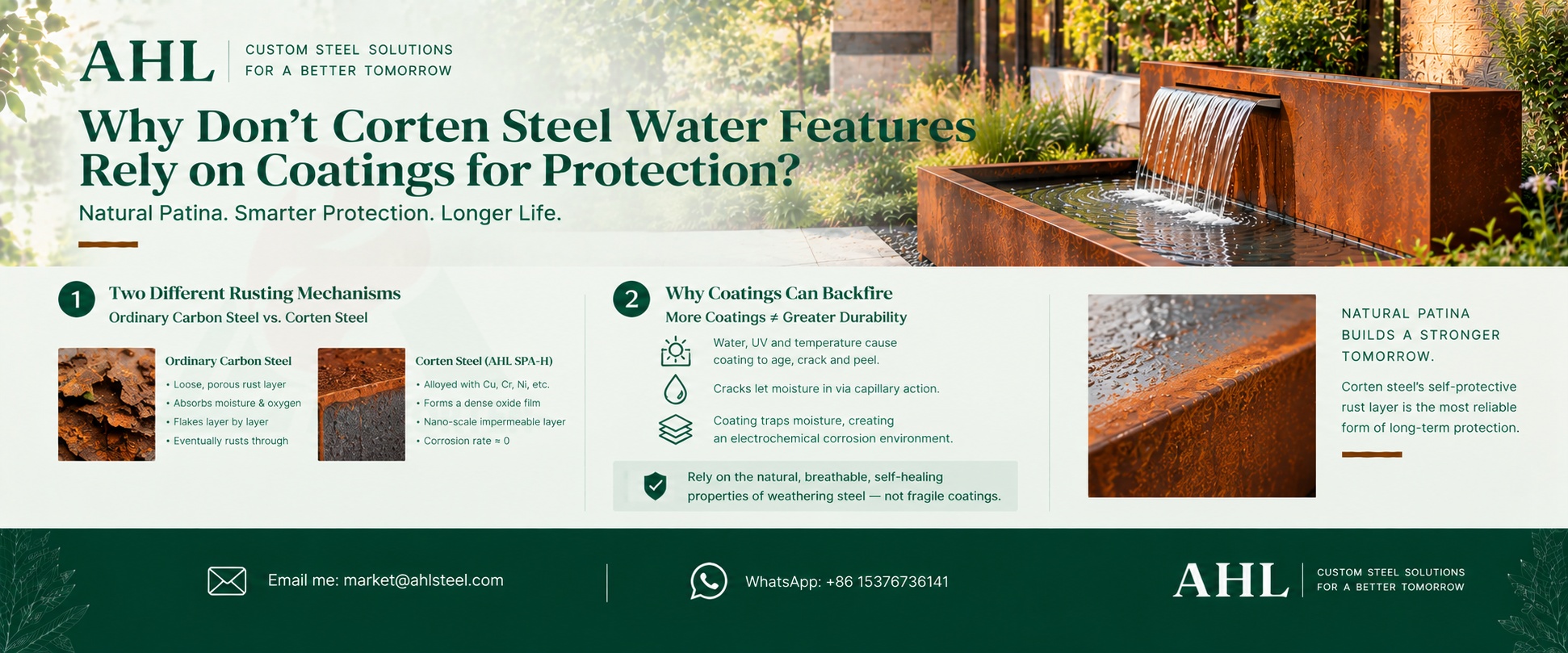
Why Don’t Corten Steel Water Features Rely on Coatings for Protection?
1. Ordinary Carbon Steel vs. Corten Steel: 2 Completely Different Rusting Mechanisms
When ordinary carbon steel rusts due to moisture, the rust layer forms a loose, porous structure resembling a sponge. Not only does it fail to protect the base material, but it also continuously absorbs moisture and oxygen, causing the steel to flake off layer by layer until it is completely rusted through and becomes scrap.
Genuine weathering steel (AHL SPA-H grade) is smelted with added alloying elements such as copper, chromium, and nickel. Under the dry-wet cycles of sun and rain, it forms a dense, amorphous oxide film.
The molecular pore size of this oxide film is smaller than that of water vapor and oxygen molecules. Once formed, it acts like a nano-scale impermeable armor, completely isolating the internal steel, with a corrosion rate approaching zero.
2. More Coatings Do Not Necessarily Mean Better Durability
Many beginners mistakenly believe that an additional coating layer provides an extra layer of protection. However, in weathering steel water feature applications, ordinary coatings are often the primary cause of premature steel damage.
Water features are constantly exposed to water flow and direct UV radiation, causing artificial paint films and sealants to inevitably age, develop micro-cracks, and peel in localized areas.
Even hairline cracks can allow moisture to penetrate the coating via capillary action. The coating blocks air, preventing water vapor from evaporating and creating an electrochemical corrosion environment that exacerbates pitting and crevice corrosion in the steel.
The coating, originally intended to prevent rust, ultimately becomes a cage that traps moisture, accelerating the steel’s deterioration. AHL experts recommend: Relying on the breathable, self-healing properties of weathering steel is far more reliable than applying fragile artificial coatings.
Want the Latest Catalog for Rusted Steel Water Walls? Contact Us!
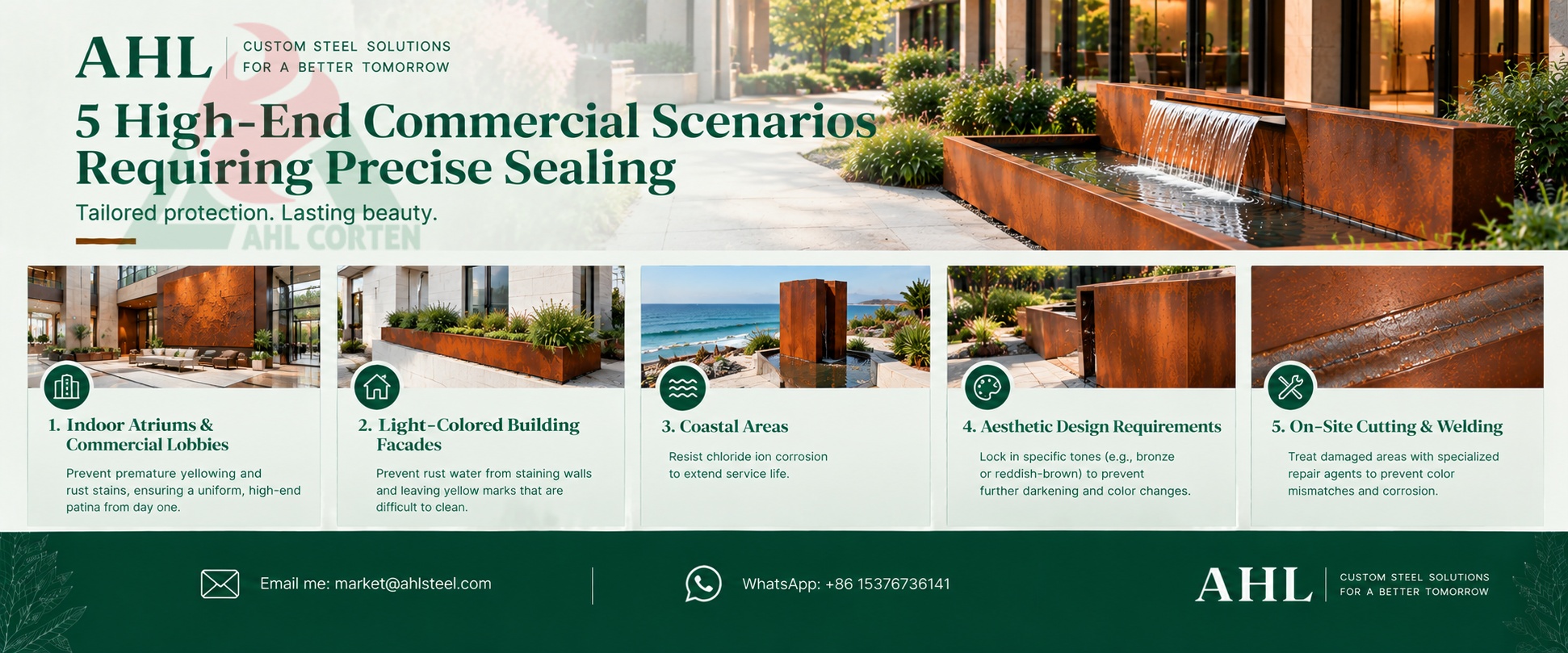
5 High-End Commercial Scenarios Requiring Precise Sealing
From an engineering implementation perspective, the following five scenarios require targeted localized sealing; the indiscriminate application of ordinary paint is strictly prohibited:
- Indoor atriums and commercial lobbies: Prevent premature yellowing and rust stains, ensuring a uniform, high-end rust patina is present from the moment the facility opens.
- Areas surrounding light-colored building facades: Prevent rust water from staining walls and leaving yellow water stains that are difficult to clean.
- Coastal Areas with High Humidity and Salt Fog: Resist chloride ion corrosion to extend the service life of steel.
- Fixed Aesthetic Design Requirements: Lock in specific tones such as bronze or reddish-brown to prevent continued darkening and color changes over time.
- Damaged Areas from On-Site Cutting and Welding: Damage to the alloy’s surface caused by construction requires treatment with specialized repair agents to prevent localized color discrepancies and corrosion.
Want the Latest Prices for Rusted Steel Water Walls? Contact Us!
3 Hidden Side Effects of Haphazard DIY Painting
Many contractors, seeking to cut corners, casually purchase clear varnish or automotive primer to coat steel. This slapdash approach leads to irreversible damage within 12 months.
1. Peeling and Flaking Paint, Ruined Aesthetics
At outlets and corners, where water flows constantly erodes the surface, ordinary coatings will begin to peel and flake off first. The areas where the coating has peeled will rust and discolor anew, while the areas where it remains will appear dull and dark. The overall surface becomes mottled and unsightly, completely losing the high-end landscape aesthetic.
2. Resetting the Corrosion Cycle and Shortening Service Life
Haphazard application disrupts the steel’s natural wet-dry cycle. Once the coating ages and peels off, the substrate is left without a protective rust layer and must undergo the rusting and flaking process anew. While this may seem to delay rusting, it postpones potential hazards and accelerates deterioration.
3. Extremely High Repair Costs and Impossible Seamless Restoration
Once the protective coating blisters or cracks, seamless on-site repairs are impossible. The refractive indices and color differences between the old and new coatings are stark. The only solution is to sandblast, strip, and polish the entire surface back to the silver-white base material—a process that incurs exorbitant rework costs.
AHL Alternative: Replacing Chemical Coatings with Structural Design
High-quality landscape projects rely on industrial design optimization to solve problems, rather than depending on chemical paints. AHL introduces three optimization solutions:
- Dry-wet separation water tank: The exterior uses high-purity weathering steel of 2.0mm or greater thickness, while the interior is lined with stainless steel to prevent long-term water erosion.
- Concealed Anti-Contamination Baffles: The bottom features a water collection and drainage structure designed to intercept early-stage rust particles, preventing contamination of surrounding paving.
- Magnetic Filtration System: Combining a magnetic interception ring with a precision filtration pump, this system adsorbs suspended rust particles in the water, maintaining crystal-clear pool water over the long term.
Corten Water Feature: How to Properly Apply a Sealing Coating When Necessary?
If project deadlines are tight, surrounding paving is expensive, or coating protection is required, strictly follow this four-step scientific construction process; avoid haphazard application:
Step 1: Define the Purpose of Protection
- Structural Rust Prevention: No coating is necessary; the steel’s inherent properties are sufficient.
- Stain Prevention and Rust Control: Apply a one-way color-locking treatment only to the dry outer panels.
- Water Tank Leak Prevention: Apply heavy-duty anti-corrosion and waterproof coatings to the inner walls.
Step 2: Differentiated Application by Zone
- Water-retaining inner tank area: Apply epoxy coal tar paint to achieve complete separation between wet and dry zones.
- Water-exposed vertical surfaces: Keep these surfaces bare; any coating applied will peel off within a short period.
- Dry, exposed panels: Apply a highly breathable fluorocarbon sealant to lock in color without obstructing the steel’s natural breathing process.
Step 3: Assess Maintenance Costs in Advance
Before construction begins, request a coating aging and repair plan from the contractor. If the only future option is to sandblast and remove the entire coating, abandon that coating scheme immediately to avoid high rework costs.
Step 4: Professional Material Selection + Sample Testing
Reject generic exterior varnishes and standard primers available on the market. Before large-scale application, conduct sample testing on the same material to observe for chemical reactions causing blackening or dulling, and to verify coating adhesion.
Want the Latest Prices for Rusted Steel Water Walls? Contact Us!
General Maintenance Guide: Tips for Both Unsealed and Sealed Water Features
Regardless of whether a sealing coating is applied, regular maintenance is key to extending the lifespan of water features. AHL has compiled a simple, standardized maintenance process:
1. Daily Basic Maintenance
Clean fallen leaves and debris weekly to prevent organic matter from causing water eutrophication and disrupting the steel’s oxidation balance. Inspect drain outlets monthly to prevent salt buildup at the bottom and abnormal water conductivity.
2. Seasonal Management
In northern regions with low temperatures, drain all water from pipes and tanks before winter to prevent ice expansion from tearing the pump housing or peeling off the protective rust layer. After heavy rain or sandstorms, promptly replace the water and rinse the filtration system to restore the water purification barrier.
3. Emergency Troubleshooting for Common Issues
- Blackened or peeling welds: Use an 80-grit stainless steel grinding wheel to sand down to the bare metal, apply a specialized repair solution, and restart the healthy oxidation process.
- White water streaks on the surface: Clear any blockages in the drainage channels and use a stiff brush to remove salt deposits; the surface will naturally regain its uniform color within 2–4 weeks.
FAQ about Corten Water Features
1. Will Rusted Steel Water Features Turn the Water Rust-Red?
During the active oxidation period in the first 3–6 months, a small amount of rust powder may flake off, causing the water to appear slightly yellowish. It is non-toxic and harmless. Once the rust layer stabilizes, the flaking will naturally stop, and the water will return to its clear state. When paired with the AHL magnetic filtration system, the yellowing issue can be resolved within a few days.
2. If No Sealing Treatment Is Applied, Will the Water Feature Rust Through Quickly?
Genuine SPA-H weathering steel will not rust through easily. It relies on a dense, passivated rust layer for self-protection. Blindly applying ordinary sealing paint can cause crevice corrosion and accelerate localized damage. Only the inner liner, which is subject to long-term water accumulation, requires a waterproof coating.
3. Are the Treatment Methods the Same for Areas Submerged in Water and Those Exposed to Splashes?
They are completely different and must be managed separately. Apply epoxy waterproofing to the inner walls of tanks subject to prolonged submersion; keep surfaces exposed to flowing water uncoated; and apply breathable, color-locking coatings to dry exterior panels.
4. Can Sealing Be Applied Only to Cut and Welded Areas?
Yes. On-site fabrication can damage the surface alloy structure of the steel. Applying specialized repair paste to these areas can inhibit localized corrosion and prevent color discrepancies and rough edges, representing an advanced, precision maintenance technique.
5. Will Sealing Treatment Ruin the Steel’s Natural Rust Patina?
Low-quality varnish makes the steel surface shiny, giving it a cheap, plastic-like appearance. AHL nano-penetrating sealant penetrates deep into the rust layer, preserving the original matte, rough texture without altering the natural, vintage grain.
6. Can a Protective Rust Layer Still Form After Applying a Coating?
Ordinary airtight coatings block air, completely halting the development of the rust layer. This leads to severe color discrepancies when the coating eventually peels off; AHL’s breathable sealant allows for minimal air circulation, enabling the rust layer to form slowly and evenly.
7. Is Additional Protection Required In Coastal Areas?
Protection is mandatory within 5 kilometers of the coastline. Chloride ions corrode immature rust layers; we recommend using thickened SPA-H steel with a thickness of 3.0 mm or more, paired with the manufacturer’s salt-fog-resistant sealing coating.
8. How Do I Determine If My Water Feature Requires Sealing?
You can use the industry-standard AHL 48-hour water drip test: Place a steel sample on the paving stones and spray water at regular intervals each day to simulate rainfall. After 48 hours, inspect the stones. If stubborn yellow stains remain and the project does not tolerate defects, localized stain-resistant sealing is required.
Summary & Guidance of Corten Steel Water Feature
For weathering steel water features, standard painting and full sealing do more harm than good. In the vast majority of outdoor settings, leaving the steel in its natural, exposed state offers the longest service life, the best texture, and the lowest cost.
Only in these five specific scenarios—tight construction schedules, high-salt-fog coastal environments, high-end light-colored paving, prolonged water accumulation, and on-site fabrication damage—is it necessary for a professional team to perform localized, breathable, and zoned sealing treatments.
Rather than relying on fragile chemical coatings, it is better to optimize hardware structures such as water circulation, drainage and filtration, and fabrication processes to address rust and contamination issues at their source.
Submit your metal waterfall fountain design drawings to receive a free customized solution for water flow anti-fouling and structural optimization.
Bulk purchases come with a complimentary standardized installation and water quality control checklist to prevent construction errors.
For an immediate, flawless finish, inquire about the manufacturer’s color-locking curing process to bypass the yellowing and oxidation phase.
Get A Free Quote!