Corten steel garden edging has become a popular choice for modern garden borders thanks to its natural, warm rust-colored texture. However, its pre-rusted oxide layer is extremely fragile; on-site cutting can easily cause scratches, heat scorch marks, and damage to the rust layer, leaving marks that are difficult to repair.
To cut the edging to fit your garden layout while preserving an intact, attractive surface, the key is not to make the cut completely invisible, but to control friction, high temperatures, and spark contamination, while ensuring proper post-cutting treatment.
First, identify the type of weathering steel edging you have
Many “rust-effect edgings” on the market are not genuine weathering steel. Different surface treatments require entirely different cutting protection methods; cutting them incorrectly will immediately ruin the surface finish.
– Unpre-rusted Weathering Steel: Not pre-rusted; it comes from the factory in its natural metallic color and will naturally form a rust layer outdoors over time. This material is more forgiving, and the cut edges can oxidize naturally.
– Pre-rusted weathering steel: The factory has applied a rust-accelerating process in advance, resulting in a stable, brownish-red rust layer on the surface. This type is the most susceptible to damage during cutting.
– Sealed weathering steel: After pre-rusting, a transparent protective sealant is sprayed on to stabilize the rusted surface and reduce rust runoff. Once the sealant layer is damaged by high temperatures, mottled discoloration will appear later.
– Rust-Simulated Coated Steel: The base material is ordinary carbon steel or galvanized steel, simply coated with a rust-simulating powder coating. This is not weathering steel and cannot be treated like weathering steel when cutting.
Be sure to verify order documents and product specifications before cutting; do not judge the material type based solely on its appearance or color.
Want the Latest Catalog for Corten Steel Edgings? Contact Us!
Do You Really Need to Cut the Corten Steel Edging?
The perfect cut is the one that isn’t made.
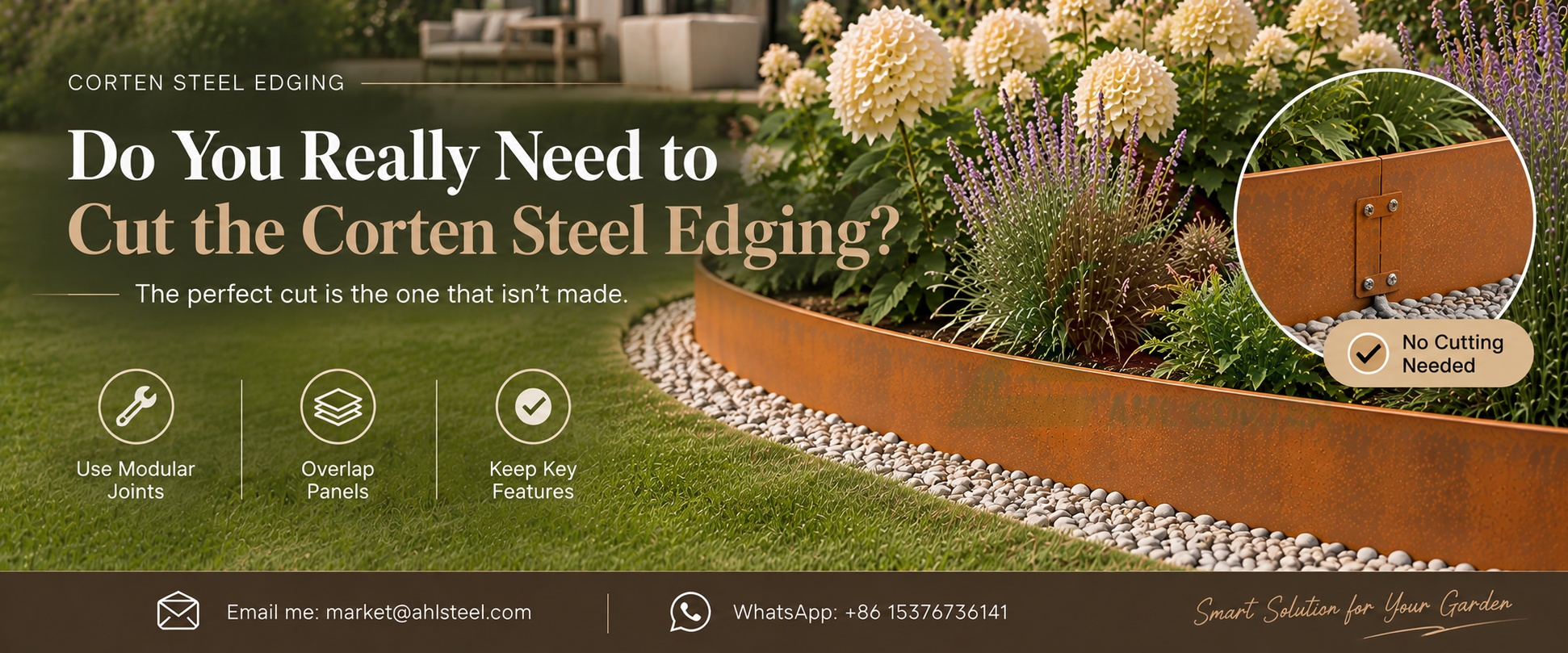
Rusted steel edging is typically designed with modular joints; the nominal length marked on each section does not equal the actual effective coverage length. Overlap areas, clips, and mounting holes will all take up some of the length.
Before installation, lay out the entire system to confirm the positions of all seams. Much of the excess material can be accommodated by overlapping panels, folding the ends, and fitting the metal garden bed edging tightly against the hard surface—without the need for cutting.
⚠️ Important Reminder: Do not cut away clips, mounting slots, or pre-drilled holes. These structural elements are critical for the stable anchoring of the edging; cutting them away can lead to loosening or tilting.
Want the Latest Catalog for Corten Steel Edgings? Contact Us!
What Tools Can Cut Rusted Steel Edging?
When selecting tools, prioritize the thickness and surface condition of the sheet material rather than focusing on cutting speed.
- Hand-held Hacksaw: Suitable for minor adjustments and thin corten steel garden edging. The advantage is low heat generation, which minimizes the risk of scorching the surrounding rust layer; the disadvantage is low efficiency, requiring patience to sand down burrs.
- Angle Grinder + Metal Cutting Disc: Most commonly used on construction sites, suitable for quick cutting. Risks include high temperatures and sparks, which can easily scorch the pre-rusted layer; the direction of the sparks must be strictly controlled.
- Factory Laser Cutting: For bulk projects, curved rusted steel edging, and gardens requiring high visual consistency, prioritize factory-prefabricated cutting. The heat-affected zone is minimal, the cut is smooth, and deburring is completed at the factory.
For edging with very slight curves, on-site cutting and bending is not recommended; prioritize factory pre-bending to avoid surface tearing or peeling.
How to Prepare the Edging Without Scratching the Visible Surface
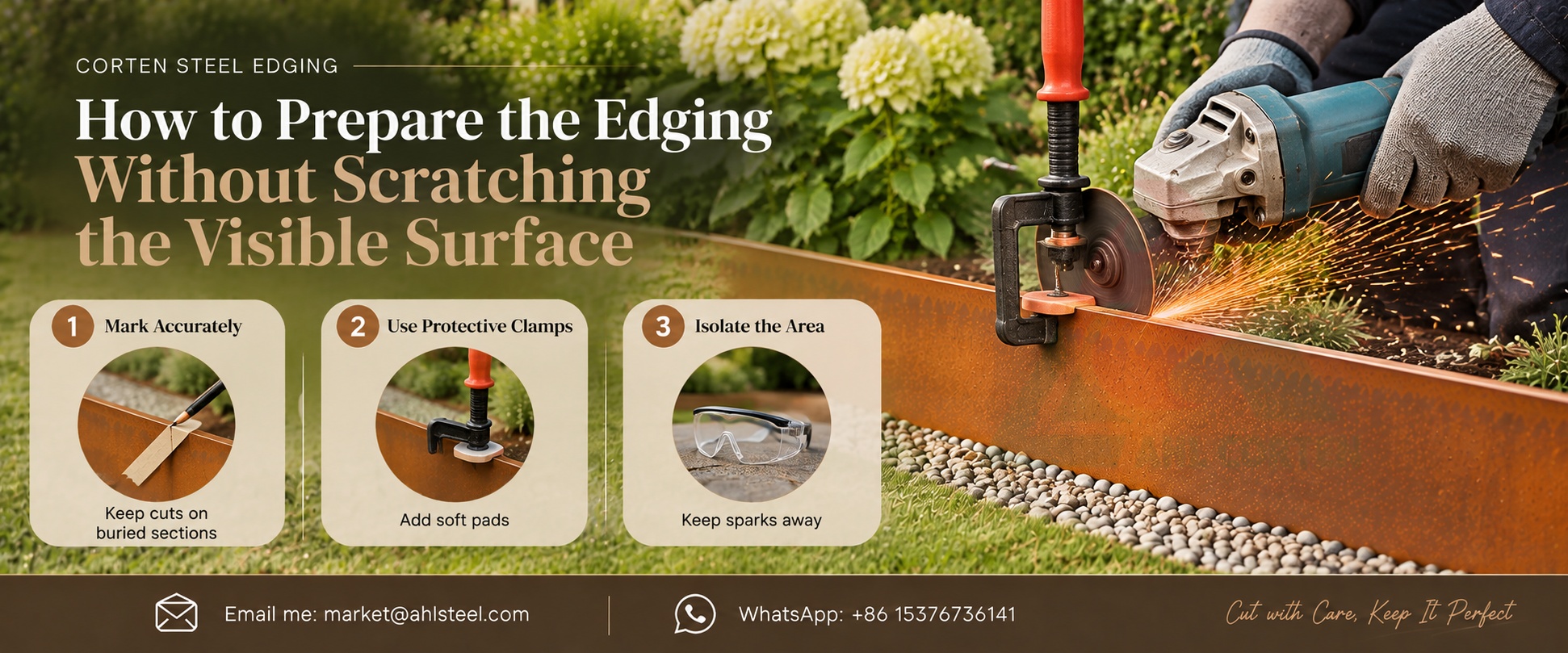
1. Mark Accurately to Distinguish Between Visible Surfaces and Buried Sections
Before marking, determine which side will be the exposed, visible surface and which part will be buried in the ground. Plan the cut lines to run primarily through the buried areas to minimize exposed cut edges.
Use low-residue masking tape when marking; do not repeatedly write directly on the rusted surface to avoid leaving permanent marks. First, lay out the pieces on-site to confirm dimensions before marking the lines.
2. Take Precautions When Clamping
Clamps pressed directly against the rusted surface can easily leave dents or scratch the oxide layer.
Place soft rubber pads between the clamps and the slab, and prioritize clamping the side that will be buried in the ground or the back side to avoid the front decorative surface. Ensure the slab is securely fastened; cutting by hand can cause vibration and slippage, which may scratch large areas of the rusted surface.
3. Isolate the Surrounding Area
If sparks or metal debris land on stone, plants, or paved surfaces, they will form stubborn rust stains when exposed to water.
Clear flammable dry grass from the cutting area and direct sparks away from finished surfaces, greenery, and glass windows. Also, wear safety goggles, ear muffs, and a face shield, and do not cut directly inside a trench.
Want the Latest Catalog for Rusted Steel Edgings? Contact Us!
How to Cut Corten Steel Edging While Minimizing Surface Damage
Cutting rusted metal landscape edging may be necessary when adjusting section lengths, fitting garden corners or completing a custom landscape layout. However, an incorrect cutting method can cause unnecessary scratches, rough edges, deformation or damage to the existing surface finish.
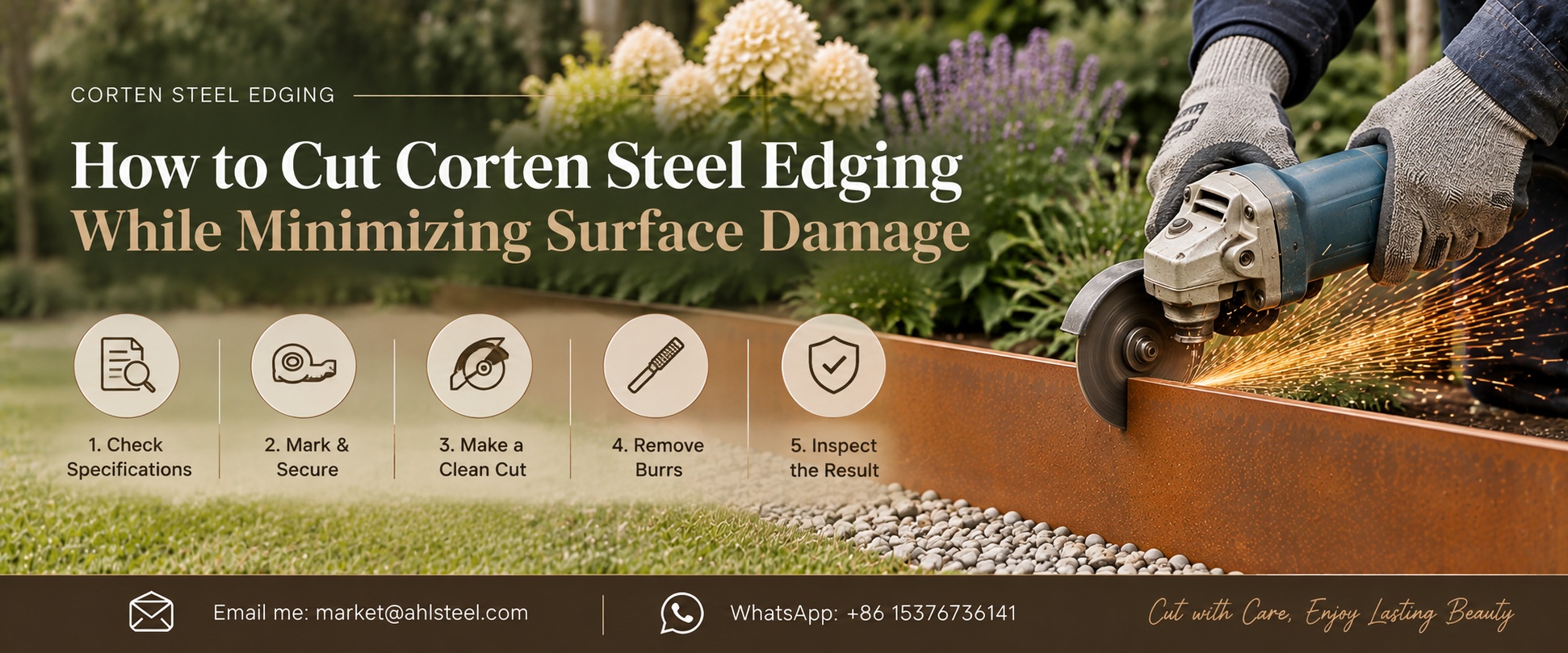
Before starting, check the product specifications and confirm that on-site cutting is permitted. The following steps explain how to prepare the edging, make a controlled cut and inspect the finished section while minimizing surface damage.
Step 1 — Confirm the Material and Manufacturer’s Instructions
Before cutting, identify the exact material and surface condition of your Corten steel edging.
Not all products described as steel garden edging have the same surface treatment. Some are supplied as bare weathering steel, while others may have additional paint, a protective coating or a surface sealer.
Check the following details:
Whether the manufacturer permits on-site cutting.
Whether the edging has a coating, sealant or other surface treatment.
Whether cutting affects the product warranty or installation requirements.
Whether special instructions apply to exposed edges or connection points.
If the rusted metal edging is part of a pre-formed or specially finished system, confirm the recommended cutting method with the supplier before making modifications.
This first check helps prevent unnecessary damage and ensures that the finished section remains compatible with the original installation system.
Step 2 — Mark and Secure the Section
Accurate measurement and stable positioning are essential for a clean cut.
Measure the required length carefully and mark the cutting line clearly. Check the measurement again before cutting, particularly if the edging needs to fit between an existing section, a corner or a fixed landscape feature.
Next, secure the workpiece on a stable support.
Use suitable clamps to prevent the rusted steel garden edging from moving.
Support the section being removed so it does not drop or bend during cutting.
Keep the cutting area clear of loose materials and obstructions.
Make sure the edging is supported without putting unnecessary pressure on the visible surface.
Avoid holding the metal section by hand while cutting. Movement, twisting or vibration can produce an uneven edge and may damage the surrounding weathered surface.
Step 3 — Make the Cut with a Suitable Tool
Choose a cutting tool and cutting accessory suitable for the material thickness and product specification. Follow the tool manufacturer’s instructions and use the recommended cutting method.
During cutting, aim for a controlled, steady operation rather than forcing the tool through the material.
Keep these points in mind:
Follow the recommended cutting speed and operating instructions.
Keep the cutting tool properly aligned with the marked line.
Avoid twisting or forcing the cutting disc during operation.
Never use the side of a cutting disc for grinding unless the disc is specifically designed for that purpose.
Minimize unnecessary contact between the tool and the visible weathered surface.
Cutting can generate sparks, hot metal fragments and sharp edges. Wear appropriate eye and face protection, hearing protection and other personal protective equipment required for the tool and working environment. Keep flammable materials away from the cutting area.
For larger quantities or precision requirements, consider asking the supplier to provide factory-cut sections instead of modifying every piece on-site.
Step 4 — Remove Burrs from the Cut Edge
After cutting, inspect the new edge for burrs, sharp corners and uneven areas.
Burr removal is important because freshly cut metal can have sharp projections that create a handling hazard or interfere with installation.
Depending on the product specifications, use an appropriate metal file or suitable abrasive to smooth the cut edge.
Focus on:
Removing sharp burrs along the cut line.
Smoothing dangerous corners and protruding metal.
Checking that the edge does not interfere with connectors or adjacent sections.
Maintaining as much of the surrounding weathered surface as possible.
Avoid aggressively grinding a large area around the cut. The goal is to make the edge safe and suitable for installation, not to remove the existing patina unnecessarily.
For bare rusty steel garden edging, exposed cut edges should be deburred and sharp areas dressed appropriately. Always follow the manufacturer’s instructions for the particular product.
Step 5 — Inspect the Surface and Connections
Once cutting and deburring are complete, inspect the modified section before installation.
Check for:
Sharp edges or remaining burrs.
Visible deformation around the cut.
Scratches or damage to the surrounding surface.
Damage to nearby connectors, fixing holes or other installation features.
Correct dimensions and compatibility with adjoining sections.
Clean away cutting dust, metal fragments and other process residues using a method suitable for the product’s surface condition.
If the edging has a coating or sealer, follow the manufacturer’s repair instructions for any affected areas. Do not automatically apply a bare-steel treatment method to a coated product.
Finally, check that the modified section still fits the planned layout and that its connection points remain suitable for installation.
Want the Latest Price for Rusted Steel Edgings? Contact Us!
Does Corten Steel Cut Edging Need Painting or Sealing?
Many landscaping contractors apply anti-rust paint directly to cut edges, which is a common misconception.
– Raw, Uncoated Weathering Steel: There is no need to actively paint or seal the edges. When fresh cut edges are exposed to an outdoor environment with alternating wet and dry conditions, they will gradually develop a natural rust layer that matches the surrounding surface. Simply deburr the edges and keep them clean.
– Pre-rusted sealed type: The cut edges are exposed new steel, so there will be a noticeable color difference compared to the existing rusted surface. If aesthetics are a priority, use the manufacturer’s recommended touch-up rust-accelerating agent; do not use ordinary zinc-rich primer indiscriminately.
– Rust-Simulation Coated Version: The base material is not weathering steel; cut edges must be sealed with a rust-preventive coating. Otherwise, rust will form rapidly, causing blistering and coating peeling.
Additionally, be prepared for the following: New cut edges will not immediately match the color of the existing rusted surface exactly. The rate of oxidation and color change depends on local humidity, rainfall, and ventilation conditions; there is no fixed timeline for this process. For projects with extremely high aesthetic standards, prioritize factory prefabrication.
Want the Latest Price for Rusted Steel Edgings? Contact Us!
Common Cutting Mistakes That Can Ruin the Weathering Steel Surface
- Judging the material solely by appearance and treating coated steel as weathering steel.
- Cutting directly without a pre-laid-out plan, thereby cutting through clips and mounting holes.
- Clamping without soft padding, allowing the clamps to press directly against the decorative rusted surface.
- Excessive sanding—grinding large areas of the original rust layer to match the color.
- Directing sparks toward stone or paving, leaving permanent rust stains.
- Blindly applying anti-rust paint, which interrupts the natural rusting process of weathering steel.
- Failing to deburr after cutting, leading to water accumulation and abnormal corrosion later on.
Want the Latest Price for Rusted Steel Edgings? Contact Us!
On-Site Cutting vs. Factory Prefabrication: How to Choose
– Only minor adjustments are needed: Standardize on-site cutting (provided the manufacturer permits it), ensuring proper protection and deburring.
– Projects with multiple sections of uniform length, such as commercial landscape projects: Prioritize factory cutting to fixed lengths, as dimensional tolerances are controllable and all cut edges are uniformly deburred.
– Small-radius curves and corner designs: Use factory pre-bending combined with laser cutting; achieving smooth curves on-site is difficult and can easily tear the rust layer.
– High-end gardens and pre-rusted finished products with strict aesthetic requirements: Process as much as possible in the factory; limit on-site work to assembly only.
Custom Pre-Cut Corten Steel Edging to Reduce On-Site Cutting Hassles
If you want to avoid the risks of rust layer damage and color discrepancies caused by on-site cutting, you can opt for a fixed-length processing service.
When placing your order, provide garden layout drawings and on-site photos, specifying: border height, thickness, total length, number of corners, straight/curved sections, surface finish (bare steel/pre-rusted coating), and matching connectors.
The factory can complete laser cutting, pre-bending of corners, deburring, and pre-rusting treatment, then deliver the components to the site for direct assembly, ensuring the rust layer remains as intact and uniform as possible.
Want the Latest Price for Rusted Steel Edgings? Contact Us!
FAQs About Cutting Corten Steel Edging
1. Can Corten Metal Edging Be Cut With an Angle Grinder?
Yes, AHL states that an angle grinder with a steel-cutting disc can be used for cutting. Use appropriate personal protection and follow the manufacturer’s safety guidance.
2. Can I Use a Hacksaw to Shorten Metal Garden Edging?
AHL lists angle grinders, abrasive cutting wheels, metal chop saws and band saws among suitable cutting tools. Confirm the recommended method for the specific edging thickness and profile before starting.
3. Will Cutting Damage the Existing Patina?
Cutting creates a fresh edge and may affect the local surface. AHL notes that cut edges, welds, scratches and damaged areas can still oxidise, including on pre-rusted products.
4. Does Bare Corten Steel Cut Edges Need Painting?
Not automatically. AHL states that a freshly cut edge will naturally weather and develop the same protective patina once exposed outdoors. Confirm whether the supplier recommends any edge treatment for the specific product and exposure.
5. How Do I Remove Sharp Burrs Without Grinding the Whole Surface?
Use a file, flap disc or similar local deburring method on the cut edge only. AHL recommends removing burrs and chamfering edges after cutting, while its finishing guidance advises avoiding removal of intact protective patina.
6. Will the Cut Edge Eventually Match the Surrounding Colour?
It can weather toward a similar appearance over time, but an immediate match should not be promised. Patina development depends on exposure conditions and the product’s surface treatment.
7. Can I Cut Through a Connector or Fixing Slot?
Avoid cutting through connectors or fixing slots unless the manufacturer confirms that the resulting configuration remains structurally sound. Check the connection details before making the cut.
8. Can I Avoid Cutting By Overlapping the Edging?
Only if the product system is designed for overlap. Do not assume that overlapping sections will provide a secure or visually acceptable joint without supplier confirmation.
9. Can I Order Edging Pre-Cut to My Layout?
Yes, subject to confirmation. AHL states that factory pre-cutting to non-standard dimensions is supported, and that custom manufacturing can include laser cutting, bending and precision forming.
Ready to Choose the Perfect Corten Steel Edging for Your Outdoor Space?
Prefer to avoid on-site cutting that could damage the beautiful rusted finish? Simply send us your garden layout plans and dimensions, and we will provide custom-cut, pre-bent corten steel edging—complete with all necessary connectors and fixing hardware. It arrives ready for immediate installation, ensuring a consistent, professional look for your finished project.
Want the Latest Price for Rusted Steel Edgings? Contact Us!