Corten steel planters of different thicknesses look almost identical. However, once filled with soil, their performance can vary dramatically.
Some planters have straight, sturdy side panels that remain distortion-free even after long-term use; others may gradually bulge outward and warp under the pressure of wet soil.
This raises a very practical question for buyers: Do metal planter boxes for private gardens require the same panel thickness as those used on commercial streets, rooftops, or around large trees? When comparing prices, focusing solely on unit price or panel thickness can easily lead to overlooking critical structural details.
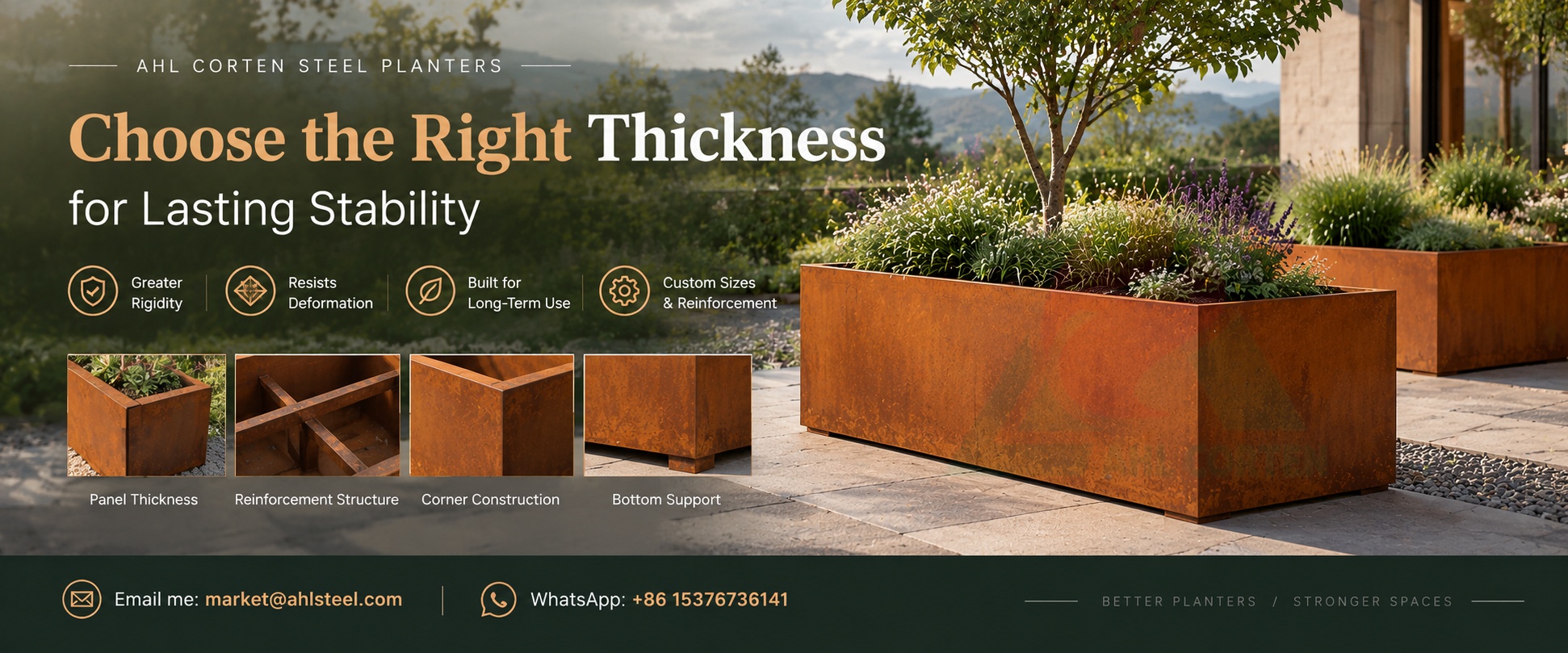
Key Conclusion: Panel thickness directly affects the planter’s rigidity and resistance to deformation, but **thickness does not equate to overall strength**.
The planter’s external dimensions, effective planting depth, reinforcement structure, corner construction, and bottom support all collectively determine the finished product’s long-term stability.
Manufacturers’ structural specifications also repeatedly emphasize that reinforcement is key to maintaining the corten metal planters’ shape. This article will explain how different thicknesses affect corten steel garden planters.
Want the Latest Catalog for Corten Steel Planters? Contact Us!
How Does Corten Steel Thickness Affect Planter Strength?
1. Thicker Panels Offer Greater Resistance to Bending
Once a corten metal planter is filled with soil, the side panels are subjected to lateral thrust from the soil pushing outward. The taller the planter and the longer the unsupported span of the side panels, the more pronounced this thrust becomes; after rain, the growing medium absorbs water and becomes heavier, further increasing the pressure.
Increasing the sheet thickness generally improves bending stiffness. Given the same dimensions and structure, thicker side panels are less prone to outward bending, allowing the corten steel raised planters’ profile to remain straight over the long term.
It is important to dispel a common misconception: while thicker sheets enhance the cross-sectional bending resistance, **they do not automatically alter the steel grade or material strength**. When purchasing, both the sheet thickness and the weathering steel specifications must be verified.
2. Wall Height and Unsupported Span Alter Load Conditions
When selecting materials for tall planters, one cannot simply apply the same logic used for small decorative flower boxes.
The taller the walls, the greater the earth pressure borne by the lower part of the planter; for long, rectangular planters, the lack of support in the middle of the side panels results in a large unsupported span, making them more prone to deformation.
It is also important to distinguish between **total external height** and **effective planting depth**. Some planters appear very tall due to the height added by the base, flanges, and legs, but the actual soil-filling depth is quite shallow. The structural load-bearing conditions and design solutions for these two dimensions are completely different.
Reinforcing components can reduce the unsupported span of the side panels. Vertical stiffeners and horizontal tie rods are common methods manufacturers use to control bulging in long, narrow side panels.
3. Thickness Alone Does Not Guarantee a Strong Planter
A planter made of thin panels, when paired with properly designed flanges, stiffeners, and bottom supports, may actually perform better structurally than a planter made of thick panels with a long unsupported span and virtually no reinforcement.
A sound design approach involves coordinating panel thickness with the reinforcement structure.
Therefore, purchasers should not judge load-bearing capacity and durability based solely on thickness. In the absence of project-specific structural calculation data, one cannot simply assume that a particular thickness is inherently superior to another.
The following section will guide you through a comprehensive comparison of specifications: external dimensions, planting depth, reinforcement schemes, bottom construction, drainage methods, and installation environments.
2 mm vs. 3 mm vs. 4–5 mm Corten Steel Planters
| Thickness |
Preliminary Selection Direction |
Main Buyer Focus |
Details to Verify |
What Not to Promise |
| 2 mm |
Small, shallow or properly reinforced planters |
Controlling weight and material budget |
Long-side span, folded edges and reinforcement structure |
Suitable for all dimensions |
| 3 mm |
Medium to large planters requiring higher stiffness |
Balancing thickness, weight and structural needs |
Planting depth, stiffeners and base support |
Automatically sufficient for commercial projects |
| 4–5 mm |
Deep, heavy-duty or large custom planters |
Providing an option for higher loads or special structures |
Overall structure, transport, installation and support conditions |
No stiffeners needed or never deforms |
The categories above are for initial communication only; they are not a universal engineering standard. Public product information includes finished planters in 2–3 mm steel, as well as selection guidance combining 3–5 mm plate with reinforcement for taller or deeper planters. The appropriate specification must be confirmed against the specific model and project conditions.
5 Factors to Consider When Choosing Corten Steel Planter Thickness
1. Planter Dimensions
The taller or wider a custom steel planter, the more important panel stiffness and structural support become. Long planters with large unsupported faces may require different detailing from compact square or round designs.
Review the relationship between panel size, plate thickness and reinforcement. A drawing is often the clearest way to assess whether the design is appropriate.
2. Soil Weight and Lateral Pressure
Wet soil, planting media and plant roots all add load to a planter. The filling height, moisture conditions and type of planting medium can influence the pressure acting on the panels.
A planter designed for shallow decorative planting may not be suitable for deep-rooted plants or consistently saturated soil. Confirm the intended planting use before selecting a specification.
3. Reinforcement and Edge Design
Folded edges, stiffeners, internal supports and corner connections can improve stiffness and shape retention. In some designs, targeted reinforcement may be more effective than simply increasing plate thickness.
Ask how the corners are formed and how the base is supported. These construction details affect both appearance and long-term structural behaviour.
4. Outdoor Environment and Drainage
Corten steel develops its rust-coloured surface through natural weathering. Drainage and water management remain important, particularly where planters sit on paving or other sensitive surfaces.
Confirm drainage openings, base detailing and any recommendations for protecting adjacent materials. Avoid allowing water to pool inside or beneath the planter.
5. Transportation and Installation
Thicker steel usually increases product weight and material consumption. This can affect handling, packaging, freight costs and installation planning.
For B2B buyers, request unit weight, packed dimensions and loading information. These details help calculate the true cost of different thickness options.
Can Reinforcement Improve Strength Without Simply Adding More Steel Thickness?
1. Folded Rims and Reinforced Edges
Folded rims and reinforced edges are more than just decorative details.
Corten steel flower boxes can enhance the rigidity of the panel edges, helping the box maintain its shape better when compressed by soil; wider folded rims also make handling easier and give the finished product a more refined appearance.
However, the structural value of the folded rims depends on the folding method, sheet thickness, and how they connect to the rest of the box.
When comparing prices, be sure to ask: Is this rolled edge merely a decorative feature, or is it part of the overall load-bearing structure?
2. Internal Ribs and Cross-Bracing
Internal ribs and cross-bracing can reduce the unsupported span of the side panels. Vertical stiffeners and horizontal tie members are both proven methods for controlling bulging in long side panels.
This explains why two planters with identical external dimensions can exhibit significant differences in load-bearing capacity and deformation behavior due to variations in their internal structures.
When purchasing, proactively request reinforcement layout drawings or actual photos; do not rely solely on external renderings for comparison.
3. Reinforced Corners and Base Supports
Corner joints, base supports, and side panels collectively form a structural system. Sturdy corners can transfer soil pressure; base supports determine whether the planter can stably bear the combined weight of the planter itself, the soil, and the plants.
There is no one-size-fits-all reinforcement solution. The appropriate design must be customized based on the planter’s size, shape, planting depth, and installation site.
FAQs About Corten Steel Planter Thickness
1. How Thick Should a Corten Steel Planter Be?
There is no universal thickness for every planter. The correct specification depends on the planter’s dimensions, soil depth, panel span, reinforcement, base design and intended use. Compare the complete structural specifications rather than selecting thickness alone.
2. Is 2 Mm Corten Steel Thick Enough for a Planter?
A 2 mm plate may be suitable for small, shallow or properly reinforced planters, but it should not be assumed suitable for every size or planting load. Confirm the panel spans, reinforcement and intended use before ordering.
3. Does a 3mm Planter Still Need Internal Reinforcement?
It can. A 3mm plate may provide useful stiffness, but internal reinforcement may still be needed for long side panels, tall walls or deeper planting areas. The requirement depends on the complete design, not thickness alone.
4. Why Do Long Steel Planters Bow Outward?
Long side panels have a greater unsupported span and are pushed outward by lateral pressure from soil and moisture. Reinforcement, folded edges and an appropriate base design can help control this movement.
5. Should the Base Plate Be the Same Thickness as the Sidewalls?
Not necessarily. The base plate, feet and support arrangement should be designed for the steel garden pot’s overall load path. Confirm the base specification separately rather than assuming it matches the sidewall thickness.
6. Do Large Tree Planters Need Thicker Steel?
Large tree planters may require a more robust specification because of their size, soil volume and load conditions. However, the appropriate solution depends on the full structural design, including reinforcement, base support and installation conditions.
7. Can Reinforcement Reduce the Need for Thicker Panels?
Reinforcement can improve stiffness and reduce unsupported panel spans, so it may allow a more efficient overall design. Whether it reduces the required thickness depends on the planter’s dimensions, loads and structural configuration.
Find the Right Corten Steel Planter for Your Needs
Corten steel planter strength depends on the relationship between plate thickness, planter dimensions, reinforcement and structural design. The best specification is the one matched to the actual planting load, site conditions and project requirements.
Contact AHL with your planter dimensions, intended planting use and project drawings. Our team can help confirm suitable thickness options, structural details and customization possibilities, then provide a quotation based on your required quantities.