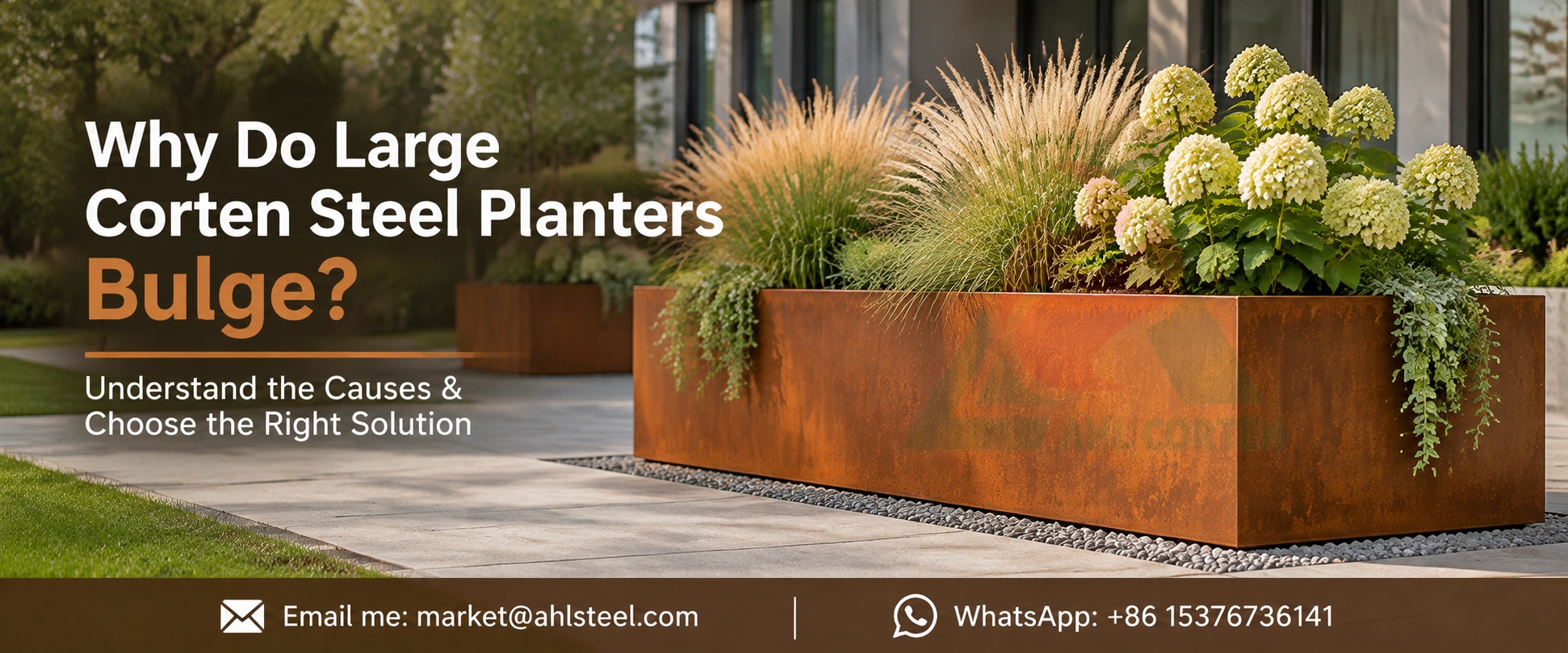
Bulging of the side walls of large corten steel planters is most often caused by a mismatch between soil lateral pressure, unsupported spans of the panels, and structural design. Long, narrow planters, tall commercial planters, and designs with large unsupported areas on the side panels are most prone to this type of deformation.
Bulging is not an inherent defect of weathering steel itself. The weight of the soil, standing water, panel thickness, internal reinforcement, welding techniques, and drainage design all affect the long-term stability of the planter.
Landscape designers, general contractors, and B2B buyers should thoroughly evaluate the entire structure before placing an order, rather than focusing solely on the appearance of the rusted surface.
When selecting large planters, a comprehensive assessment must be made based on dimensions, soil depth, reinforcement plans, and installation conditions; procurement should not be based solely on appearance or style.
Want the Latest Catalog for Corten Steel Planters? Contact Us!
Why Do Large Corten Steel Planters Bulge?
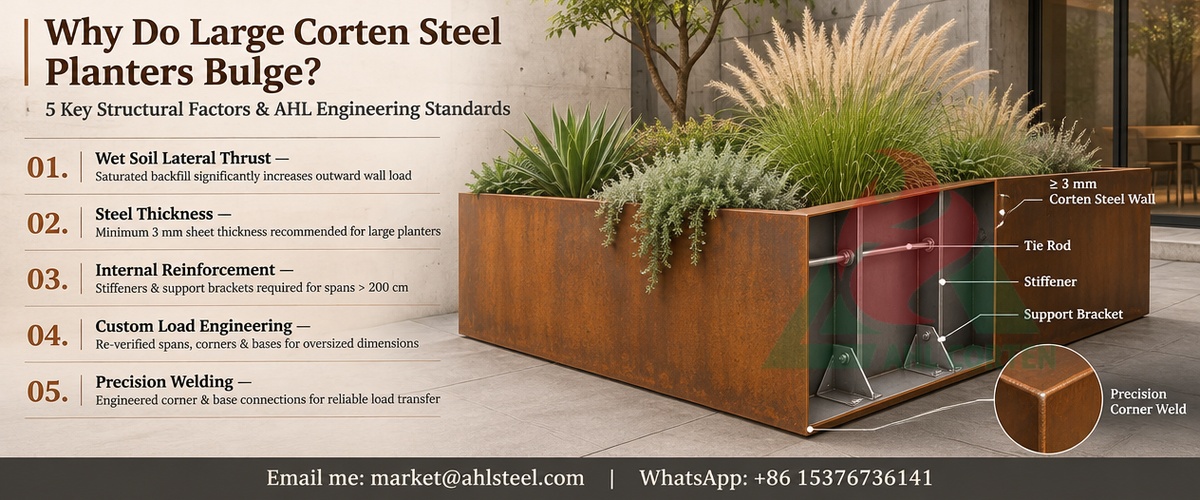
1. Excessive Pressure from Wet Soil
Soil continuously exerts lateral thrust against the side walls of the commercial landscaping planters. When the soil becomes saturated with rainwater or irrigation water, its weight and lateral pressure increase significantly, placing a greater load on the side panels.
Planters that are tall, have long individual sections, or lack support for the side panels are at the highest risk. The actual magnitude of the pressure is directly related to soil type, moisture content, backfill depth, and planter design.
2. Insufficient Steel Thickness
The thicker the sheet metal, the greater its rigidity and the better its resistance to deformation. According to AHL’s design standards, a minimum sheet thickness of 3 mm is recommended for large planting boxes; thinner sheets are more prone to deformation under soil pressure.
However, thickness is only one aspect of structural integrity; it cannot alone guarantee resistance to deformation. Thin sheet metal, when combined with proper reinforcement, may perform better than a box made of thick sheet metal that has a structurally weak design or poorly engineered connections.
3. Lack of Internal Reinforcement
Large, unsupported side panels are most prone to outward bending and bulging. Internal support rods, stiffeners, and support brackets can distribute the load and reduce the effective load-bearing span of the side panels.
AHL Special Note: Long corten steel planter troughs exceeding 200 cm in length must be equipped with a sturdy internal support system that relies on reinforced brackets and stiffeners to distribute pressure.
4. Oversized Planter Dimensions
As length, height, and width increase, the structural load requirements change accordingly. Even with the same sheet thickness, the reinforcement schemes for long planters and tall, cubic planters are completely different.
Do not simply scale up small planters proportionally. The side panel spans, corners, bases, and support methods all require re-verification.
5. Poor Welding and Structural Connections
Welds, corners, and base locations are critical points for load transfer. Even if the sheet metal itself meets specifications, poor welding design and weak welds can create local failure points.
When purchasing, request drawings to verify weld locations, corner construction, and reinforcement details. The rust-resistant properties of weathering steel cannot compensate for defects in structural connections.
Want the Latest Price for Corten Steel Planters? Contact Us!
How Does Steel Thickness Affect Planter Strength?
1. Thin Steel vs. Thick Steel for Large Planters
Thin steel sheets are lightweight and have lower material costs, but they lack sufficient rigidity for the same span. Thick steel sheets offer higher rigidity but have greater dead weight, resulting in higher material costs.
AHL offers 2mm-thick planter boxes, but according to its design guidelines, 3mm and thicker are more suitable for large-scale projects. These are merely optional specifications and do not constitute universal standards for all corten steel raised planters.
2. Choosing the Right Thickness for Planter Dimensions
Suppliers need to provide thickness recommendations based on the rusty metal planter’s length, width, height, and soil depth. For long, narrow planters with very wide spans, simply increasing the steel plate thickness is often insufficient.
When submitting specifications, clearly state the soil depth, soil type, installation environment, and ground-anchoring method to help suppliers determine the appropriate thickness and reinforcement plan.
3. Why Thicker Steel Alone May Not Prevent Bulging
Thicker side panels do not eliminate the lateral loads imposed by soil. If the side panels span a large distance without internal bracing, they will still bend outward under prolonged pressure.
The most reliable solution is: appropriate thickness + internal bracing + sturdy corners + a stable base. Panel thickness and internal bracing are two complementary measures; one cannot be chosen over the other.
Want the Latest Price for Ruste Steel Planters? Contact Us!
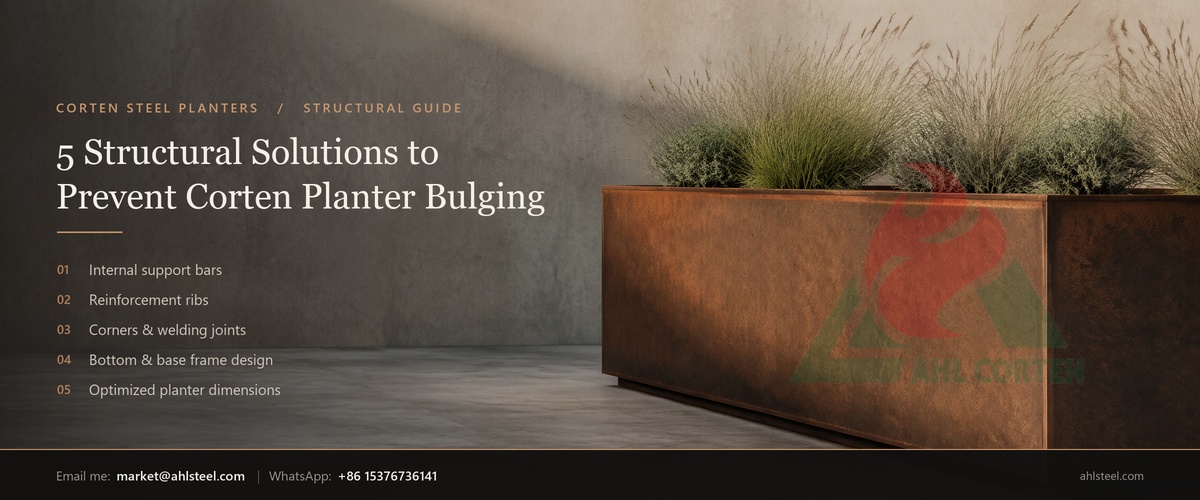
5 Structural Solutions to Prevent Corten Planter Bulging
1. Add Internal Support Bars
Internal tie rods and support members can shorten the effective load-bearing span of long side panels. The support structure must match the planter’s design and cannot be added arbitrarily as a generic accessory.
Confirm the support locations and whether they will affect soil depth, drainage, or future maintenance. The support structure must not create dead zones where water accumulates, and must not block drainage channels.
2. Install Reinforcement Ribs
Reinforcement ribs can significantly increase the rigidity of large side panels and are particularly suitable for long, narrow troughs and tall commercial planters. Request drawings before placing an order to confirm the spacing, orientation, and welding method of the ribs.
Reinforcement ribs and support brackets are the core components for distributing pressure on the side panels.
3. Reinforce Corners and Welding Joints
Corners and welds are stress concentration points. Corner construction must be tailored to the sheet thickness, container dimensions, and anticipated loads.
Confirm whether the welds are continuous or intermittent, their locations, and the quality inspection methods. Do not judge welding quality based solely on photos of the finished product.
4. Improve Bottom and Frame Design
The base frame must support the full weight of the container when filled with soil and distribute the load evenly to the ground. If the base is weak, the container will still deform even if the side panels are properly reinforced.
Confirm the base frame, support legs, lifting points, and ground support plan. For large containers, also evaluate the load-bearing capacity of the installation site and foundation simultaneously.
5. Optimize Planter Dimensions
Sometimes, the optimal solution is to adjust the planter’s proportions. Reducing the span of unsupported side panels, dividing excessively long sections into modular units, and decreasing the soil depth can all help reduce structural stress.
Discuss the planting plan before finalizing the dimensions. Large planters should serve the landscape design, not create intractable structural challenges.
Want to Get Your Own Rusted Steel Planter? Click to Customize! Want the Latest Price for Rusted Steel Planters? Contact Us!
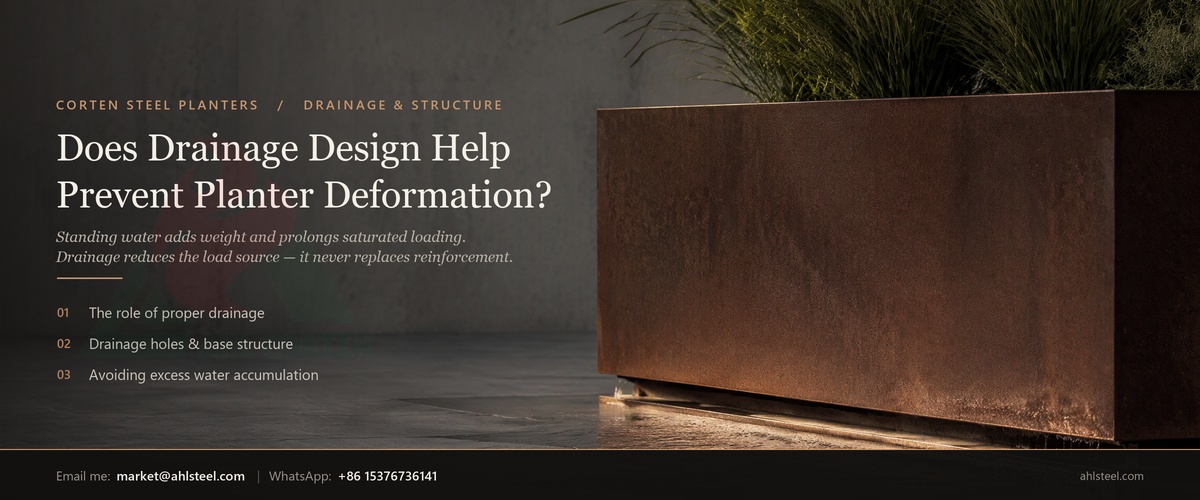
Does Drainage Design Help Prevent Planter Deformation?
1. The Role of Proper Drainage
Poor drainage can cause water to accumulate inside the custom rectangular steel planters. Standing water continuously increases the weight of the soil, prolongs the duration of saturated loading, and increases the load on the sidewalls and base.
Drainage cannot replace structural reinforcement; it can only reduce the source of load while protecting the plant roots.
2. Drainage Holes and Base Structure
AHL recommends incorporating drainage holes and installing a drainage layer at the bottom to accelerate water flow and reduce soil loss. For large planters, water accumulation at the bottom and resulting bottom compression are key risk factors.
Confirm the size, number, and location of drainage holes, and verify whether the planter is elevated to prevent contact with standing water on the ground. Do not assume that simply having drainage holes guarantees reliable drainage.
3. Avoid Excessive Water Accumulation
Assess the irrigation system, local rainfall levels, and surrounding ground elevation. Rainwater and irrigation water must drain smoothly and must not accumulate at the bottom of the large metal planter manufacturer.
For commercial projects, incorporate drainage maintenance into the long-term maintenance plan. Clogged drainage holes can simultaneously affect plant survival and the structural stability of the planter.
Want to Create a Unique Backyard Metal Planter? Contact Us!
How to Choose a Durable Large Corten Steel Planter
1. Check Material Specifications and Steel Thickness
Request the material grade, sheet thickness, and technical documentation. Do not rely solely on the term “weathering steel” to determine specifications.
Confirm that the thickness of the side panels, bottom panel, and reinforcing components is consistent. For large planters, sheet thickness may be designed to vary by section.
2. Inspect Internal Reinforcement and Welding Quality
Request drawings to examine the layout of internal supports, stiffeners, corners, and welds. Confirm the weld inspection process.
AHL’s guidelines emphasize that an internal support system is essential for planters longer than 200 cm. Drawings serve as the basis for project review; do not assume that all models come with the same level of reinforcement.
3. Consider Planter Size and Intended Planting Application
Confirm the depth of soil cover, plant types, soil composition, and irrigation methods. These factors directly determine the large metal planter manufacturer’s load-bearing capacity and drainage requirements.
For planting large trees or long-term commercial landscaping, a specialized structural review is mandatory; do not simply select standard catalog dimensions.
Request Technical Drawings Before Ordering
Before placing a bulk order, request the following from the supplier:
- Overall dimensions and tolerances
- Panel thicknesses for each section
- Internal reinforcement layout drawings
- Corner and weld details
- Drainage solutions
- Base support plan
- Lifting and packaging instructions
- Warranty terms and scope of liability
Drawings facilitate side-by-side comparison of quotes from multiple suppliers and reduce misunderstandings during fabrication.
Want to Create a Unique Backyard Metal Planter? Contact Us!
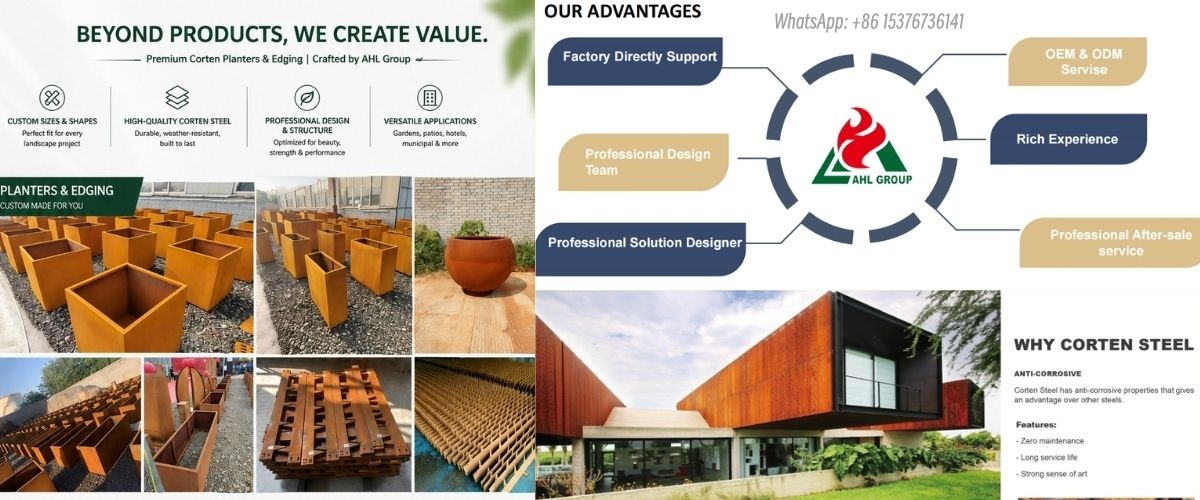
Why Choose AHL’s Large Weathering Steel Planters
1. Wide Range of Sizes
AHL offers both standard and custom rusted steel planters in a variety of shapes, including square designs, to easily accommodate different sites and planting plans.
2. Flexible Thickness Options
Our product lineup includes 2mm models, while we recommend 3mm or thicker sheets for large-scale projects. Thickness is determined on a case-by-case basis according to the project’s specific requirements, rather than applying a one-size-fits-all standard.
3. Structural Customization Support
AHL can design internal supports, stiffeners, and bracket systems for long, trough-shaped planters; these can serve as key points for discussing custom solutions.
4. Custom Fabrication Capabilities
We support custom dimensions and provide design coordination services. We confirm in advance whether proposed modifications are feasible and assess their impact on delivery times, costs, and warranties.
5. B2B Supply and Support Services
For commercial orders, we can provide itemized quotes covering: main materials, fabrication, reinforcement components, packaging, and logistics. Please confirm that production will be based on drawings and technical specifications before placing an order.
Want to Create a Unique Backyard Corten Planter? Contact Us!
FAQ
1. Why Do Large Metal Planters Bulge After Being Filled With Soil?
Soil lateral pressure—especially from wet soil—can cause unsupported side panels to bend outward. The final outcome is determined by the combination of the sheet’s span, thickness, reinforcement, and connection methods.
2. What Is the Most Suitable Sheet Thickness for Large Corten Steel Planters?
There is no universal thickness. AHL uses 3 mm as the minimum threshold for large planters; the final specification depends on dimensions, soil depth, and the reinforcement plan.
3. Do Large Rusted Steel Planters Require Internal Bracing?
Bracing is recommended in most cases, and it is especially important for long, slotted planters and those with wide-span side panels. For planters longer than 200 cm, internal bracing is essential.
4. Can Internal Struts Prevent Sidewall Bending?
Properly designed, integrally welded struts can reduce deformation, but they still require matching sheet thickness, reliable connections, and a stable base.
5. Does Water-Saturated Soil Increase Pressure On the Side Walls?
Yes. Wet soil exerts a higher load, so drainage and soil quality are just as important as structural design.
6. Can Drainage Holes Solve the Problem of Bulging?
Drainage holes reduce the additional load caused by standing water, but they cannot replace structural reinforcement. A comprehensive drainage and support plan must be confirmed.
7. Can Corten Steel Planters Be Customized With Reinforced Structures?
Yes, subject to technical review. AHL supports custom dimensions and structural solutions; reinforcement details must be confirmed in writing on drawings and in quotes.
Ready to Choose the Perfect Outdoor Corten Steel Planter for You?
To prevent bulging, a comprehensive solution is required: appropriate sheet thickness, internal reinforcement, reliable welding, proper dimensions, and effective drainage. Large corten steel raised planters are designed based on soil load and site conditions, not just appearance.
If you need large weathering steel planters for a landscaping project, contact AHL and provide the planter dimensions, soil depth, site conditions, and quantity required.
Request technical drawings, product specifications, and wholesale quotes, and confirm the sheet thickness, reinforcement layout, and drainage solution in writing before production begins.
Want to Create a Unique Backyard Corten Planter? Contact Us!