Many homeowners, landscape designers, and buyers assume that as long as a planter is labeled as having drainage holes, they can safely plant in it.
But that’s not the case. Drainage holes are just one component of the entire drainage system.
Effective drainage also depends on the structure of the base, the support legs, the lining material, and the type of surface on which the planter is placed. Even if drainage holes are provided, waterlogging will still occur if the outlets are blocked or poorly positioned.
The drainage requirements for rusty metal planter boxes placed directly on soil are completely different from those placed on concrete patios, balconies, or paved plazas.
Understanding these details can help you avoid problems such as root rot, frequent maintenance, and premature corrosion or damage to the planter boxes.
This article is intended for homeowners, landscape contractors, and wholesalers, and explains the core principles of drainage for corten steel planters, key inspection points, the selection of support accessories, and customization options.
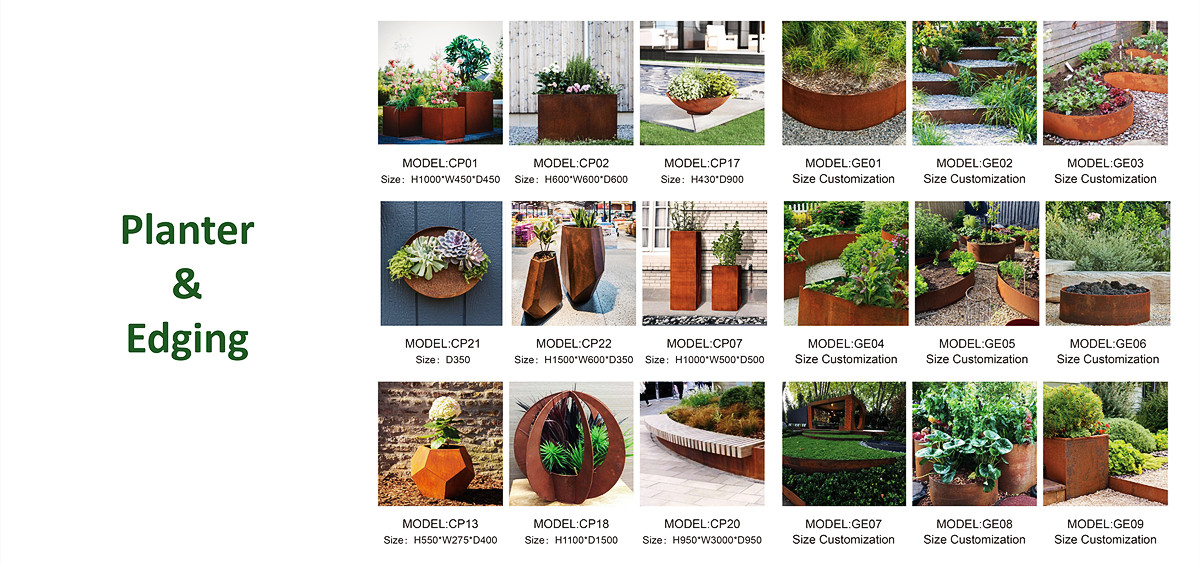
Want the Latest Catalog for Corten Steel Planters? Contact Us!
Do Corten Steel Planters Need Drainage Holes?
Not all styles of weathering steel planters feature the same drainage design; it’s important to first determine their intended use.
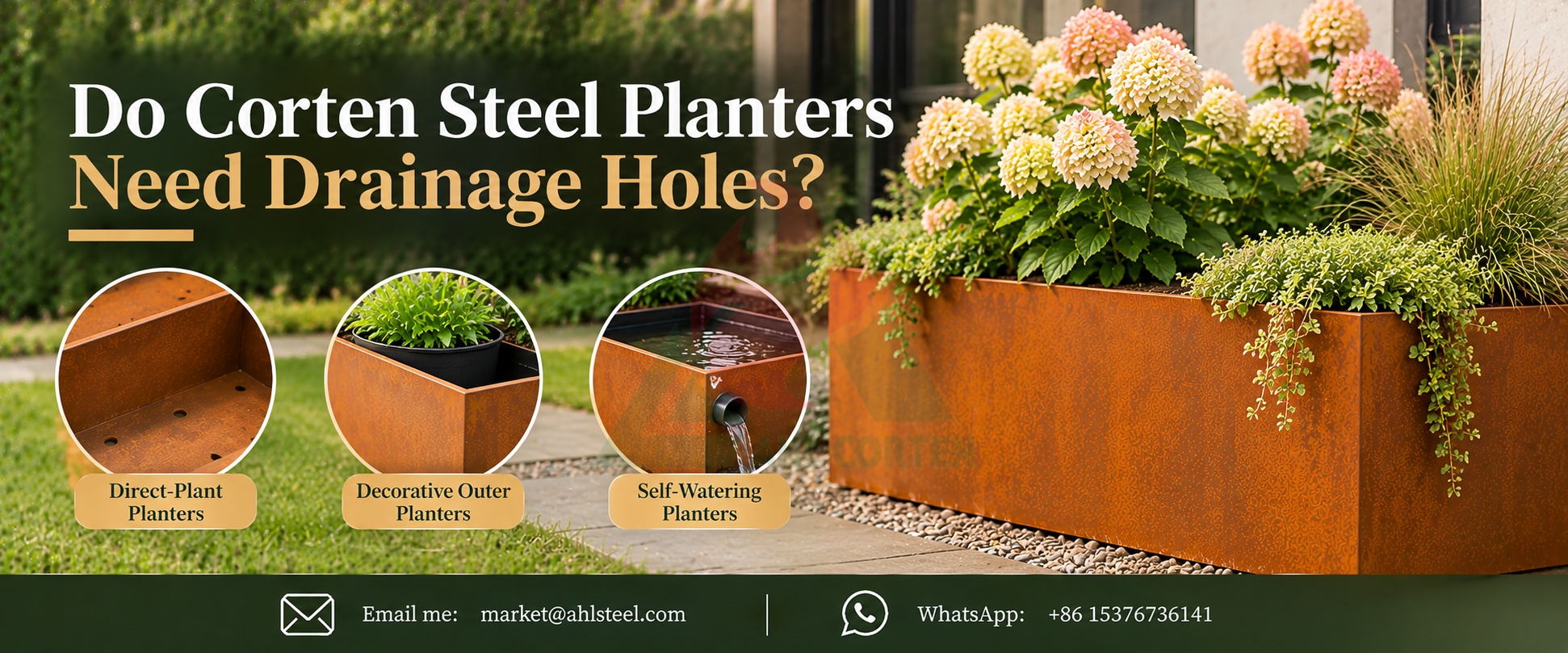
1. Direct-Plant Outdoor Containers
Weathering steel planters designed to have soil and plants placed directly inside the container almost always require reliable drainage.
Rainwater and irrigation water will remain in the growing medium, and excess moisture must be drained away. Prolonged waterlogging displaces oxygen from the soil pores, which can easily lead to root rot.
Drainage does not mean allowing the soil to dry out completely. Maintaining appropriate moisture levels requires a comprehensive balance of plant species, growing medium, planter depth, and watering frequency. Drought-tolerant plants and moisture-loving plants have very different moisture requirements.
2. Decorative Outer Planters and Open-Bottom Designs
Some corten metal planters serve only as decorative outer shells, with seedling pots placed inside—a “nested pot” configuration.
If the outer shell of this type is completely sealed, standing water draining from the inner pot will accumulate between the two layers, creating a similar risk of waterlogging.
Another type features an open-bottom design, where the planter sits directly on the soil, allowing water to seep directly into the ground; its drainage mechanism differs from that of models with a bottom plate and drainage holes. Before purchasing, confirm the intended usage method and do not confuse the two types.
3. Self-Watering Planters with Water Reservoirs
Self-watering planters with water reservoirs operate as independent systems. They rely on overflow holes to regulate water levels, which differs from the structure of conventional drainage planters; standard drainage solutions cannot be applied to them.
Want the Latest Catalog for Rusted Steel Planters? Contact Us!
Why Is Drainage Important for Plants and Steel Planters?
Drainage design serves two purposes: it ensures the health of plant roots and extends the service life of rusty metal planter boxes.
1. Ensuring a Healthy Environment for Root Growth
Plant roots require both water and oxygen. When the growing medium remains saturated for extended periods, the soil pores become filled with water, depriving the roots of oxygen and significantly increasing the risk of root rot and disease.
Many factors influence drainage effectiveness: plant habits, growing medium composition, local rainfall, planter dimensions, soil depth, and the number, diameter, and placement of drainage holes.
More drainage holes aren’t necessarily better; the hole configuration must be tailored to the planter’s specifications.
2. Preventing Premature Corrosion of Weathering Steel
Weathering steel relies on alternating wet and dry conditions to gradually form a stable, dense rust-colored passivation layer—the weathered texture that many people appreciate.
If water persists at the bottom of the planter and the steel remains immersed in a damp environment for an extended period, the stable rust layer cannot form properly. Localized corrosion will continue to develop, eventually leading to premature rust-through and leaks.
Note: Even a well-designed drainage system cannot completely prevent corrosion. Steel plate thickness, manufacturing processes, and on-site salt spray conditions also affect long-term durability. Drainage is merely a means of reducing the risk of accelerated corrosion.
What Drainage Features Should You Check Before Buying?
| Inspection Item |
Questions Buyers Should Confirm |
Purchasing Value |
| Drainage Hole Placement |
Can water flow toward the outlets, and are there any areas where water could collect? |
Confirms the drainage path, not just the presence of holes |
| Drainage Hole Quantity and Size |
Are the number and size of drainage holes appropriate for the specific planter dimensions and base-panel design? |
Avoids copying drainage specifications from other models without assessment |
| Feet or Base Supports |
Will sufficient clearance remain beneath the drainage holes for water to escape after installation? |
Reduces the likelihood of blocked outlets |
| Internal Liner or Protective Layer |
Does the liner or protective layer integrate correctly with the drainage holes and outlets? |
Helps prevent internal components from obstructing drainage |
| Cleaning and Inspection Access |
Can the drainage system be checked for visible blockages after installation? |
Makes ongoing maintenance easier |
| Drawings and Supporting Instructions |
Are installation drawings and instructions provided for the specific model? |
Allows key details to be checked before production |
Note: There are no standardized specifications for hole diameter, number of holes, or leg height applicable to all planters. Existing products include designs with adjustable drainage hole counts and sizes, as well as leg structures of varying heights; please refer to the specific model for details.
The Location of Drainage Holes Takes Precedence Over Their Number
The location of the holes is more critical than the number of holes.
If drainage holes are drilled in raised areas of the base plate, water pooled in low-lying areas cannot flow to the drainage outlets, and water will still accumulate in the planter.
For large, custom-shaped planters, be sure to review the base plate drainage layout drawings in advance.
There Is No Uniform Standard for Hole Diameter or Number of Holes
The drainage capacity varies significantly between small square planters and large commercial rectangular planting beds.
Do not simply copy the drainage hole layout from other models; request the drainage configuration plan specific to your model from the supplier.
Support Feet and Raised Bases: When are They Necessary?
The purpose of support feet and raised bases isn’t just to elevate the planter; their core function is to create space for water to drain out.
1. Essentials for Hard-Surface Installations
When weathering steel planters are placed on impermeable hard surfaces—such as concrete, stone pavers, tiled balconies, or rooftop terraces—support feet are absolutely essential.
Without a gap at the bottom, the drainage holes will be flush with the surface, preventing water from draining out and causing it to pool at the bottom of the planter.
After raising the planter, you must also plan where the water will drain. Simply raising the planter does not solve the drainage problem; if the ground slope causes water to flow back under the planter base, water will still accumulate.
2. How to Choose the Right Support Accessories
Common options include one-piece steel legs, raised base frames, and non-slip pads. When selecting a type, consider the following:
– Stable support that evenly distributes the weight of the planter when filled with wet soil
– Support points should avoid drainage holes and not block the outlets
– Compatibility with the surface material where the planter will be placed
If you’re unsure whether to raise the planter, you can provide the supplier with details on the surface material and planter dimensions in advance to find a suitable support solution.
Key Preparation Steps for the Interior of Planters Before Filling with Soil and Planting
Inspecting the corten metal planter before filling it with soil can help prevent most drainage issues in advance.
1. Clean the Drainage Holes
Check whether the drainage holes are blocked by packaging debris, metal shavings from manufacturing, or protective film.
Only fill the planter with growing medium after confirming that the drainage holes are clear.
**Do not arbitrarily enlarge holes or modify the base plate**. Any modifications not approved by the manufacturer will compromise the base plate’s structure and protective design, voiding the warranty.
2. Liner and Soil-Barrier Membrane Combination
It is common practice to use a waterproof liner in combination with a geotextile soil-barrier membrane.
When cutting the liner, make sure to align the openings with the drainage holes; do not completely seal the drainage outlets.
At the same time, select a growing medium suitable for the plants. Many people lay a layer of gravel at the bottom of the planter, but this is not a universal drainage solution.
If the growing medium itself retains too much water, simply laying gravel will not solve the waterlogging problem; the growing medium and drainage structure must be designed in conjunction.
3. Follow Model-Specific Planting Instructions
Different planter models have varying requirements for liners, filling methods, and water level control.
For bulk procurement in construction projects, it is recommended to request model-specific planting guidelines from the supplier to ensure consistent installation standards.
Where Will the Drainage Water Go?
Many projects only consider how water drains out of the planters, overlooking the secondary issues caused by the drained water.
1. Risk of Rust Stains on Light-Colored Paving and Stone Surfaces
As weathering steel undergoes weathering, drainage water may carry rust-colored iron particles.
When this water lands on light-colored concrete, marble, or light-colored natural stone, it can easily leave yellowish-brown rust stains that are very difficult to remove.
Solutions: Plan the placement and flow path of the planters in advance; install a protective underlayment at the drainage outlets; direct the flow toward green belts or drainage ditches.
Support legs can only provide a gap for water to escape; they cannot completely solve the problem of rust-stained water.
2. Special Requirements for Balcony and Rooftop Terrace Projects
Rooftops and balconies are controlled drainage areas and must comply with building waterproofing codes.
Key considerations:
– Drainage flow direction; water must not flow into areas below
– Floor load-bearing capacity when planters are filled with wet soil
– Protective measures for the waterproofing layer
– Access for future maintenance
If rainwater collection or controlled drainage is required, do not seal the drainage holes directly. Instead, install custom-made collection trays and overflow systems, along with a comprehensive management plan.
8 Common Mistakes in Drainage for Rusted Steel Planters
- Assuming that drainage will work properly just because the product is labeled as having drainage holes, while ignoring the base plate structure and placement method
- Placing the planter directly on the ground, causing the drainage holes to be blocked by the surface
- Failing to align the openings when installing the liner, resulting in the drainage holes being covered by the liner
- Using a sealed drip tray without an overflow design, causing standing water to flow back into the planter
- Drilling additional holes in the base plate on your own, compromising the structure and corrosion-resistant design
- Treating standard drainage planters as self-watering planters, confusing the two systems
- Focusing only on the planter’s own drainage without considering how rusty water may stain surrounding paving
- A single set of installation instructions is applied to flower boxes of all sizes and styles
Standard Drainage Solutions vs. Custom Drainage Solutions
For standard small garden flower boxes, the manufacturer’s standard drainage configuration typically meets usage requirements.
However, special scenarios such as large-scale landscape projects, irregularly shaped flower boxes, and paved terraces often require a custom drainage layout for the base plate.
| Project Scenario |
Recommended Solution |
Information to Provide |
| Standard Planting in Residential Gardens |
Choose a standard planter with drainage holes |
Dimensions, intended use, and installation surface |
| Oversized or Irregularly Shaped Trough Planters |
Customize the base-panel layout and drainage outlet locations |
Drawings, soil depth, and support requirements |
| Stone-Paved Terraces Requiring Controlled Water Discharge |
Use custom supports with directed drainage |
Site photos, paving material, and intended drainage direction |
| Planters with Nursery Pot Inserts or Dedicated Liners |
Coordinate the liner configuration with drainage hole locations |
Inner pot dimensions and proposed liner design |
| Water Collection or Storage for Self-Watering |
Use a dedicated water reservoir and overflow system |
Required water storage capacity, maintenance method, and installation conditions |
AHL supports customization of the number, diameter, and placement of drainage holes, as well as the corresponding support structures. Drawings for all custom solutions will be provided for confirmation prior to production.
AHL Weathering Steel Planter Custom Procurement Service (End B)
AHL weathering steel planters are suitable for a wide range of outdoor landscaping scenarios, and both standard and custom models come with drainage solutions.
When placing an order or requesting a quote, we recommend preparing the following information in advance to help the supplier provide an accurate proposal:
– Dimensions (length, width, height) and required steel plate thickness
– Types of plants to be grown and soil depth
– Drainage requirements: number of holes and preferred hole diameter (subject to structural design)
– Installation location: soil, concrete, paved surfaces, balconies, or rooftops
– Support options: integrated steel legs, raised bases, or no support required
– Order quantity and delivery timeline
Whether you’re a retailer stocking standard off-the-shelf products or a landscape project requiring custom bulk planters, we recommend confirming the complete drainage solution before production to minimize on-site rework.
If you’re looking for weathering steel planters with a standardized drainage design, please send us your dimensions, planting requirements, installation location, and order quantity to receive a customized quote that includes drainage layout, support options, and liner choices.
Frequently Asked Questions
Do All Outdoor Weathering Steel Planters Require Drainage Holes?
Models designed for direct soil planting generally require effective drainage. However, models with inner pots, bottomless freestanding designs, and self-watering features have unique structures and different drainage designs.
How Many Drainage Holes Should a Planter Have?
There is no uniform standard; it depends on the planter’s dimensions and the shape of the base. Before placing an order, have the manufacturer confirm the hole layout based on the product specifications.
What Is the Optimal Size for Drainage Holes?
The hole diameter is determined by the product design and drainage volume. Larger is not necessarily better; excessively large holes can cause rapid loss of growing medium. Confirm the standard hole diameter with the manufacturer.
Can Rusted Steel Planters Be Placed Directly On a Concrete Surface?
Yes, but ensure that the drainage outlets will not be blocked. Also, assess in advance the risk of rust water staining light-colored paving.
Will the Liner Block the Drainage Holes?
It will if installed incorrectly. The liner must have holes cut in the appropriate locations to align with the planter’s drainage channels.
Is a Layer of Gravel Required at the Bottom of the Planter?
This is not a mandatory requirement. Drainage effectiveness depends on the growing medium, drainage holes, and base plate structure; a gravel layer alone cannot solve waterlogging issues.
Can I Drill Additional Holes Myself?
It is recommended to consult the manufacturer first. Drilling holes on your own may weaken the base plate’s strength, damage the anti-rust structure, and void the warranty.
How Can I Prevent Rusty Water from Staining Stone Floors?
Plan the placement and water flow direction in advance. Protect the area where water drains out and direct the flow toward green spaces. Raising the planter on support legs cannot completely prevent rust stains.
Can the Drainage Holes and Support Legs Be Customized?
Customization is possible, depending on the planter model and manufacturing process. Please provide drawings and a site condition assessment plan.
Conclusion
A reliable drainage system is more than just drilling a few holes in the base plate.
Drainage holes, base plate slope, support elevation, lining selection, and the direction of site drainage together form a comprehensive system.
When purchasing rusted steel planters with drainage holes, do not focus solely on appearance and the rusted finish. Make the entire drainage structure a key part of your evaluation to ensure both plant health and an extended service life for the planters.
Want the Latest Catalog for Rusted Steel Planters? Contact Us!