Straight-edged weathering steel edging is well-suited for modern gardens characterized by clean lines, orderliness, and strong geometric elements. However, curved flower beds, winding paths, and circular planting areas often require metal edging with smooth, flowing curves.
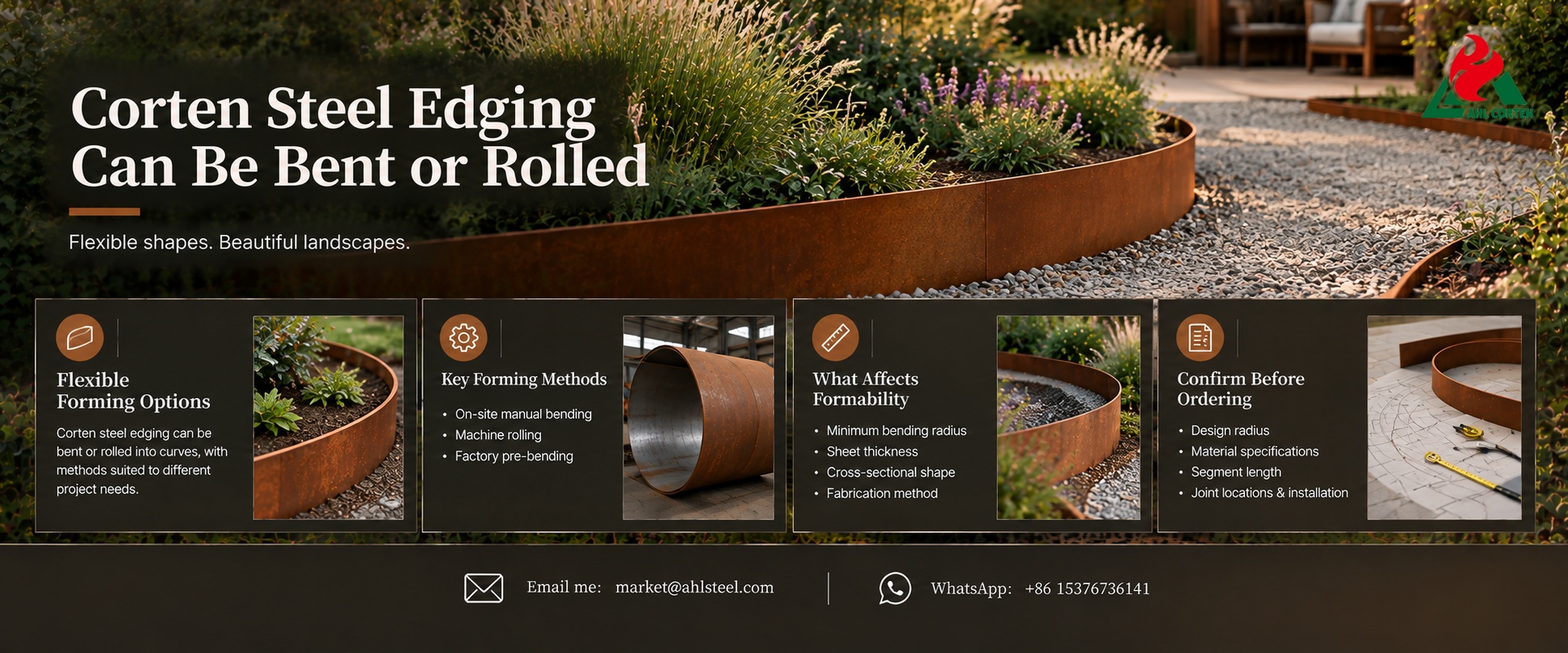
The bottom line is: Corten steel garden edging can be bent or rolled into curves, provided that the sheet thickness, cross-sectional shape, target curvature, and fabrication method are all compatible.
There are three main forming methods available on the market: on-site manual bending to create gentle curves, machine rolling to achieve continuous arcs, and factory pre-bending to create complex or consistently uniform shapes in bulk.
Whether a shape can be formed depends on the minimum bending radius, sheet thickness, and structural configuration.
Before placing an order, you need to confirm the design radius, material specifications, segment length, joint locations, and installation method. AHL can help you assess whether standard products can be shaped on-site or if you should opt for custom, prefabricated curved edging.
Want the Latest Catalog for Corten Steel Edgings? Contact Us!
Can Corten Steel Edging Be Bent into Curves?
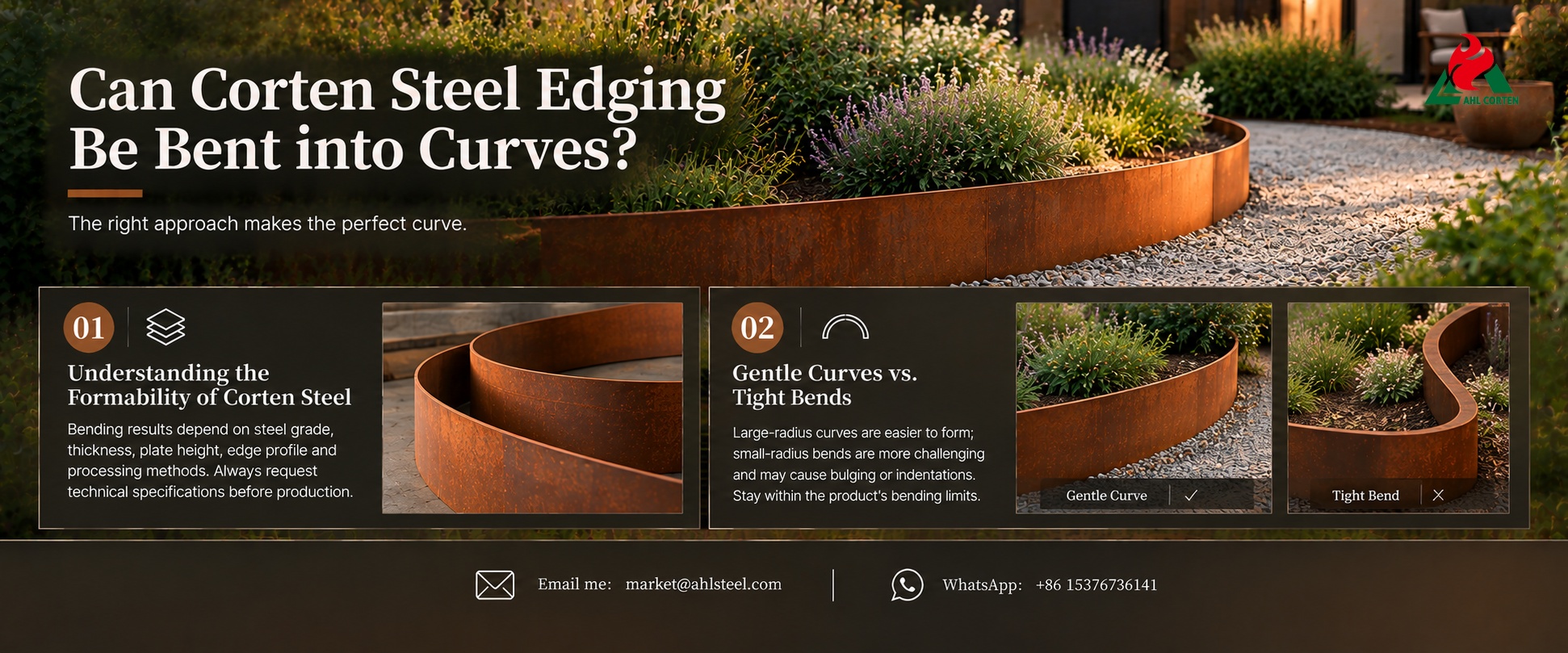
1. Understanding the Formability of Corten Steel
Weathering steel can be bent into arcs, but the forming results depend on the steel grade, plate thickness, plate height, edge profile, and processing methods.
Do not assume that all weathering steel profiles have the same bending capabilities. Even among weathering steel products, one specification may easily form a smooth arc, while another with greater rigidity may be much more difficult to process.
Requesting technical specifications before production begins can help prevent issues such as deformation and installation difficulties later on.
2. Gentle Curves vs. Tight Bends
Large-radius, gentle curves are easier to form; they result in smooth, uniform arcs, subject the material to less stress, and are less likely to leave indentations on the surface.
Small-radius, tight bends require careful evaluation; they carry higher risks and are prone to localized bulging, uneven curvature, and surface indentations.
Do not force the sheet to bend beyond the curvature limits of the product or equipment.
Want the Latest Catalog for Corten Steel Edgings? Contact Us!
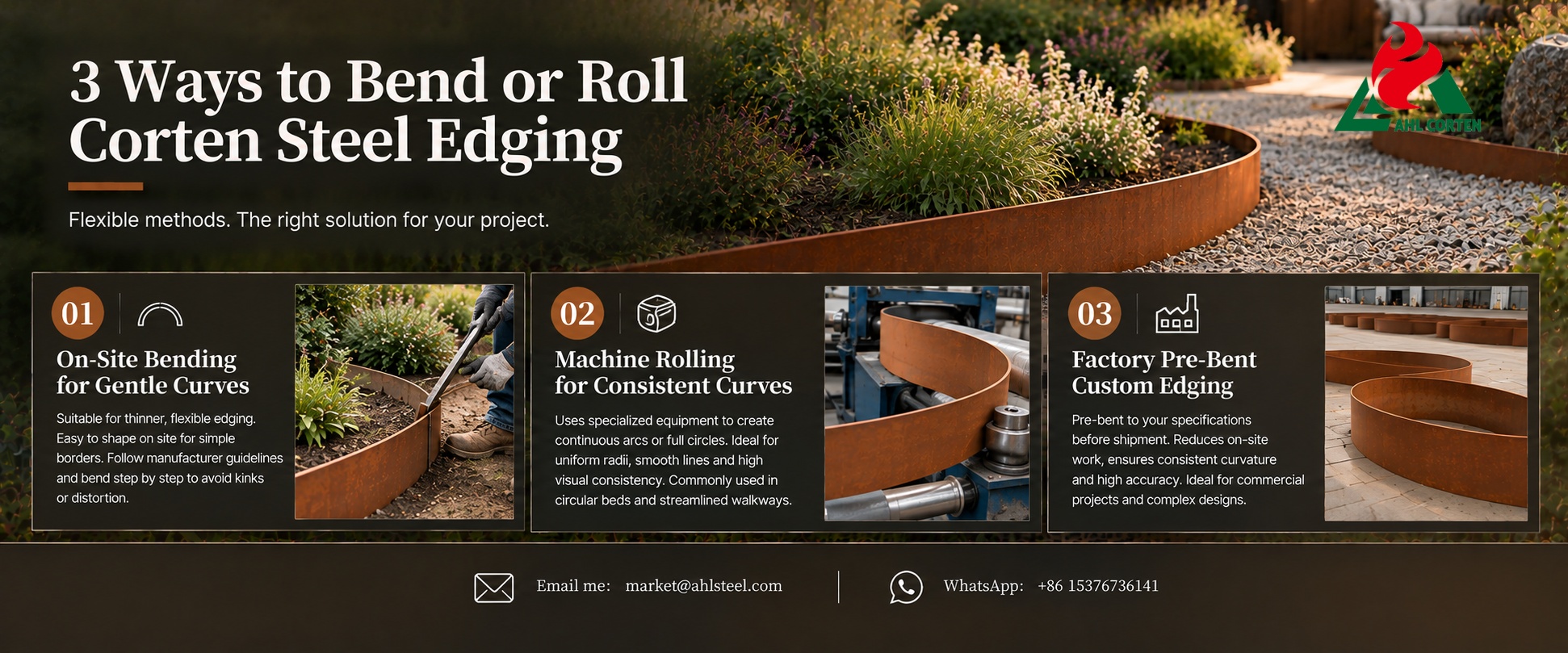
3 Ways to Bend or Roll Corten Steel Edging
1. On-Site Bending for Gentle Curves
Some thinner, more flexible weathering steel edging can be transported to the site and shaped directly to fit the gentle curves of a garden. This method is convenient for simple garden borders.
On-site bending must strictly follow the manufacturer’s guidelines; forceful bending is strictly prohibited, as it may result in kinks, distortion, or uneven curvature.
For installation, it is recommended to first mark out the layout, adjust the curvature in sections step by step, and secure the edging only after confirming the shape meets specifications.
If the curvature is relatively small, the design requirements are high, or the project structure is complex, factory prefabrication should be prioritized.
2. Machine Rolling for Consistent Curves
The rolling process uses specialized rolling equipment to shape curved metal garden edging into continuous arcs or full circles.
When multiple sections of edging require a uniform radius, uninterrupted lines, and high visual consistency, rolling is the preferred solution, offering far greater control than manual on-site bending.
The rolling process is frequently used for circular planting beds, streamlined walkways, and orderly landscape layouts.
Of course, the achievable radius is still determined by plate thickness, cross-sectional profile, and equipment capabilities.
3. Factory-Pre-Bent Custom Edging
Factory pre-bending involves processing the edging to the specified curvature according to drawings before shipment, allowing for direct on-site installation.
The advantages include reduced on-site fabrication work, consistent curvature across batches, and higher fitting accuracy for complex shapes.
This method is particularly well-suited for commercial landscaping, projects with repetitive shapes, and projects where on-site construction conditions are limited or on-site fabrication is impractical.
For large-scale landscaping projects featuring multiple curved landscape borders, factory pre-bending ensures a high degree of consistency between the finished product and the design plan.
Want the Latest Catalog for Rusted Steel Edgings? Contact Us
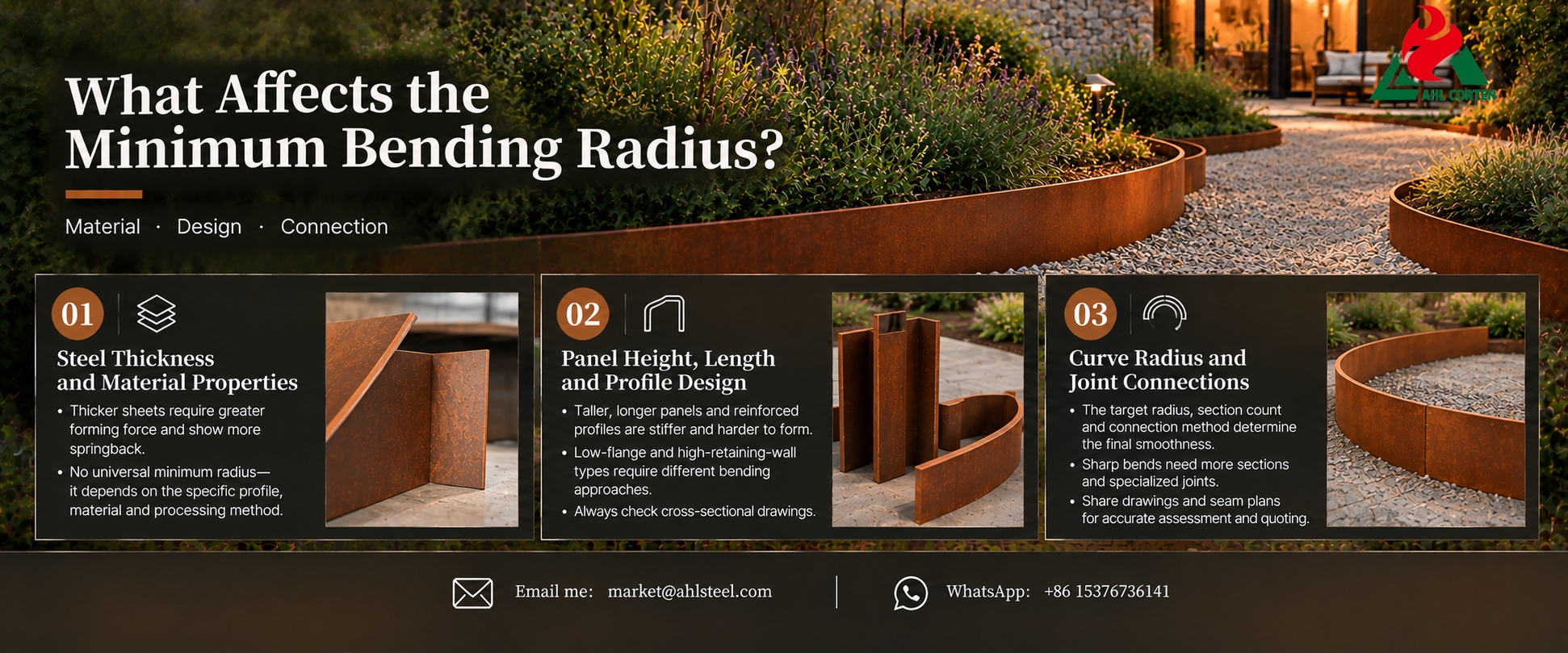
What Affects the Minimum Bending Radius?
1. Steel Thickness and Material Properties
The thicker the sheet, the greater the external force required for bending, the more pronounced the springback, and the higher the demands on forming control.
There is no universal minimum bending radius that applies to all weathering steel edging profiles.
The achievable curvature must be evaluated on a case-by-case basis, taking into account specific specifications and processing methods.
2. Panel Height, Length, and Profile Design
Tall, long panels and profiles with reinforced flanges exhibit greater rigidity, making them more challenging to form.
Low-flange flexible edging and high-retaining-wall-type edging—though both classified as weathering steel edging—have vastly different bending requirements.
It is essential to thoroughly review the cross-sectional drawings before finalizing a curved design.
3. Curve Radius and Joint Connections
The target radius, number of sections, and connection methods determine the final smoothness of the lines.
Large-radius arcs require fewer sections and fewer seams; sharp bends typically need to be divided into smaller sections and paired with specialized connection joints.
Seam locations should avoid visual focal points, maintain the continuity of the lines, and not create weak points.
Provide the drawings, radii, and seam plans to the supplier to facilitate feasibility assessment and accurate quoting.
Want the Latest Catalog of Garden Edging? Contact Us!
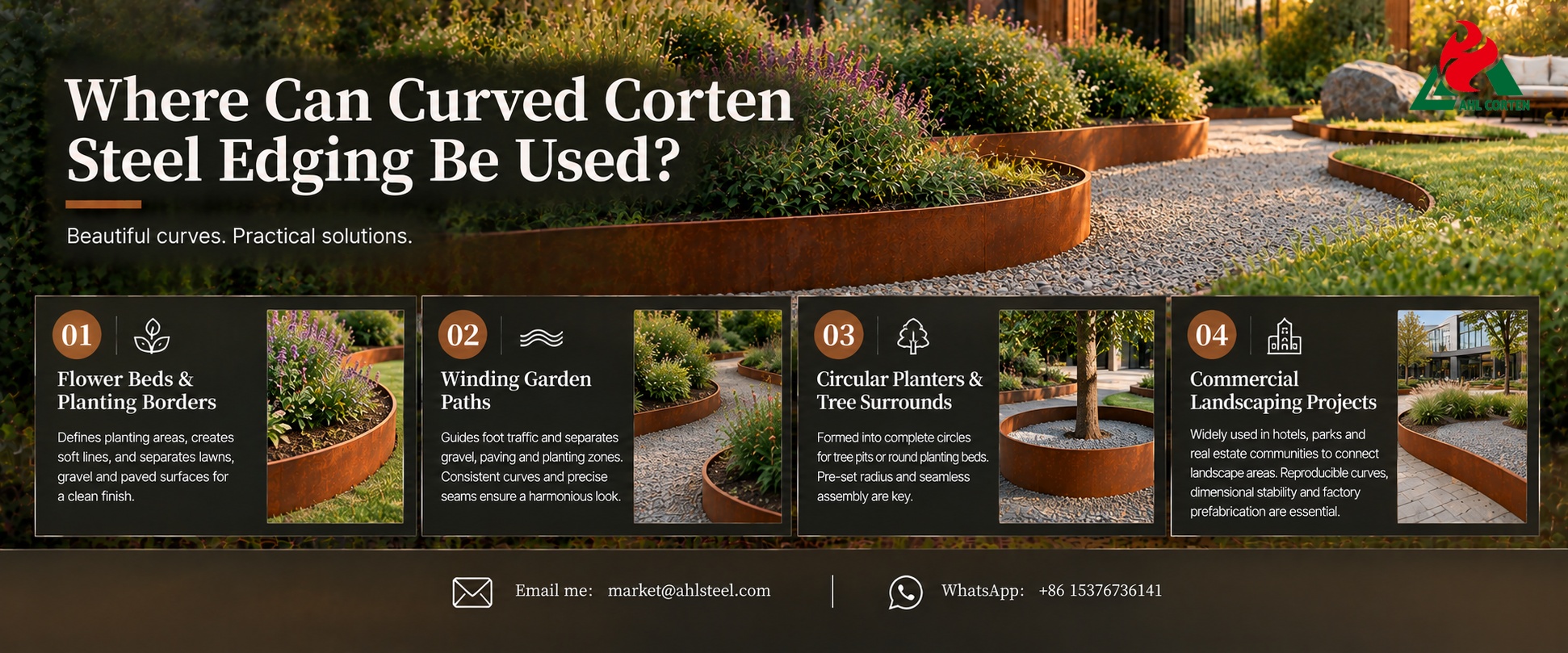
Where Can Curved Corten Steel Edging Be Used?
1. Curved Flower Beds and Planting Borders
Curved edging is used to outline the contours of flower beds, giving the garden soft lines while clearly separating planting areas from lawns, gravel, and paved surfaces for a clean, crisp finish.
They are suitable for both natural-style gardens and meticulously designed landscapes, with the curves echoing the forms of walkways, feature walls, and plant groupings.
2. Winding Garden Paths
Continuous curved edging extends along winding paths, separating gravel surfaces, paved areas, and planting zones while guiding the flow of foot traffic.
Such applications demand high consistency in curvature and precise seam alignment; only with continuous, flowing lines can the entire garden landscape achieve harmony and unity.
3. Circular Planters and Tree Surrounds
Corten steel edging can be formed into complete circles to serve as tree pits or circular planting beds.
For these projects, it is essential to determine the radius in advance to ensure seamless assembly of individual sections—a technique commonly used in gardens, parks, and commercial landscapes.
4. Commercial Landscaping Projects
Hotels, public parks, and real estate model communities frequently use curved edging in large quantities to connect different landscape areas.
These projects require reproducible curves, dimensional stability, and proven installation methods, making them ideal for factory-prefabricated solutions.
Want a Free Quote on Corten Steel Edging? Contact us!
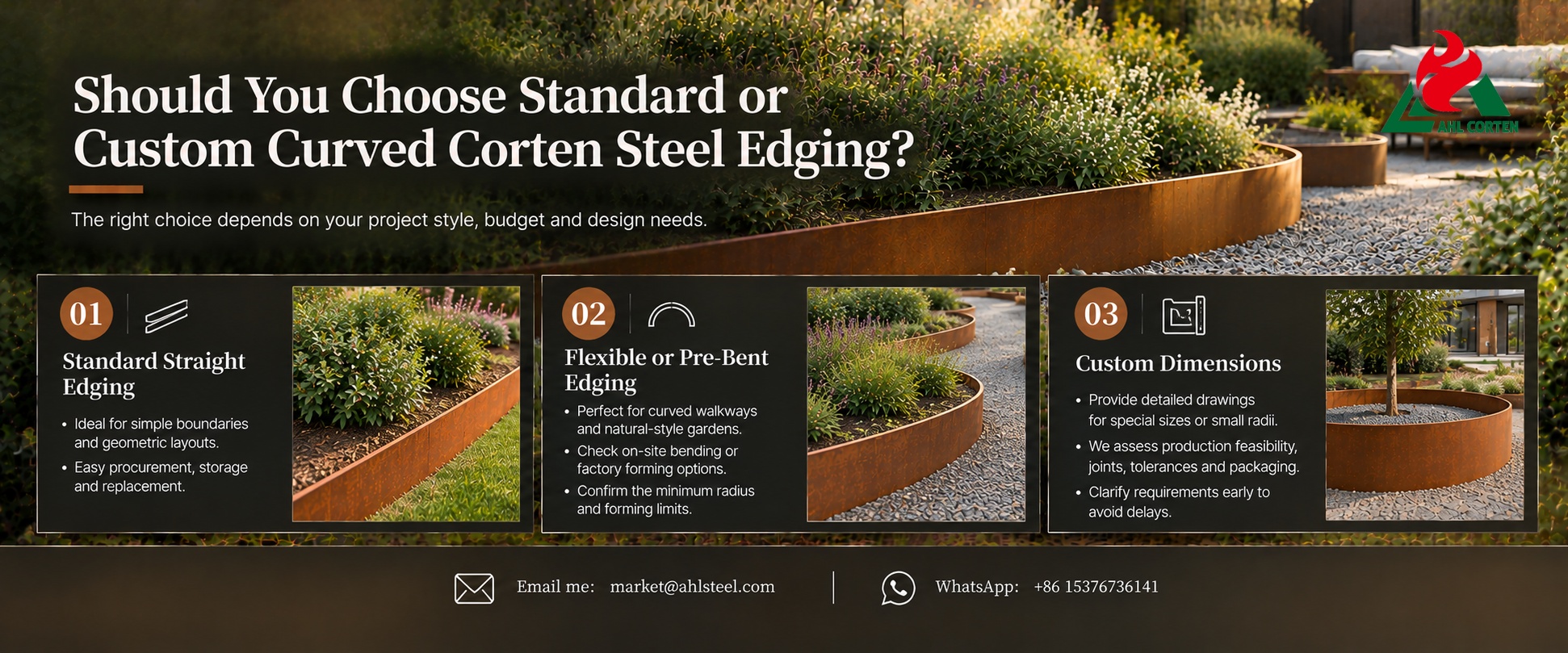
Should You Choose Standard or Custom Curved Corten Steel Edging?
1. Standard Straight Edging for Simple Layouts
Standard straight edging is suitable for simple boundaries and geometric layouts. It offers greater convenience in procurement, transportation, storage, and replacement, providing excellent value for money.
For retailers and distributors, stocking is straightforward and inventory management is less burdensome, making it ideal for large-scale, routine garden projects.
2. Flexible or Pre-Bent Edging for Curved Designs
Flexible or pre-bent edging is better suited for natural-style gardens, curved walkways, and complex borders.
Before purchasing, confirm whether the edging can be bent on-site or must be formed in the factory.
This directly affects labor costs, construction time, and the minimum achievable curvature. Even if labeled “bendable,” there are forming limits, so technical confirmation is essential.
3. Custom Dimensions for Project Requirements
For special heights, thicknesses, lengths, or small-radius designs, submit dimensioned drawings in advance.
Suppliers will use these to evaluate production feasibility, connection joints, tolerances, and packaging solutions.
The key to successfully customizing curved edging is to clarify design requirements early in the project to avoid delays later on.
Want to Get Your Own Corten Edging? Click to Customize!
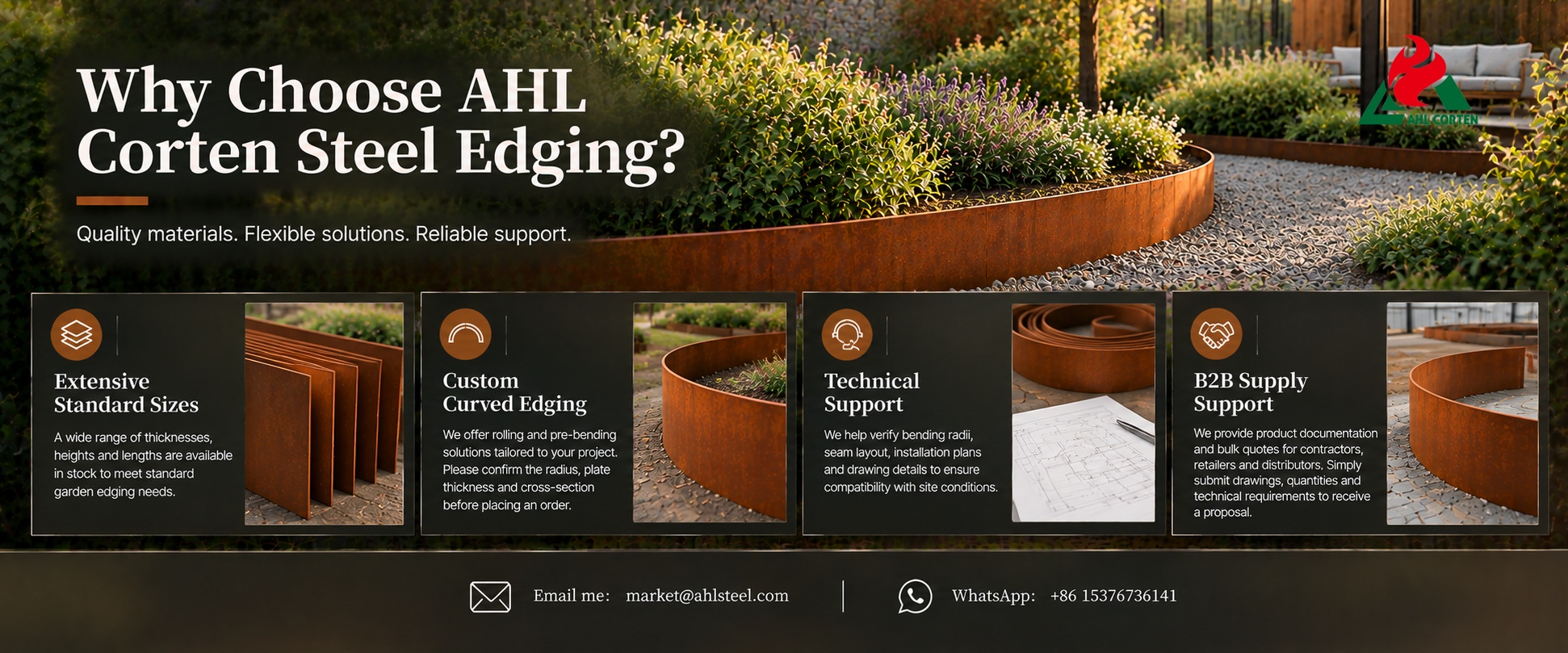
Why Choose AHL Corten Steel Edging?
– Extensive Standard Sizes: A wide range of thicknesses, heights, and lengths are available in stock to meet standard garden edging needs.
– Custom Curved Edging: Within our production capacity, we offer rolling and pre-bending solutions tailored to the curvature of your project. Please confirm the radius, plate thickness, and cross-section before placing an order.
– Technical Support: We assist in verifying bending radii, seam layout, installation plans, and drawing details to ensure compatibility with site conditions.
– B2B Supply Support: For landscape contractors, retailers, and distributors, we provide product documentation and bulk quotes; simply submit drawings, quantities, and technical requirements to receive a proposal.
Want to Create a Unique Corten Lawn Edging? Contact Us!
Frequently Asked Questions
1. Can Corten Steel Edging Be Bent By Hand?
Some thin, flexible edging profiles can be shaped on-site under gentle curvature conditions, but this depends on the thickness, cross-section, and manufacturer’s instructions. Do not forcefully bend thick plates or rigid profiles by hand, as this can easily cause kinks or distortion of the curve.
2. Can Corten Steel Edging Be Rolled Into a Circle?
Edging that meets specifications can be rolled into a circle using appropriate rolling equipment. The maximum achievable diameter depends on the plate thickness, cross-section, and equipment; be sure to confirm the radius with the supplier before production.
3. What Is the Minimum Bending Radius for Corten Steel Edging?
There is no uniform standard; it depends on the grade, thickness, plate height, cross-section, and processing method. Send the target radius and specifications to the manufacturer for verification.
4. Does Bending Affect the Appearance of Weathering Steel?
If the processing results in indentations, twisting, or uneven deformation, it will affect the appearance. By selecting appropriate equipment and a reasonable radius, the forming process can be controlled, ensuring the rust patina develops evenly.
5. Is Factory-Pre-Bent Corten Steel Edging Better for Complex Gardens?
For projects involving complex curves, repetitive shapes in batches, or those requiring high precision, factory pre-bending offers significant advantages by reducing on-site processing and ensuring consistent curvature. The final solution should be selected based on budget and construction conditions.
6. Can Thick Corten Steel Edging Be Curved?
Thick plates can be curved, but this requires greater forming force and more rigorous processes. Feasibility must be assessed individually for each specification; there is no one-size-fits-all answer.
7. Can I Order Custom Curved Corten Steel Edging from AHL?
Yes, but feasibility depends on dimensions, radius, plate thickness, and production capacity. Provide drawings, the target radius, material, and estimated quantity, and we’ll conduct a feasibility assessment and provide a quote.
Get Custom Corten Steel Edging for Your Landscape Design
Corten steel garden bed edging, utilizing bending and rolling processes, can be adapted to curved flower beds, winding pathways, and circular planting areas. To ensure a stable and aesthetically pleasing final product, it’s essential to confirm the sheet specifications, bending radius, and installation details in advance.
If you’re designing a curved garden edging project, feel free to contact AHL to verify the feasibility of your plan.
Submit your drawings, target radius, sheet thickness, and purchase quantity, and we’ll match you with a suitable weathering steel edging solution and provide a quote.
Want to Create a Unique Corten Lawn Edging? Contact Us!