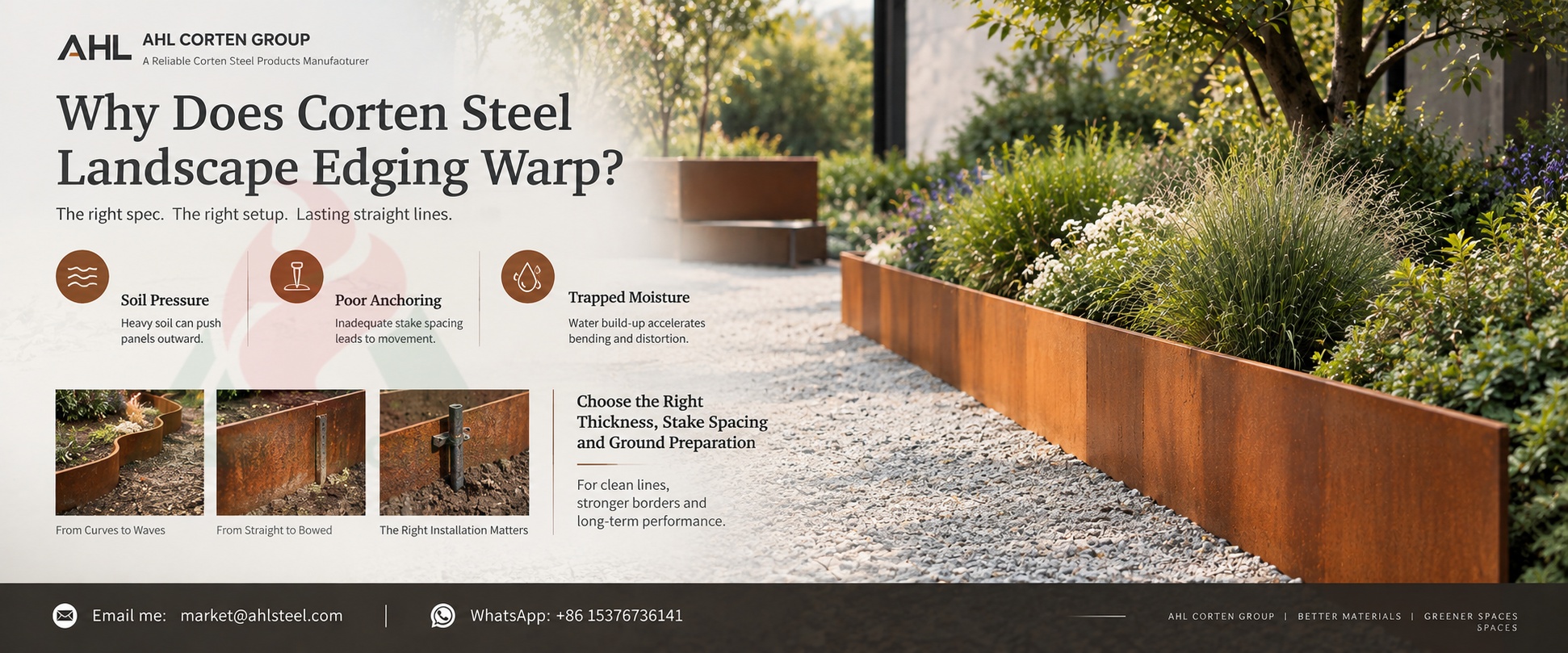
Installing Corten steel landscape edging is the ultimate way to achieve crisp, modern borders—until straight lines turn into wavy S-curves and the steel panels bow outward under heavy soil.
This frustrating warping isn’t a material flaw; it’s a structural mismatch. While thinner Corten profiles are engineered for smooth, flexible curves, achieving razor-straight lines or structural retaining borders requires the right steel thickness, stake spacing, and ground preparation.
Understanding why metal edging shifts—whether from soil pressure, poor anchoring, or trapped moisture—is the secret to preventing it. Below, we break down why deformation happens and how to choose the exact specification your project needs for permanent, flawless performance.
Want the Latest Catalog for Rusted Steel Edgings? Contact Us!
Quick Answer: How Can You Keep Edging Straight?
Combine the right profile with secure anchoring, supported joints and careful installation. Thicker steel can improve rigidity, but it cannot compensate for inadequate fixings or an unsuitable retaining application. Product specifications should consider height, profile, connections and ground conditions together.
| Prevention Method |
Main Problem Addressed |
Buyer Benefit |
| Choose a suitable thickness and profile |
Panels too flexible for the application |
Better shape retention |
| Prepare firm, consistent support |
Settlement and leaning |
More reliable alignment |
| Match stakes to site conditions |
Movement between fixings |
Stronger anchoring |
| Reinforce joints and corners |
Localised kinks and separation |
Cleaner transitions |
| Control retained soil and runoff |
Outward pressure and erosion |
More stable borders |
| Install and backfill carefully |
Installation-related distortion |
Fewer corrections |
| Protect during handling and inspect |
Transport damage and developing movement |
Lower repair risk |
Want the Latest Catalog for Corten Steel Edgings? Contact Us!
7 Ways to Prevent Corten Steel Edging Bending
1. Choose Thickness and Profile for the Application
Flexible lawn borders, straight path edging and soil-retaining systems serve different purposes. Select profiles by considering exposed height, retained soil, unsupported length and potential impact—not thickness alone.
Folded edges and reinforced profiles can improve rigidity. However, no universal thickness chart guarantees structural performance: taller retaining products may require braces or anchor posts that ordinary lawn edging does not.
2. Prepare a Firm, Consistent Installation Line
Mark the alignment and finished levels before excavation. Remove obstructions and unsuitable loose material, then prepare a support appropriate to the product and ground conditions.
Follow the selected system’s burial-depth instructions rather than applying one fixed rule. Manufacturer’s guidance shows that installation depth, shaping and anchoring work together to support heavy-duty corten edging.
3. Use Suitable Stakes and Support Spacing
Use compatible stakes, posts or brackets and follow the supplier’s approved fixing layout. Review support requirements where the ground slopes, soil is loose or exposed height increases.
Avoid leaving long sections unsupported. Different systems use different arrangements: some have movable spikes, while taller products require bracing or anchor posts. Their spacing requirements are not interchangeable.
4. Secure Joints, Corners and Changes in Direction
Connect sections using the specified plates, locking tabs or fasteners. Check alignment and engagement before final backfilling, and add support at transitions where the design requires it.
For tight curves or corners, use suitable formed components or the manufacturer’s approved bending method. Do not force a rigid profile into a shape it was not designed to accommodate.
5. Managing Retained Soil and Water
Distinguish decorative separation from retaining a change in ground level. Soil-retaining applications can need dedicated braces, posts or foundations rather than ordinary garden stakes.
Prevent concentrated runoff from eroding the supporting ground. Specify drainage alongside the retaining structure, and seek qualified design review for substantial level changes, unstable slopes or additional loads near the edge.
6. Avoid Distortion During Installation and Backfilling
Use a timber block or rubber mallet where the manufacturer permits it. Do not strike exposed edges directly with a metal hammer or force sections over buried obstructions. Straightcurve’s installation guidance specifically recommends a rubber mallet when tapping the upper edge.
Secure the supports before backfilling. Add material progressively, recheck alignment and avoid pushing heavy fill or compaction equipment directly against unsupported panels.
7. Protect Long Sections and Inspect After Installation
Support long sections during delivery, storage and positioning. Avoid dragging them or lifting them in ways that leave excessive unsupported length.
After installation, check alignment, connections and ground support following initial settlement or heavy rain. If movement returns, investigate the anchoring, drainage or loading instead of repeatedly bending the weathering steel landscape edging back.
For stronger project evidence, include a verified photograph of the fixing layout and a follow-up inspection—not an unsupported “never bends” claim.
Want the Latest Catalog for Corten Steel Edgings? Contact Us!
Common Mistakes to Avoid
| Mistake |
Better Approach |
| Choosing by price or thickness alone |
Compare the complete profile and fixing system |
| Using decorative edging as a retaining wall |
Specify a retaining assembly for the actual loads |
| Leaving joints unsupported |
Follow the connection and anchoring detail |
| Forcing sharp bends into unsuitable profiles |
Order formed corners or suitable flexible sections |
| Ignoring drainage and erosion |
Plan how runoff leaves the installation area |
Why Choose AHL Corten Edging?
1. Diverse Product Options for Every Application
- 1.6mm Decorative Edging: Lightweight and flexible, ideal for low-impact residential garden borders and delicate flowerbeds.
- 2mm Residential Landscape Edging: The gold standard for home gardens, balancing structural rigidity with easy manipulation for clean lawn borders.
- 3mm Heavy-Duty & Commercial Edging: Built for high-traffic public parks, commercial landscapes, and hard use areas requiring superior strength.
- 4–6mm Engineered & Retaining Edging: Heavy-specification steel designed for driveways, sloped retaining soil, and heavy structural applications.
- Bespoke Customization: Full OEM/ODM support for custom profile heights, segment lengths, steel plate thicknesses, and specialized geometric shapes.
2. Advanced Anti-Bending Features & Structural Engineering
- Folded & Reinforced Top Rims: Rolled or top-folded edges prevent wall bowing, eliminate sharp edges, and provide maximum linear stiffness.
- Factory-Preformed Curves & Circles: Precision-rolled sections, modular tree rings, and custom-radius curves ensuring smooth arcs without on-site stress warping.
- Seamless Joining & Anchoring Systems: Heavy-duty steel ground stakes, internal joining clips, flush-bolted connector plates, and anchored base tabs.
- Engineered Corner Pieces: Pre-welded 90° inside/outside corners and tailored angle connectors for crisp, clean installation joints.
- Project-Specific Fixing Guidance: Tailored anchor layout recommendations based on your soil type, burial depth, and lateral load requirements.
3. Comprehensive Project Support Across Diverse Landscapes
- Residential Gardens & Courtyards: Framing lawn borders, flowerbeds, and decorative gravel pathways.
- Landscape Contractor Projects: Fast-assembly, reliable systems designed to reduce site labor and installation costs.
- Public Parks & Urban Streetscapes: Heavy-duty borders built to withstand commercial maintenance equipment and public foot traffic.
- Hotels, Resorts & Commercial Landscapes: Architectural-grade finishes that elevate curb appeal and harmonize with modern hardscapes.
- Sloped Terrain & Raised Beds: Secure soil retention for stepped gardens, elevated planters, and pathway containment.
4. Achieve Long-Term Straight Lines & Uncompromised Structural Stability
AHL helps you eliminate curved corten steel edging bowing and bending before installation even begins. By combining the optimal steel thickness and engineered burial depths with heavy-duty stakes, seamless bolted connections, factory-preformed curves, and integrated drainage details, we deliver complete, turn-key landscape edging solutions built to maintain flawless architectural lines for decades.
Want the Latest Catalog for Corten Steel Edgings? Contact Us!
Decision Guide: Which Prevention Method Do You Need?
When installing Corten steel landscape edging, selecting the correct structural configuration is essential for preventing bowing, bending, and long-term soil displacement. To achieve a crisp, permanent border that withstands site conditions, use this decision guide to determine which engineering features your project requires.
1. Choose Closer Stake Spacing If You:
- Work with challenging soil: Installing in soft, sandy, or saturated soil where anchoring friction is lower.
- Build custom curves and sharp corners: Need extra holding points to absorb lateral tension along bent profiles.
- Install on slopes or uneven terrain: Require continuous resistance against downhill soil creep and erosion.
- Experience freeze-thaw cycles: Need to prevent frost-heave from shifting the steel border over time.
- Target long, razor-straight lines: Require maximum alignment accuracy across extended lawn borders or gravel pathways.
2. Choose Thicker Steel Edging (3mm–6mm) If You:
- Design raised planting beds: Need structural strength to retain heavy topsoil without mid-section bulging.
- Retain heavy materials: Contain dense crushed stone, gravel, or high-volume mulch beds.
- Expect heavy equipment or foot traffic: Are installing near lawnmowers, maintenance machinery, or high-density pedestrian zones.
- Execute commercial & public projects: Require heavy-duty, vandal-resistant steel borders built for decades of exposure.
- Demand a bold architectural profile: Want a thicker, premium top line that creates a strong visual outline for modern hardscapes.
3. Choose Factory-Preformed Curves If You:
- Specify small-radius arcs: Require tight, clean circles or organic curves without forcing straight steel bars.
- Use heavy plate material (3mm+): Want to avoid difficult, high-stress manual bending on the job site.
- Need repeatable modular layouts: Require uniform tree surrounds, circular flowerbeds, or matching curved borders.
- Aim for precise geometric design: Need exact CAD-matched radii for high-end commercial or residential landscapes.
- Reduce site installation time: Want pre-engineered components that fit together instantly without risk of material spring-back.
4. Choose Integrated Drainage Features If You:
- Install in clay-heavy soil: Deal with low permeability and slow surface water absorption.
- Border heavily irrigated lawns: Need to prevent standing water accumulation behind the edging profile.
- Operate in severe freeze-thaw climates: Want to prevent trapped water from expanding and pushing the metal garden bed edging out of alignment.
- Relieve hydrostatic pressure: Require continuous weep holes or gravel drainage channels to safely divert rainwater.
- Ensure rainy season performance: Want a stable, wash-out-free edge restraint during heavy seasonal downpours.
Need Custom Corten Edging Specifications for Your Project?
Whether you need high-tensile ground stakes, custom pre-curved segments, or factory-punched drainage slots, AHL Corten Group manufactures tailored landscape edging solutions for commercial contractors, landscape architects, and global distributors. Contact our engineering team today to discuss your site requirements and receive a factory-direct quotation.
Want the Latest Catalog for Corten Steel Edgings? Contact Us!
FAQ Section
Is Corten Steel Edging Supposed To Bend?
No. Corten steel raised beds should remain straight or follow its intended curve. Bending, bowing or leaning usually indicates excessive soil pressure, insufficient fixing, shallow installation or poor ground preparation.
How Deep Should Corten Steel Edging Be Buried To Prevent Bending?
As a general guide, bury about one-third to one-half of the total edging height. Higher edging, slopes, soft soil and vehicle-exposed areas may require deeper installation or additional anchoring.
How Many Stakes Do I Need for Corten Steel Edging?
Straight residential runs often use stakes at about 600–1000mm centres. Curves, corners, soft ground and slopes should use closer spacing, often around 300–600mm.
Can 1.6mm Corten Edging Bend?
Yes. 1.6mm edging can perform well for low-height decorative borders, but it is more vulnerable to bending under high soil pressure, long unsupported spans, impact or poor fixing.
Can 2mm Corten Garden Edging Bend?
It can bend if used beyond its intended load. For standard residential lawns and beds, 2mm offers a good balance, but long, tall or curved sections may need closer stakes or reinforcement.
Is 3mm Metal Garden Border Bend-Proof?
No material is completely bend-proof. However, 3mm offers much greater stiffness and shape retention, especially when paired with proper burial depth, strong anchors and preformed curves.
Can I Bend 3mm Corten Steel Edging By Hand?
Large-radius curves may be possible with preparation, but 3mm is generally difficult to bend accurately by hand. Roll forming, hydraulic bending or factory-preformed sections are usually better.
Does Drainage Really Prevent Edging From Bending?
Yes. Good drainage reduces saturated soil pressure, frost movement and loss of stake holding power. Free-draining backfill and a stable base help the edging resist lateral forces.
Does Rust Cause Steel Garden Edging to Bend?
The normal protective patina does not cause structural bending. Bending is mainly related to thickness, soil pressure, fixing, installation quality and ground movement.
Can AHL Provide Custom Anti-Bending Rusty Metal Edging?
Yes. AHL can supply custom thicknesses, heights, preformed curves, reinforced profiles, stakes, connectors and project-specific installation recommendations.