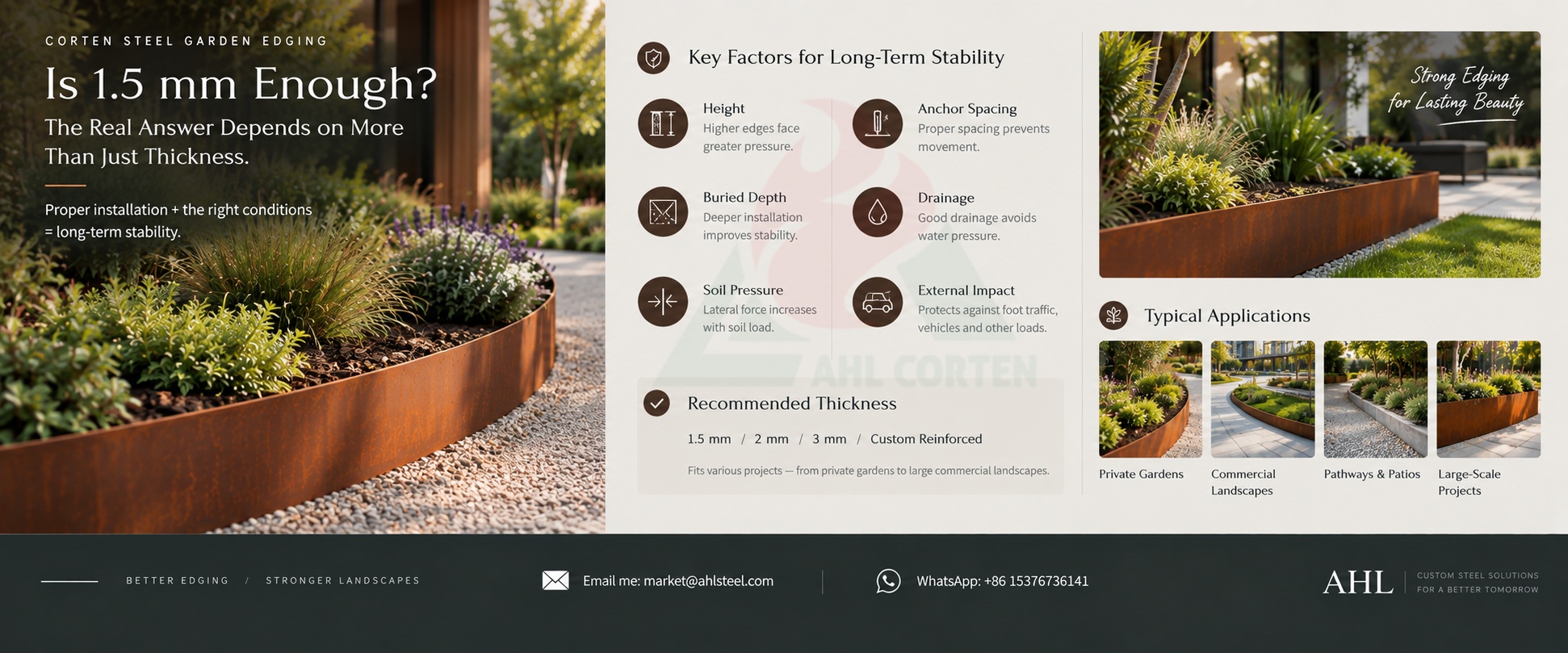
Many garden renovation projects face the same dilemma: Will a 1.5-millimeter weathering steel garden border provide long-term, stable performance?
The answer isn’t simply a matter of whether it’s sufficient or not. For most residential gardens and light-duty landscaping projects, a 1.5-millimeter corten garden border is perfectly adequate—provided it is installed properly.
However, the actual strength of the border depends on more than just the thickness of the steel plate. The key factors that truly affect long-term stability include: the height of the edging, the depth buried underground, lateral soil pressure, the spacing between anchor posts, site drainage conditions, and whether it will be subjected to external impacts or vehicle traffic.
AHL offers 1.5 mm, 2 mm, 3 mm, and custom reinforced corten metal edging to meet the needs of various projects, ranging from private gardens to large-scale commercial landscapes.
Want the Latest Catalog of Garden Edging? Contact Us!
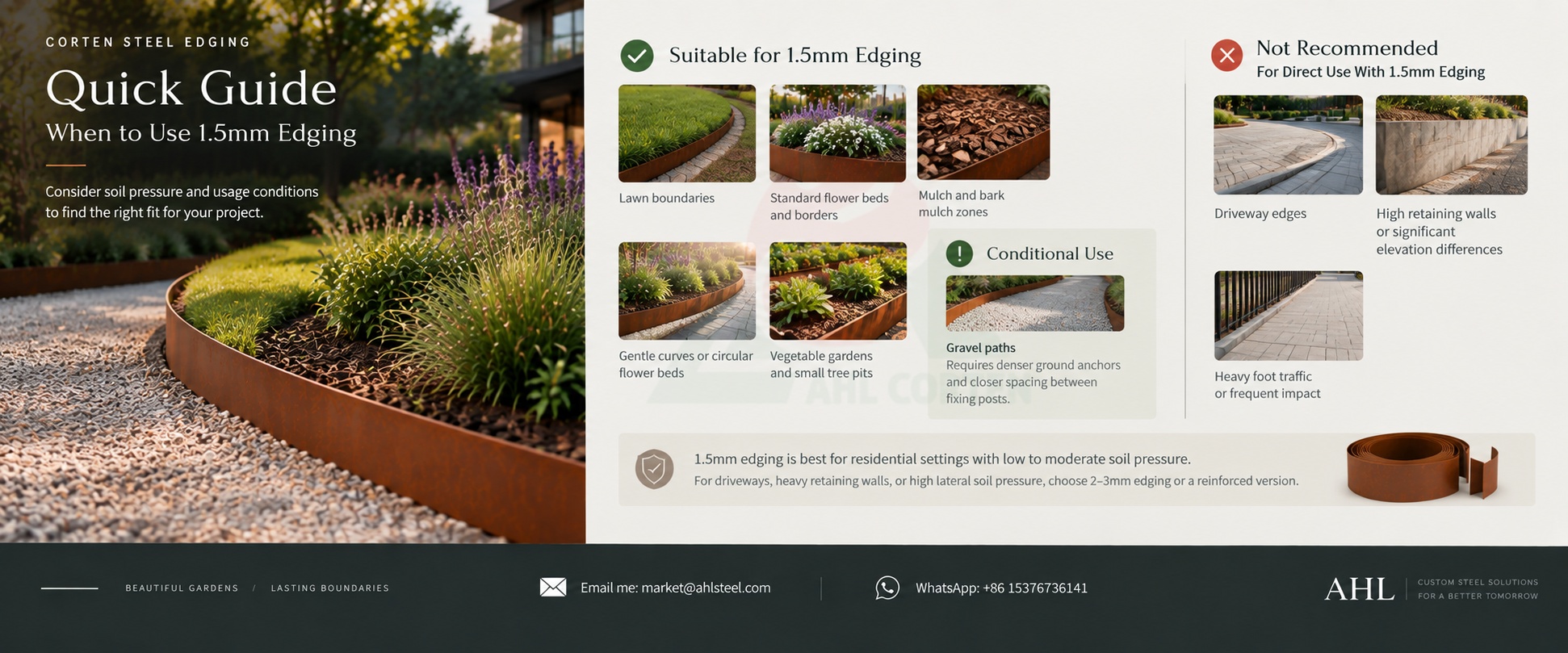
Quick Guide: When to Use 1.5mm Edging
By considering soil pressure and usage conditions, you can quickly determine whether 1.5mm rusted steel edging is suitable for your project.
✅ Suitable for 1.5mm edging:
- Lawn boundaries
- Standard flower beds and borders
- Mulch and bark mulch zones
- Projects requiring gentle curves or circular flower beds
- Vegetable gardens and small tree pits
⚠️ Conditional use: Gravel paths—requires denser ground anchors and closer spacing between fixing posts.
❌ Not Recommended For Direct Use With 1.5mm Edging:
- Driveway edges
- High retaining walls or boundaries with significant elevation differences
- Areas with heavy foot traffic or frequent impact
1.5mm edging is best suited for residential settings with low to moderate soil pressure. For projects involving driveways, heavy retaining walls, or high lateral soil pressure, we recommend upgrading to 23mm edging or a reinforced version.
Want a Free Quote on Corten Steel Edging? Contact us!
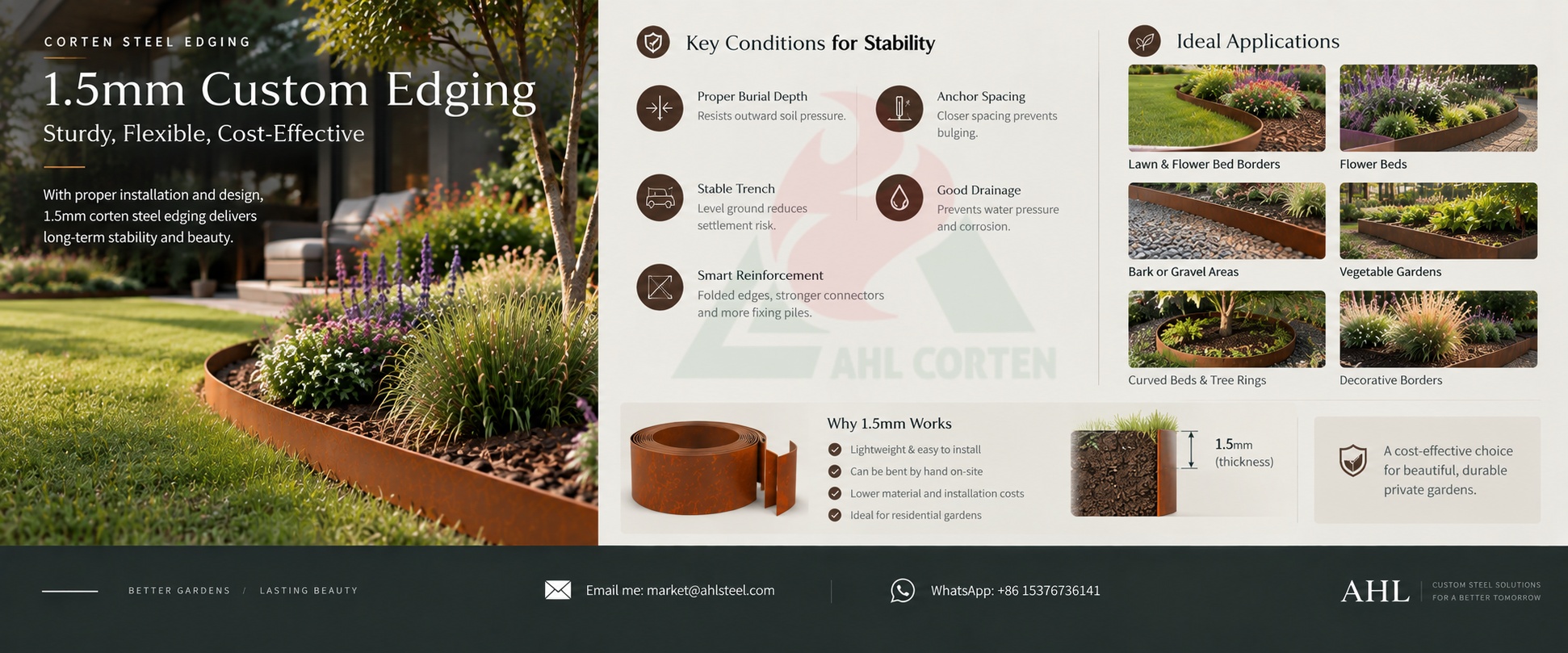
Under What Conditions Is 1.5mm Custom Corten Edging Sufficiently Sturdy?
Weathering steel inherently possesses excellent outdoor weather resistance, but thin steel sections require proper installation techniques to ensure structural integrity.
Appropriate burial depth and edging height form a stable foundation. Burying part of the steel in the ground helps counteract the outward thrust of the soil, reducing the risk of deformation.
The spacing of the ground anchors directly determines the overall resistance to deformation; if the spacing is too wide, the steel plate is prone to bulging outward. Excavating a level and stable trench can minimize deformation caused by subsequent settlement.
Good drainage is crucial. In water-saturated soil, lateral pressure increases significantly, while also accelerating corrosion at the bottom of the steel.
1.5mm steel plates possess moderate flexibility and can be bent by hand on-site to create gently curved flower beds. Structural performance can be further enhanced by reinforcing the top edges with folded flanges, upgrading specialized connectors, and increasing the density of the fixing piles.
Ideal Applications for 1.5mm Weathering Steel Edging
1.5mm weathering steel garden edging offers distinct advantages in residential yard projects and is particularly well-suited for the following scenarios:
- Boundaries between lawns and flower beds
- Various types of flower beds
- Separating areas with bark mulch or gravel
- Home vegetable garden plots
- Curved flower beds and circular tree rings for small trees
- Decorative landscape borders
The core advantages of this edging lie in its light weight and ease of cutting and processing; it can be bent into shape by hand on-site. Additionally, both material and installation costs are more economical, making it a cost-effective choice for private gardens.
Want to Get Your Own Corten Edging? Click to Customize!
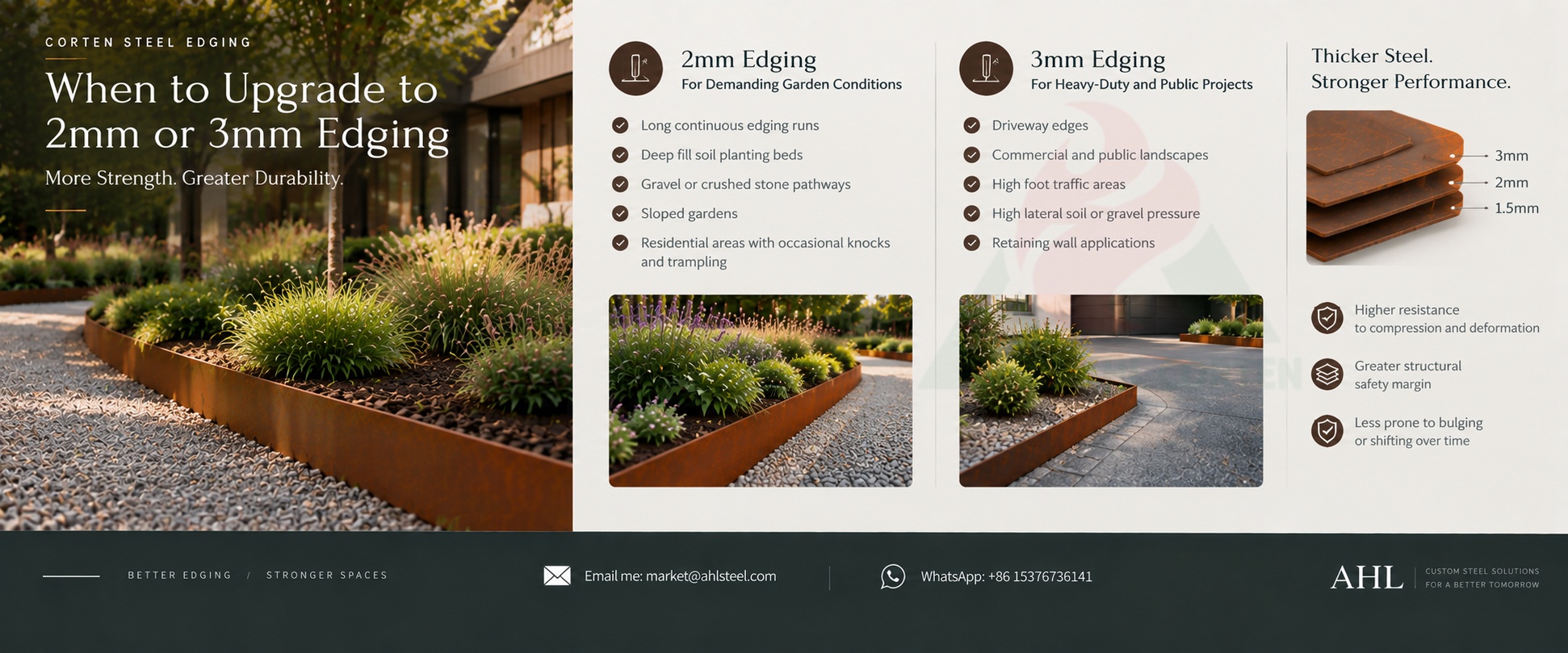
When to Upgrade to 2mm or 3mm Corten Edging
Not all gardens are suitable for 1.5mm edging. In situations involving heavier loads, it is necessary to increase the steel plate thickness to ensure a greater structural safety margin.
Scenarios for Using 2mm Rusted Steel Edging
- Long continuous edging runs
- Planting beds with deep fill soil
- Edges of gravel or crushed stone pathways
- Gardens with a certain slope
- Areas in residential settings prone to knocks and trampling
Scenarios for Using 3mm Weathering Steel Edging
- Edges along both sides of driveways
- Commercial and public landscaping projects
- Areas surrounding walkways with high foot traffic
- Areas where soil or gravel exerts significant lateral pressure
- Edges required to function as retaining walls
Compared to 1.5 mm, the thicker steel plates offer greater resistance to compression and deformation, provide a larger structural safety margin, and are less prone to bulging or shifting during long-term use.
Want to Create a Unique Corten Lawn Edging? Contact Us!
Key Practical Installation Points for 1.5mm Corten Metal Edging
The service life of thin edging depends largely on installation details. The following are key installation guidelines.
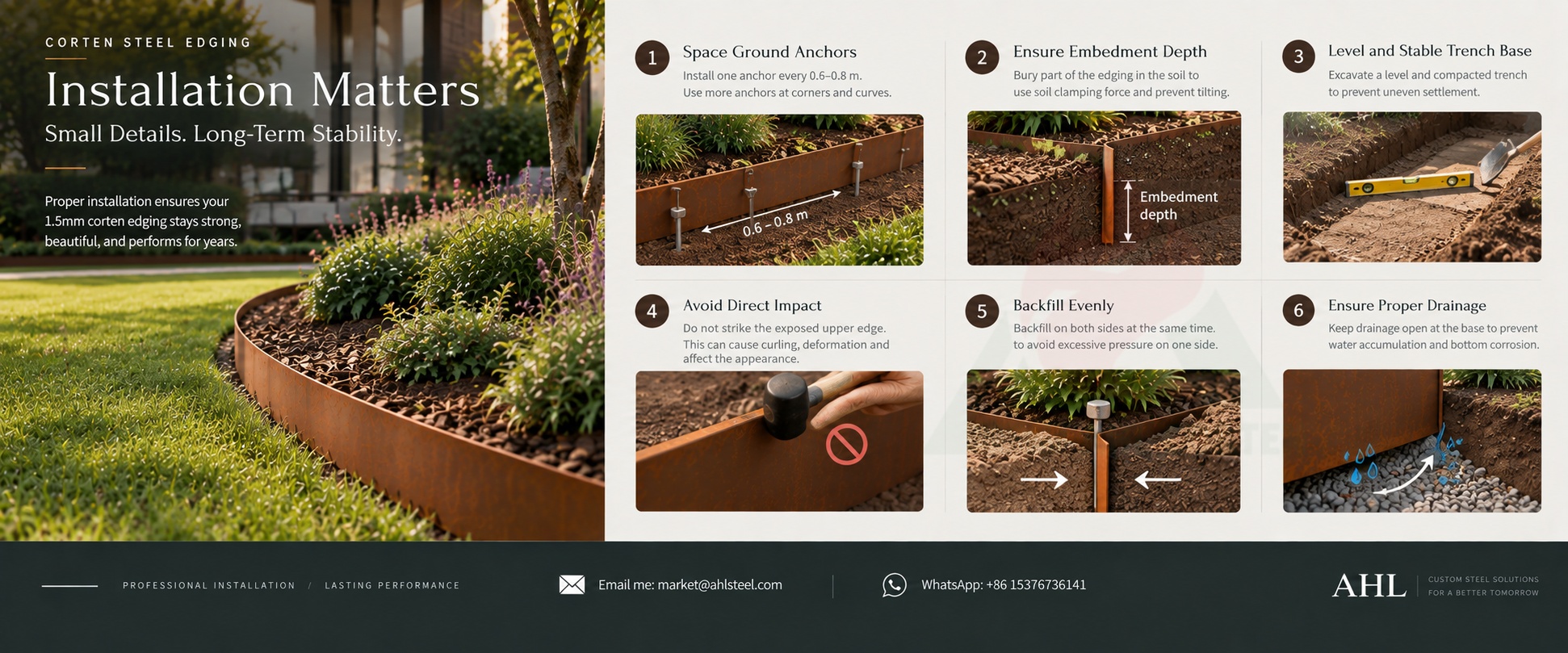
- Properly space the ground anchors. It is recommended to install one ground anchor every 0.6 to 0.8 meters. At corners and curves, further reduce the spacing between anchors and increase the number of anchor points.
- Ensure Sufficient Embedment Depth: Bury a portion of the edging into the soil to leverage the soil’s clamping force, thereby enhancing overall stability and reducing outward tilting.
- Ensure the Trench Base Is Level and Stable: Excavate a level and well-compacted trench to prevent subsequent uneven soil settlement from causing the edging to twist or deform.
- Do not strike the exposed upper edge directly. Do not strike the visible upper edge of the steel plate directly, as this can easily cause curling, deformation, and damage to the aesthetic lines.
- Backfill evenly on both sides. Backfilling on both sides of the perimeter should be carried out simultaneously to prevent excessive soil pressure on one side from warping the steel plate.
- Ensure proper drainage at the base. Maintain unobstructed drainage around the buried section to prevent prolonged water accumulation from saturating the bottom of the steel.
Want a Free Quote on Corten Steel Edging? Contact us!
Key Points on Rusting, Aging, and Maintenance of Corten Landscape Edging
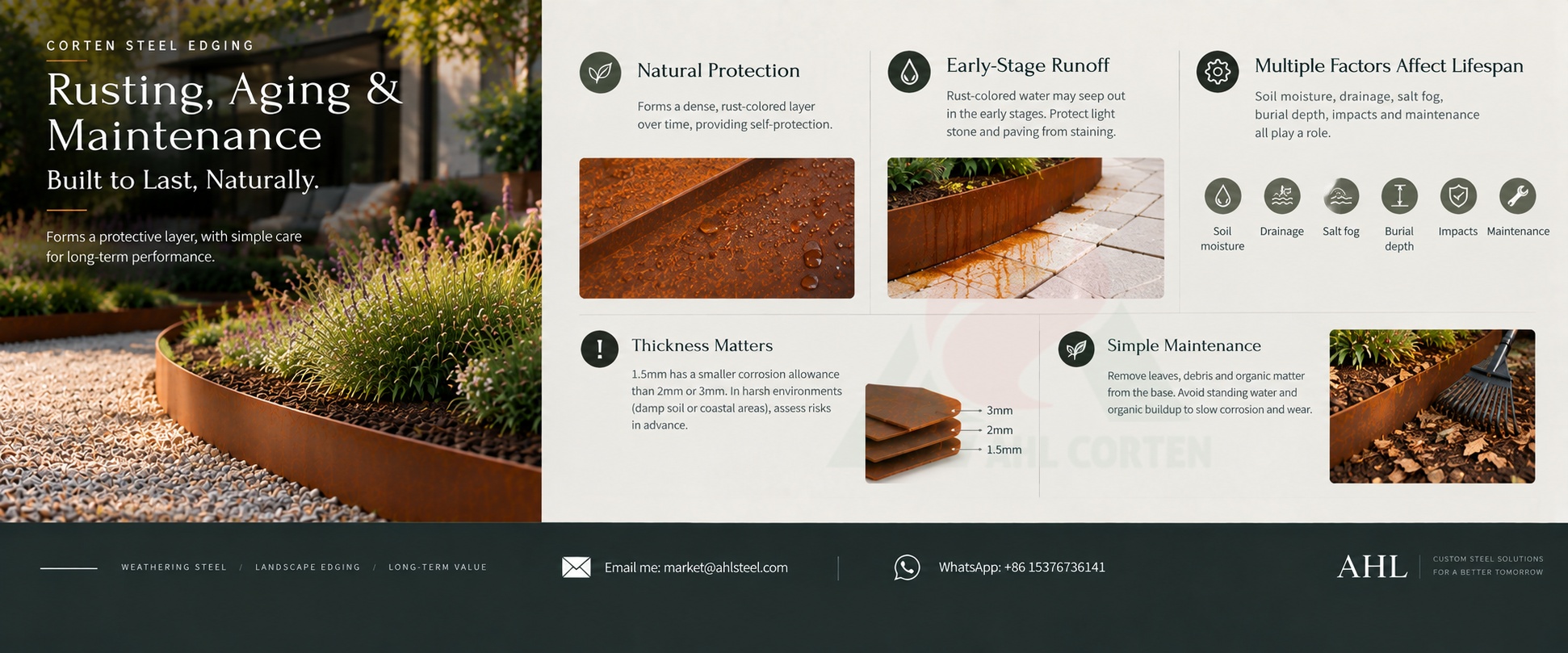
Weathering steel naturally forms a dense, rust-colored protective layer over time, providing self-protection—this is an inherent property of the material.
During the early stages of a project, rust-colored water may seep out; take precautions in advance to protect light-colored stone and paving to prevent staining.
The actual service life of the edging is influenced by multiple factors: soil moisture, drainage effectiveness, coastal salt fog environments, burial depth, external impacts, and routine maintenance.
Compared to 2mm and 3mm steel plates, 1.5mm steel plates have a smaller corrosion allowance. In highly corrosive environments, such as damp soil or coastal salt fog, it is essential to assess the risks in advance.
Routine maintenance is simple: periodically clear accumulated organic matter, fallen leaves, and debris from the base of the edging. Do not allow standing water or organic matter to remain in prolonged contact with the bottom of the steel to slow down corrosion and wear.
Want the Latest Catalog of Garden Edging? Contact Us!
Thickness Comparison: 1.5mm vs. 2mm vs. 3mm Weathering Steel Edging
| Factor |
1.5mm |
2mm |
3mm |
| Cost |
Lowest |
Moderate |
Highest |
| Flexibility |
Excellent |
Good |
Limited |
| Hand�installation |
Easy |
Relatively easy |
Demanding |
| Soil pressure resistance |
Light�to�moderate |
Moderate |
High |
| Curve suitability |
Very suitable |
Suitable |
Often requires mechanical assistance |
| Residential application |
Excellent performance |
Excellent performance |
For heavy�duty scenarios only |
| Commercial project application |
Limited suitability |
Moderate suitability |
Recommended |
| Driveway edge application |
Not recommended |
Evaluate according to working conditions |
Preferred choice |
Common Errors in Selection and Installation
Many cases of edging deformation or failure are not due to quality issues, but rather result from errors in selection and installation.
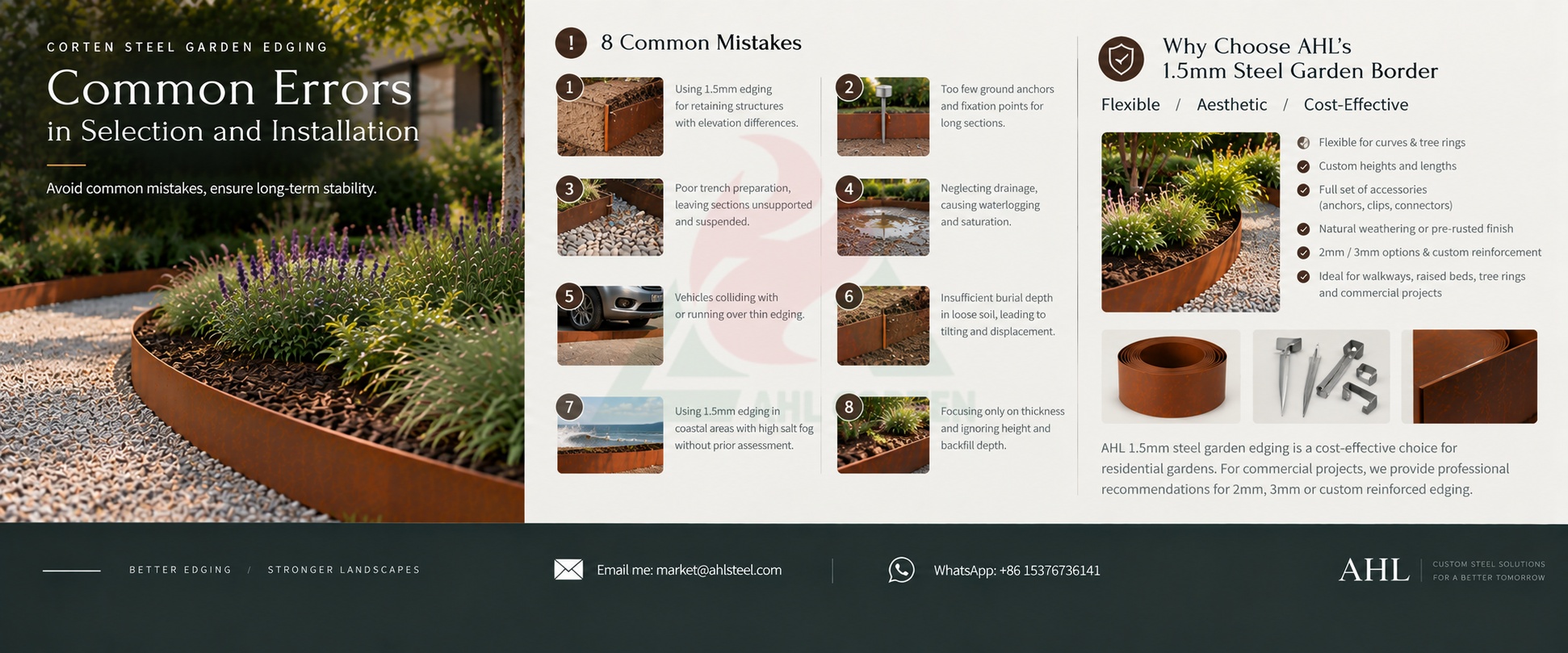
- Using 1.5mm edging for retaining structures with elevation differences, causing it to bear excessive lateral earth pressure.
- Insufficient number of ground anchors, too few fixation points, and lack of support for long sections of edging.
- Poor trench preparation, resulting in long sections of edging left unsupported and suspended.
- Neglecting drainage, causing the soil to remain waterlogged and saturated for extended periods.
- Allowing vehicles to repeatedly collide with and run over thin edging.
- Insufficient burial depth in loose soil, making the edging highly prone to tilting and displacement.
- Directly selecting 1.5mm thin steel plates for coastal environments with high salt fog without prior assessment.
- Focusing solely on thickness while ignoring border height and backfill depth, leading to blind product selection.
Why Choose AHL’s 1.5mm Steel Garden Border
AHL’s 1.5mm garden border strikes an excellent balance between flexibility, aesthetic appeal, and cost, making it ideal for private gardens and decorative landscape borders.
- The steel offers excellent flexibility, making it easy to create curved and circular tree pit designs.
- Custom heights and lengths are available.
- A full set of accessories is available, including ground anchors, clips, and joint connectors.
- Surface finishes include either natural weathering or pre-rusted treatment.
- We also offer 2mm and 3mm thickened versions, as well as custom reinforced edging.
- Suitable for a wide range of projects, including walkways, raised plant beds, tree rings, and commercial landscaping.
AHL 1.5mm steel garden edging is a cost-effective solution for residential landscaping. For commercial projects with higher load requirements and more demanding conditions, we can provide professional recommendations for 2mm, 3mm, or custom reinforced edging.
Want the Latest Catalog of Garden Edging? Contact Us!
Frequently Asked Questions (FAQ): Corten Steel Edging
Q: Is 1.5mm Rusted Steel Edging Sufficient for Lawn Borders?
A: For lawn edging applications, when secured with standard stakes, 1.5mm is perfectly sufficient.
Q: Can 1.5mm Weathering Steel Edging Be Bent By Hand?
A: Yes, steel of this thickness can be bent by hand on-site, making it suitable for curved designs.
Q: How Deep Should 1.5mm Edging Be Buried?
A: Depending on the total height of the edging, we recommend burying at least one-third of its height in the ground; for loose soil, increase the burial depth accordingly.
Q: Is 1.5mm Corten Edging Suitable for Raised Garden Beds?
A: It depends on the fill height and soil pressure. We do not recommend using 1.5mm edging alone for raised beds with significant fill height.
Q: How Do I Decide Between 1.5mm and 3mm?
A: Choose 1.5mm for standard residential edging; prioritize 3mm for driveways, retaining walls, and commercial or public areas.
Q: How Long Will 1.5mm Steel Edging Last Outdoors?
A: Lifespan depends on environmental factors such as drainage, soil, and coastal salt fog. With proper installation and maintenance, it can provide many years of reliable service in residential gardens; however, its lifespan will be shorter in humid or coastal environments.
Conclusion | Are You Ready to Choose the Perfect Corten Steel Edging for Your Outdoor Space?
Select the right thickness of weathering steel edging for your landscaping project.
👉 Get a custom quote for weathering steel edging
👉 Compare the differences between 1.5mm, 2mm, and 3mm specifications
👉 Inquire about matching mounting hardware and installation guidance
👉 Get professional advice on selecting landscape edging