Why Proper Edging Connection Matters
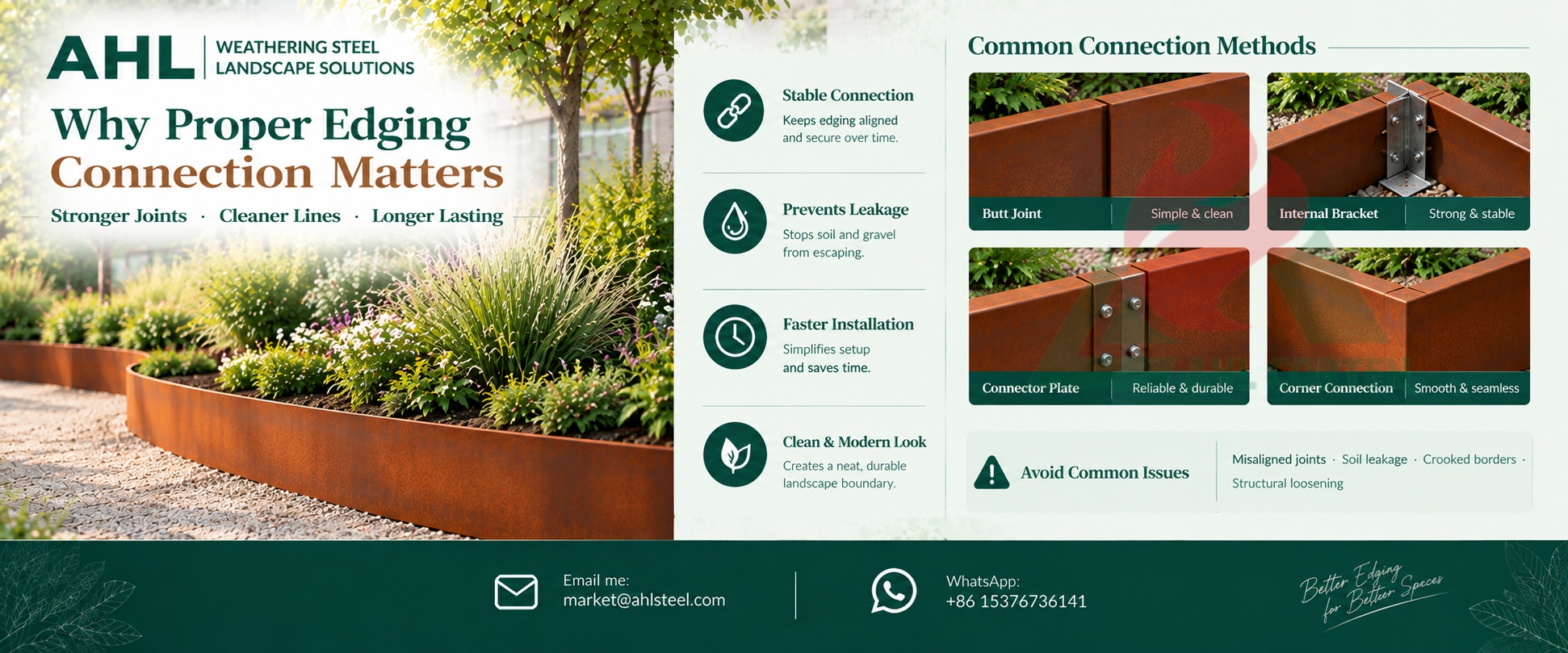
Corten steel edging is a favorite in modern landscaping for flower beds, lawn borders, and commercial spaces. However, proper installation depends heavily on how the sections are connected.
Improper connections often cause misaligned joints, soil leakage, crooked borders, and structural loosening over time. Choosing the right connection system ensures long-term stability, speeds up installation, and creates a clean, durable, and modern landscape boundary.
Want the Latest Catalog for Corten Steel Edgings? Contact Us!
Corten Steel Edging Connection Methods
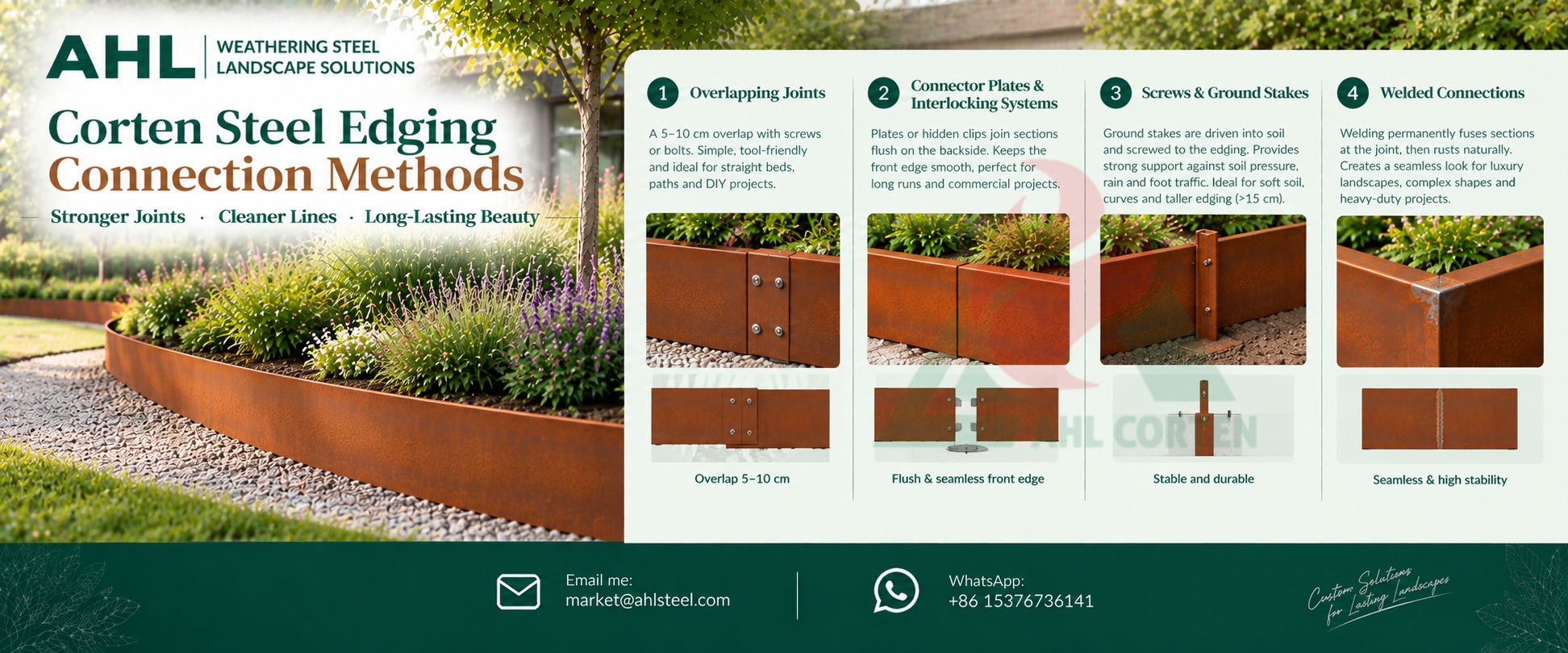
1. Overlapping Joints Sections overlap by 5–10 cm and are secured with screws or bolts. This straightforward method is ideal for straight flowerbeds, paths, and DIY garden projects because it requires no specialized tools and allows easy length adjustments during installation.
2. Connector Plates & Interlocking Systems Connector plates or hidden insert clips join two sections flush end-to-end on the backside. This approach keeps the front edge smooth and distortion-free, making it perfect for long straight runs and commercial landscapes while saving installation time.
3. Screws & Ground Stakes Ground stakes are driven into the soil at connection points and screwed directly to the edging. This provides essential structural support against soil pressure, rain erosion, and foot traffic, making it the best choice for soft soil, curved designs, and taller edging (over 15 cm).
4. Welded Connections Welding permanently fuses adjacent sections at the joint, which then rusts naturally over time. It creates a seamless, continuous appearance for luxury custom landscapes, complex geometric shapes, and heavy-duty commercial projects requiring maximum stability.
Want the Latest Catalog for Rusted Steel Edgings? Contact Us!
Comparison of Optimal Connection Solutions for Different Scenarios
To help you make a quick decision, we’ve compiled a list of common scenarios and recommended connection methods below:
| Application Scenario |
Recommended Connection Method |
Main Advantages |
| Small Home Gardens |
Overlapping joints with screws. |
Simple installation, low tool requirements, and ideal for DIY projects. |
| Straight Flower Beds or Path Borders |
Dedicated joining plates with ground stakes. |
Creates clean, straight border lines with stable structure and a strong linear appearance. |
| Curved or Organic Landscape Designs |
Adjustable-angle connectors with ground stakes. |
Allows fine adjustment along curves for a smooth and natural-looking installation. |
| High Edging or Retaining Borders |
Reinforced connectors with deeply embedded ground stakes. |
Significantly improves resistance to lateral soil pressure and helps prevent tipping or movement. |
| Large Commercial Landscape Projects |
Custom modular connection system or welded joints. |
Delivers a highly consistent appearance, exceptional structural strength, and dependable long-term performance. |
Get a Free Catalog and Quote!
Standard Installation Steps for Connecting Corten Steel Edging
Standard Installation Steps for Corten Steel Edging
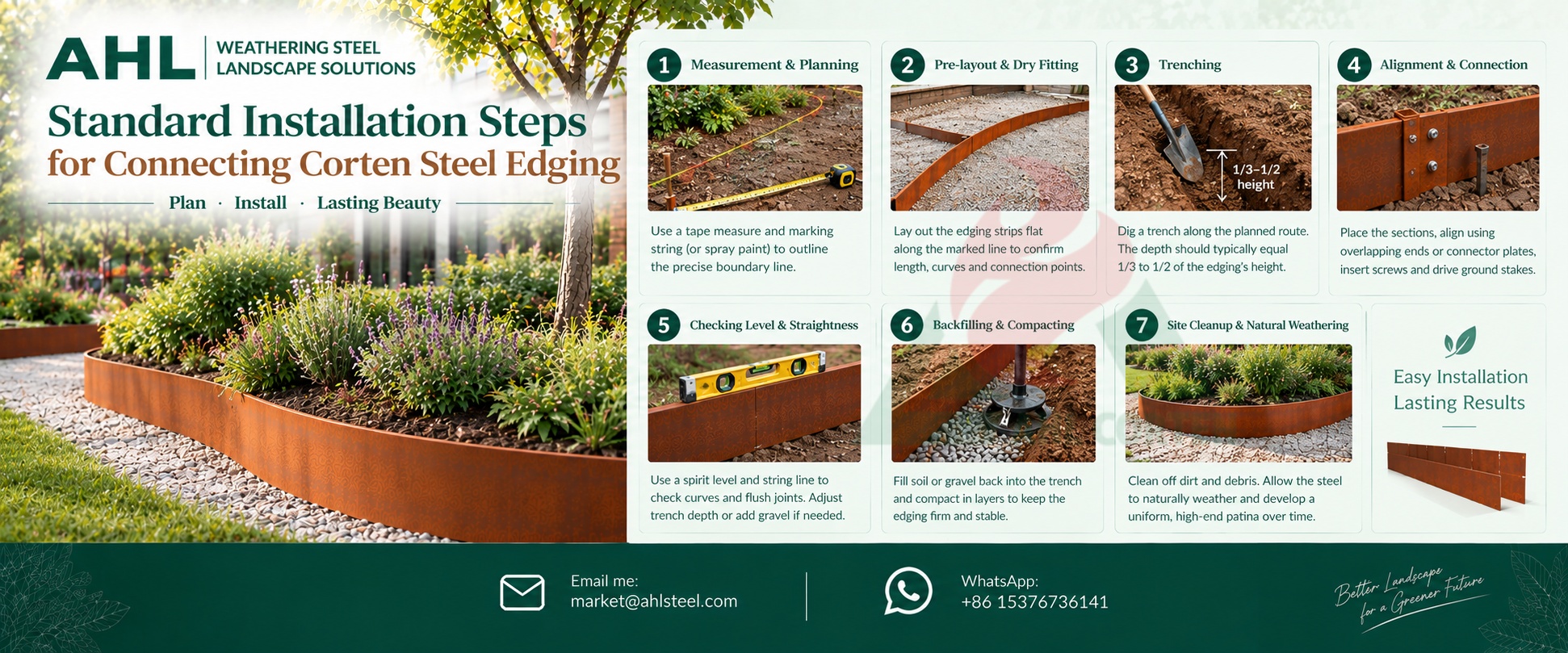
Following a standardized installation process ensures your Corten steel edging remains visually striking and structurally secure.
1
Step 1: Measurement & Planning
Use a tape measure and marking string (or spray paint) to outline the precise boundary line for your flowerbed or pathway on the ground.
2
Step 2: Pre-layout & Dry Fitting
Lay out the Corten steel edging strips flat along the marked line according to your desired length and curves to confirm corner angles and connection points.
3
Step 3: Trenching
Dig a trench along the planned route. The depth should typically equal 1/3 to 1/2 of the edging’s total height (deepen as needed for soil retention).
4
Step 4: Alignment & Connection
Place the first edging section into the trench, followed by the second. Align them using overlapping ends or connector plates, insert screws, and drive ground stakes into the soil to lock them in place.
5
Step 5: Checking Level & Straightness
Use a spirit level and string line to check for smooth curves and flush joints. Adjust trench depth or add gravel underneath uneven sections as needed.
6
Step 6: Backfilling & Compacting
Fill soil or gravel back into both sides of the trench and compact it in layers to ensure the edging stays solid and firmly anchored without wobbling.
7
Step 7: Site Cleanup & Natural Weathering
Clean dirt and debris off the steel surface and allow the Corten steel to naturally weather and develop a uniform, high-end protective patina over time.
Get a Free Catalog and Quote!
Key Factors Affecting Connection Stability
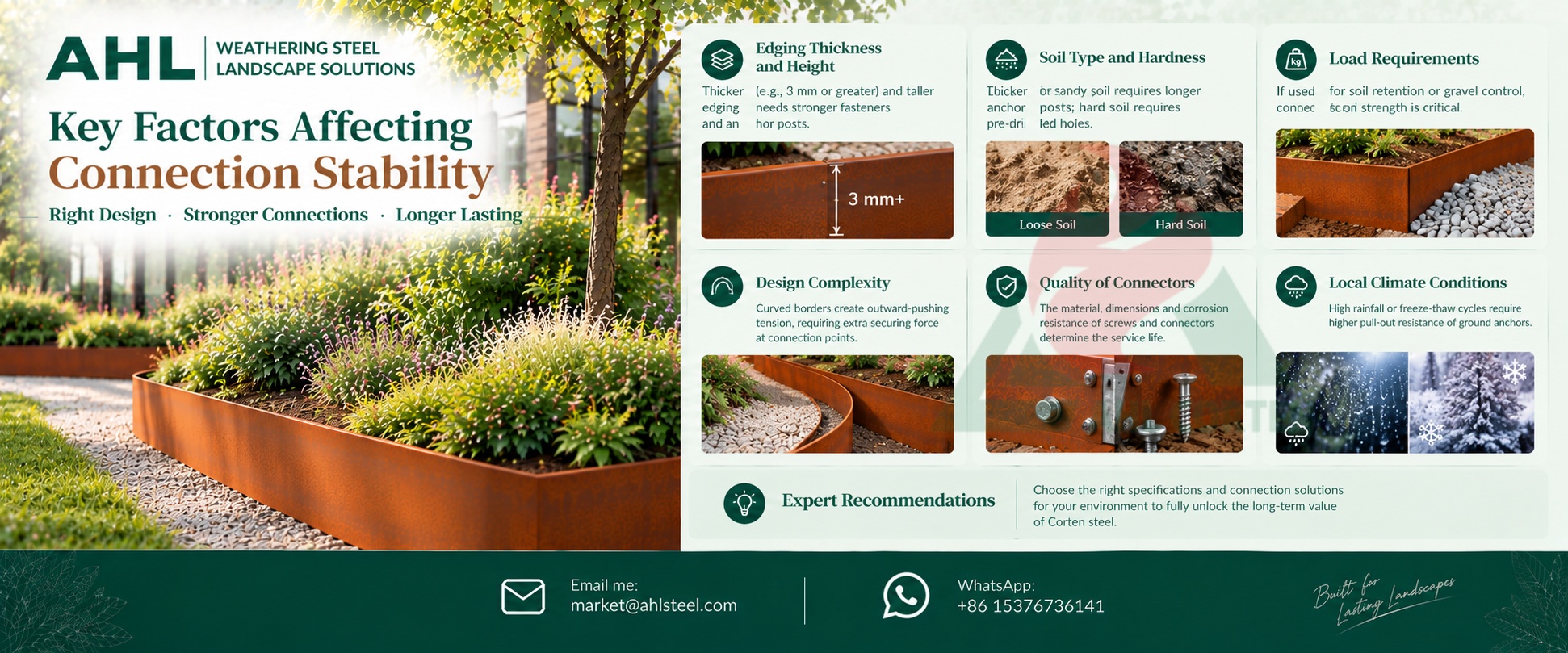
When designing and selecting weather-resistant steel edging systems, the following core factors must be comprehensively considered:
Edging Thickness and Height: Thicker (e.g., 3 mm or greater) and taller edging is subjected to greater soil pressure and must be paired with stronger fasteners and anchor posts.
Soil Type and Hardness: Loose or sandy soil requires longer anchor posts driven deeper into the ground; hard soil requires pre-drilled holes.
Load Requirements: If the edging is intended to retain soil or prevent gravel from spreading, the load-bearing capacity of the connections is of paramount importance.
Design Complexity: Curved borders generate outward-pushing tension when bent, requiring additional securing force at the connection points.
Quality of Connectors: The material, dimensions, and corrosion resistance of screws and connectors directly determine the service life of the entire system.
Local Climate Conditions: Areas with high rainfall or winter freeze-thaw cycles place higher demands on the pull-out resistance of ground anchors.
Expert Recommendations: Selecting the correct specifications and connection solutions tailored to specific environments is essential to fully leverage the low-maintenance and exceptionally long-lasting properties of Corten steel.
Want the Latest Catalog of Garden Edging? Contact Us!
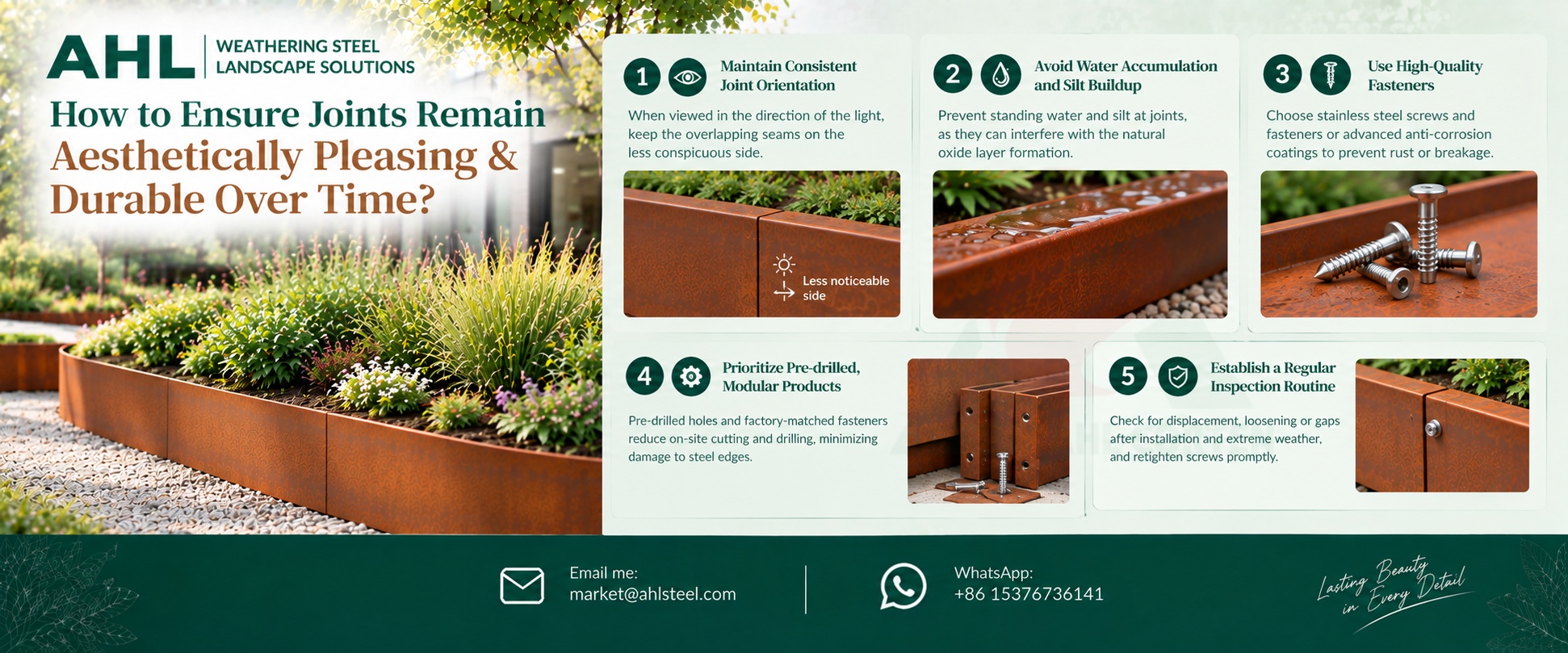
How to Ensure Joints Remain Aesthetically Pleasing and Durable Over Time?
To ensure that the weathering steel edging remains in perfect condition for many years after installation, please pay attention to the following details:
1. Maintain Consistent Joint Orientation
When viewed in the direction of the light, ensure that the overlapping seams face the less conspicuous side to enhance the overall visual flow.
2. Avoid Prolonged Water Accumulation and Silt Buildup
Although Corten steel is corrosion-resistant, prolonged exposure of joints to standing water can interfere with the normal formation of the natural protective oxide layer.
3. Use High-Quality Fasteners
It is essential to use stainless steel screws and fasteners or those with advanced anti-corrosion treatment to prevent structural failure caused by rust or breakage of small components.
4. Prioritize Pre-drilled, Modular Products
Selecting products that come with pre-drilled holes and factory-matched fasteners can significantly reduce damage to the steel edges caused by on-site cutting and drilling.
5. Establish a Regular Inspection Routine
After installation and following extreme weather events, regularly inspect joints for displacement, loosening, or abnormal gaps, and retighten screws promptly.
Want a Custom Corten Steel Edging? Contact Us!
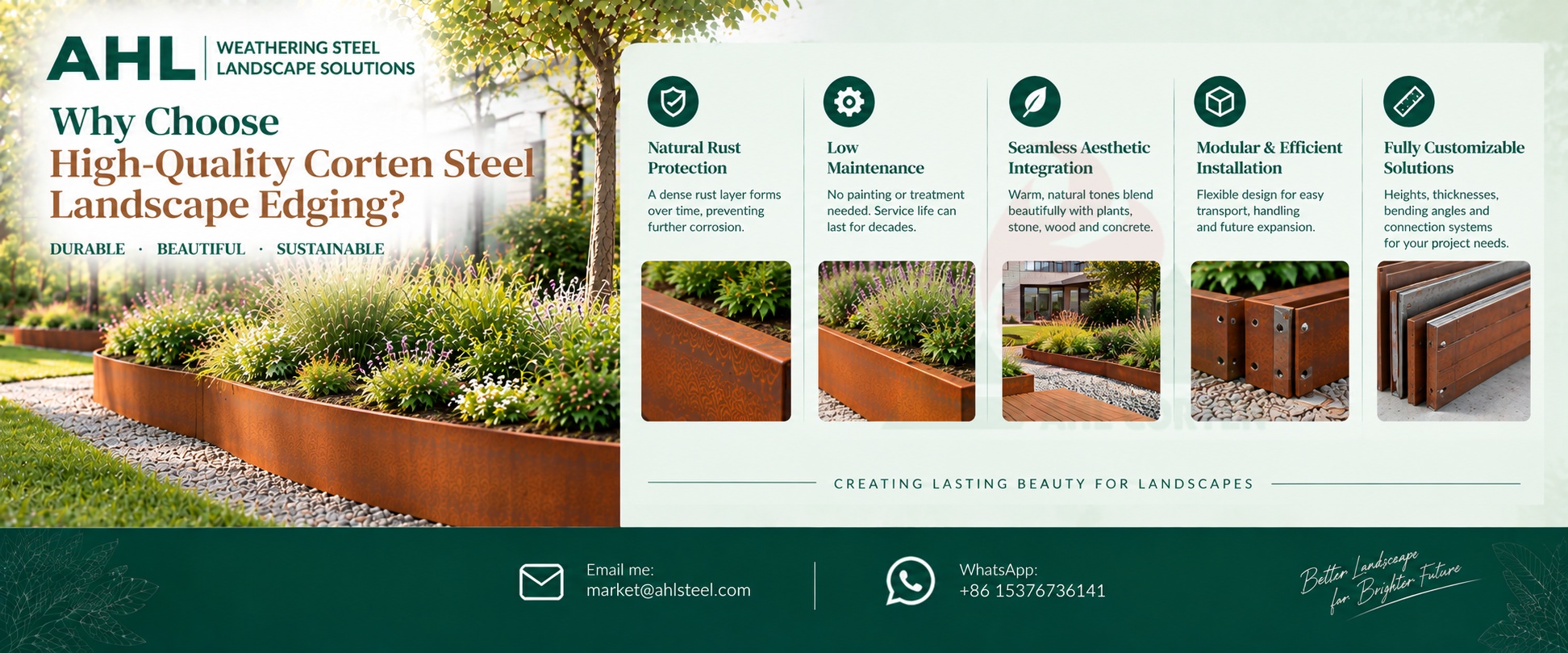
Why Choose High-Quality Corten Steel Landscape Edging?
Compared to plastic, aluminum alloy, or ordinary carbon steel edging, high-quality weathering steel edging offers unparalleled advantages:
Naturally Formed Protective Rust Layer: Over time, a dense rust passivation layer forms on the surface, effectively preventing further internal corrosion.
Extremely Low Maintenance Costs: No need for regular painting, rust prevention treatments, or frequent replacement; service life can span several decades.
Outstanding Aesthetic Integration: The warm, rich reddish-brown tones blend seamlessly with greenery, wood, natural stone, and modern concrete architecture.
Modular and Efficient Installation: The flexible modular design not only facilitates transportation and on-site handling but also allows for easy future expansion.
Extensive Customization Options: Heights, thicknesses, bending angles, and custom connection systems can be tailored to meet specific project requirements.
Want to Get Your Own Corten Edging? Click to Customize!
FAQ Frequently Asked Questions
Q1: Can Corten Steel Edging Sections Be Joined Without Welding?
A: Absolutely. The vast majority of residential and commercial landscaping projects use lap joints, specialized connector plates, or screw fasteners combined with anchor posts to achieve extremely high strength without any welding.
Q2: Do Corten Edging Sections Require Special Connectors?
A: It depends on the design requirements. While overlapping and drilling holes is sufficient for securing the sections, using specialized internal or external connector plates results in a smoother, more seamless appearance and improves installation efficiency.
Q3: How Much Should Corten Edging Sections Overlap?
A: For overlapping connections, we recommend an overlap length of 5 cm to 10 cm (2–4 inches). This ensures sufficient connection strength without wasting excessive material.
Q4: Are Screws Or Stakes Better For Connecting Corten Edging?
A: A combination of both works best. Screws are used to secure adjacent edging strips, while stakes are driven deep into the ground to provide overall resistance to tipping. Together, they create the most stable system.
Q5: Can Connected Corten Edging Be Used For Curved Borders?
A: Yes. By selecting thinner Corten steel edging (such as 1.5 mm–2.0 mm) and using adjustable-angle connectors at the joints, you can easily create smooth, natural, and elegant curves.
Q6: How Do You Connect Corten Edging For Retaining Soil?
A: For edging intended to retain soil, we recommend using thicker steel plates, employing reinforced joint plates at the connections, and increasing the density of deeply buried stakes (for example, one stake per meter).
Q7: Can Custom Corten Edging Sections Be Manufactured?
A: Yes. Based on your project drawings, we can customize specific lengths, heights, bend angles, as well as proprietary pre-drilled holes and connectors.
Q8: Does The Connection Point Affect The Rusting Process?
A: No. The weathering steel at the connection point is exposed to air and moisture at the same rate as the main panels, ultimately forming a protective rust layer with a completely uniform color.
Conclusion and Call to Action (CTA)
Choosing the right connection method is the most critical step in creating the perfect weathering steel landscape edging. Whether it’s a simple lap joint or a high-strength post-and-brace system, proper installation significantly improves construction efficiency and ensures your edging remains straight and secure for decades to come.
We offer a high-quality modular Corten steel edging system featuring pre-drilled holes, specialized connectors, and deep-set anchor posts—making your landscaping project simpler and more professional!
Ready to Upgrade Your Outdoor Landscape?
[ Explore Our Corten Steel Edging Collection ] — Browse our standard Corten steel edging product line.
[ Get a Custom Connection Solution ] — Submit your project drawings to receive a customized connection and fabrication solution.
[ Contact Our Experts ] — Contact our technical advisors for guidance on selecting specifications, connection hardware, and on-site installation.
Use high-quality weathering steel to create clean, sturdy, and timelessly elegant borders for your garden and architectural projects!
Want to Get Your Own Corten Edging? Click to Customize!