In courtyards and landscaped gardens, untidy lawns, exposed soil, and piles of mulch around trees often detract from the overall aesthetic quality of the landscape. Corten steel edging is currently the most popular edging solution in high-end landscaping.
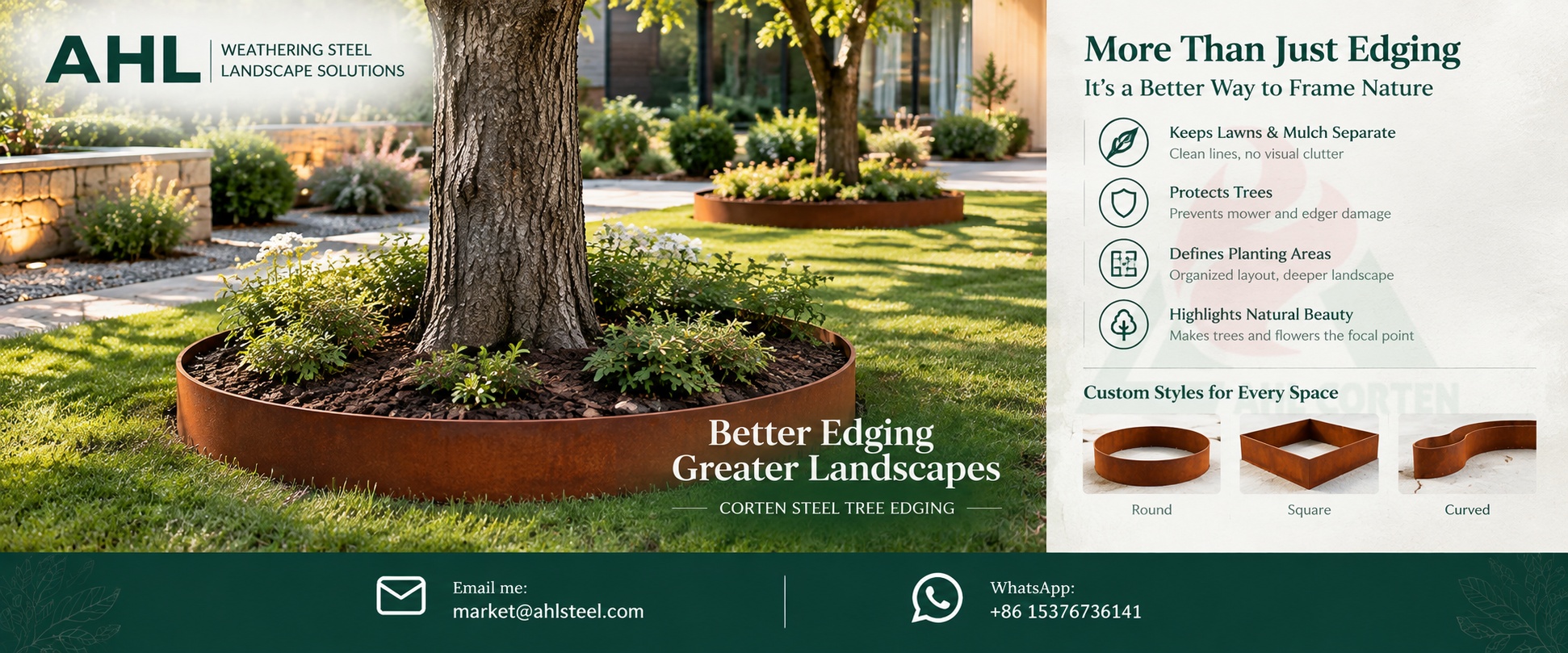
Steel landscape edging creates clean lines, distinct layers, and an architectural aesthetic around tree trunks, making the trees the visual focal point of the courtyard and eliminating the appearance of disorganized planting areas.
Weathering steel edging combines functionality with decorative appeal, and its core practical value is reflected in four key aspects:
- Effectively separate lawns from bark mulch and gravel planting areas, eliminating visual clutter;
- Prevent lawn mowers and edgers from operating too close to tree trunks to avoid accidental damage to bark and roots;
- Clearly define planting areas, organize the garden layout, and enhances the landscape’s sense of depth;
- It highlights the trees, allowing individual trees and flowering trees to become the focal points of the garden.
AHL offers full-size custom rusted steel garden edging, including standard round, geometric square, and natural curved styles. We provide pre-rusted finishes and cater to all scenarios, from residential gardens to commercial landscapes.
Want the Latest Catalog for Corten Steel Tree Rings? Contact Us!
Why Is Corten Steel Recommended for Tree Edging?
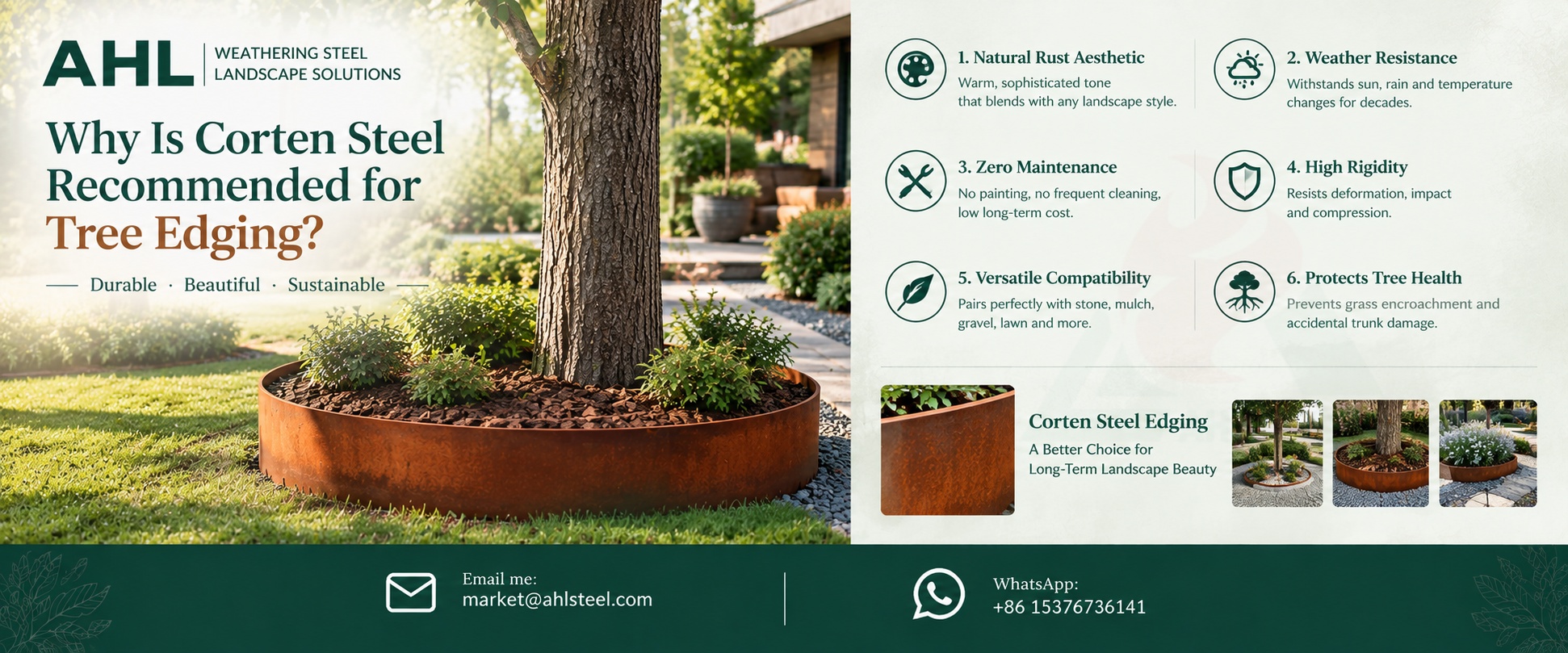
Plastic, stone, and ordinary sheet metal tree edging available on the market each have their shortcomings, whereas weathering steel is the preferred material for landscape tree edging, as it is well-suited for long-term outdoor use.
1. Natural, Vintage Rust Color with a Unique Aesthetic
Weathered steel naturally forms a uniform rust-colored passivation layer with a warm, sophisticated tone. It blends seamlessly with various landscape styles, including natural, minimalist, industrial, and light luxury courtyard designs.
2. Strong Outdoor Weather Resistance and Exceptionally Long Service Life
The protective layer formed through natural weathering resists sun exposure, rain, and temperature fluctuations. When used outdoors in the open, it remains stable for decades and is resistant to aging and damage.
3. Zero Maintenance, Low Cost, Hassle-Free, and Durable
No painting, frequent cleaning, or regular maintenance is required. Once formed, the rust layer is stable and sturdy, preventing large-scale flaking and significantly reducing long-term landscaping maintenance costs.
4. High Rigidity, Strong Resistance to Deformation, and Excellent Impact Resistance
The material’s hardness far exceeds that of ordinary plastic and galvanized sheet metal. It can withstand foot traffic, minor impacts, and soil compression, making it resistant to deformation, toppling, and cracking, while maintaining neat, defined edges over the long term.
5. Versatile and Compatible with Various Landscape Materials
It pairs perfectly with crushed stone, gravel, bark mulch, lawns, landscape stones, and low-growing flowers and greenery, blending seamlessly to suit a wide range of landscaping designs.
6. Core Protective Function
Completely prevents the lawn from spreading into the tree root zone, avoids accidental damage to the base of the trunk during manual trimming, and effectively protects the health of the tree’s root system and trunk.
Want the Latest Catalog for Corten Steel Tree? Contact Us!
Tree Border Selection: Precise Matching of Shape, Height, and Thickness
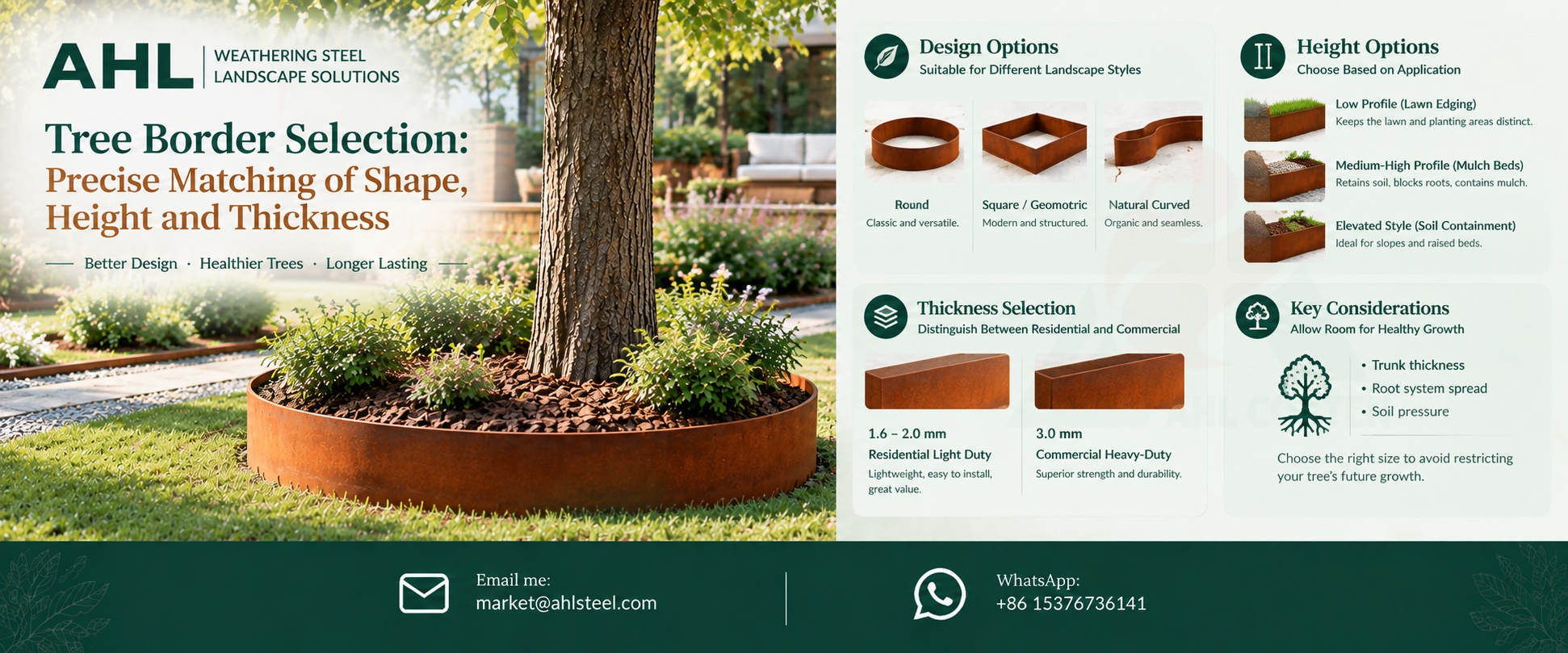
Design Options: Suitable for Different Landscape Styles
Standard Round Tree Border: The most versatile style, suitable for solitary trees and focal trees in courtyards. Its neat, symmetrical lines offer a classic, versatile look that never goes out of style.
Square/Geometric Edging: Suitable for modern minimalist gardens, commercial plazas, and formal gardens; enhances a sense of order and architectural structure in the landscape.
Natural Curved Edging: Features smooth, natural curves; ideal for natural-style gardens, woodland flowerbeds, and group plantings; minimizes the appearance of artificial intervention and blends seamlessly with the natural landscape.
Height Options: Choose Based on Application
Low Profile (Lawn Edging): With a low height, it serves solely to demarcate the boundary between the lawn and planting areas without obstructing vegetation, maintaining an open and airy feel in the garden.
Medium-High Profile (Mulch Beds): Suitable for areas covered with bark mulch or gravel, it effectively retains soil, blocks roots, prevents mulch from spilling out, and creates distinct layers.
Elevated Style (Soil Containment): Suitable for sloped terrain, areas with elevation differences, and soil-covered planting scenarios; provides stable soil retention to prevent soil erosion and landslides.
Thickness Selection: Distinguishing Between Residential and Commercial Applications
1.6–2.0 mm (Residential Light Duty): Suitable for private gardens, small trees, and decorative edging; lightweight, easy to install, and offers excellent value for money.
3.0 mm (Commercial Heavy-Duty): Suitable for large-diameter tree trunks, long landscape borders, and public projects such as parks and hotels; offers superior resistance to soil pressure and deformation, along with enhanced durability.
Key Considerations for Selection
When selecting a model, ensure you allow sufficient growth space based on the trunk’s thickness, the root system’s spread, and soil pressure to avoid choosing a border that is too small, which could restrict the tree’s future growth.
Want the Latest Catalog for Corten Steel Trees? Contact Us!
Tree Pit Preparation: Standardized Preparatory Work Before Installation
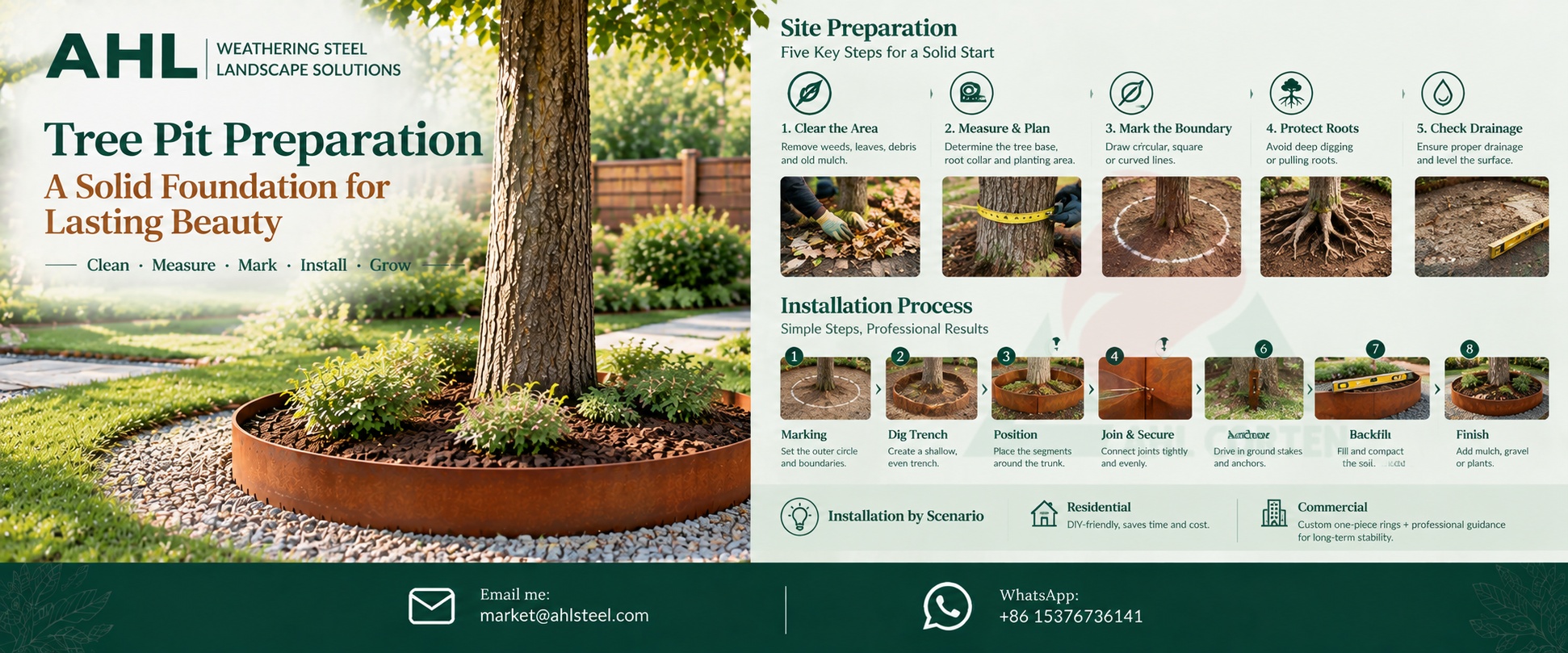
A high-quality installation depends on proper preliminary site preparation, which lays the foundation for a level, secure, and durable tree pit.
First, thoroughly clear weeds, fallen leaves, dead branches, old mulch, and debris from around the tree trunk to ensure the work area is clean and tidy.
Next, precisely measure the position of the tree’s base and root collar. Based on landscaping requirements, determine the planting area and the diameter of the tree surround, allowing ample space for the tree to grow.
Then, according to the chosen design, mark out circular, square, or curved boundaries to ensure smooth and symmetrical lines.
Throughout the installation process, avoid disturbing the surface root system. Do not dig deeply or pull on the roots, as this can damage the tree’s root system and hinder its growth.
Finally, inspect the site’s drainage conditions and level any low-lying areas to prevent future issues such as waterlogging, root suffocation, and soil siltation.
Standard Installation Steps: DIY-Friendly Even for Beginners
The installation process for Corten steel tree rings is simple; for residential settings, you can install them yourself, while large-scale commercial projects may require professional installation.
Complete Installation Process
- Precise Marking: Mark the outer circle of the tree’s circumference and the installation boundaries according to the preset dimensions.
- Dig a Shallow Trench: Dig an even, shallow trench along the marked lines to a moderate depth, ensuring the perimeter sits vertically on the ground.
- Position and Arrange: Place the Corten tree ring segments around the tree trunk, aligning them neatly.
- Join and Secure: Connect the joints of each segment tightly, ensuring even gaps and a seamless line.
- Reinforce and Anchor: Drive in specialized ground stakes and anchors to prevent shifting, tilting, or toppling.
- Calibrate and Fine-Tune: Check the overall roundness, height, and levelness to ensure the structure is neat and symmetrical.
- Backfill Evenly: Backfill the soil evenly on both sides of the trench and compact it to secure the edging structure.
- Landscape Finishing: Lay bark mulch, gravel, groundcover plants, or low-growing flowers inside the tree surround to complete the landscaping.
Installation Recommendations by Scenario
For standard residential yards and small trees, a simple DIY installation is recommended, as it saves time and effort and is more cost-effective.
For large trees, sloped landscapes, and commercial projects such as hotels and parks, we recommend using custom-made, one-piece tree surrounds with reinforced fasteners, combined with professional installation guidance, to ensure long-term stability.
Want the Latest Catalog for Corten Steel Trees? Contact Us!
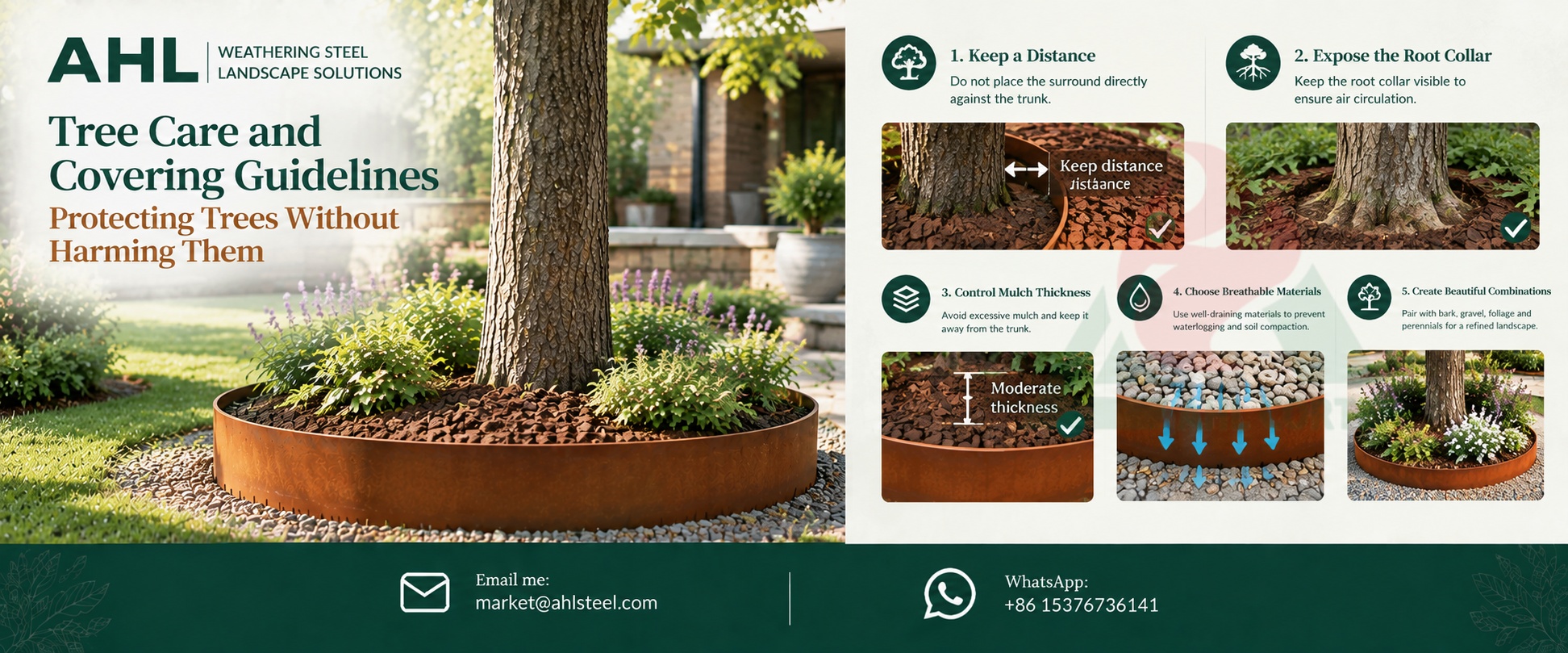
Tree Care and Covering Guidelines: Protecting Trees Without Harming Them
The primary purpose of installing a Corten tree surround is to protect the tree; incorrect placement or backfilling methods can harm the tree’s health.
1. Surroundings Must Not Be Placed Directly Against the Trunk
A reasonable distance must be maintained from the trunk to avoid compressing it, hindering growth, and to allow space for the root system to breathe.
2. Keep the Root Collar Exposed to Ensure Air Circulation
The root collar and the base of the trunk must be completely exposed. Do not cover them with soil or other materials to prevent root suffocation, rot, and the breeding of pests and diseases.
3. Strictly Control the Thickness of Mulch
Mulch such as bark or gravel should not be piled too thickly, and it should not remain in direct contact with the surface of the trunk for extended periods.
4. Prioritize Breathable, Drainage-Friendly Materials
Select mulch materials with good breathability and drainage to prevent waterlogging and soil compaction, thereby protecting the root system’s breathing environment.
5. Enhance Aesthetics Through Landscaping Combinations
Combine with bark chips, gravel, low-growing foliage plants, and perennial flowers to add depth and enhance the overall refinement of the landscape.
Want the Latest Catalog for Corten Steel Trees? Contact Us!
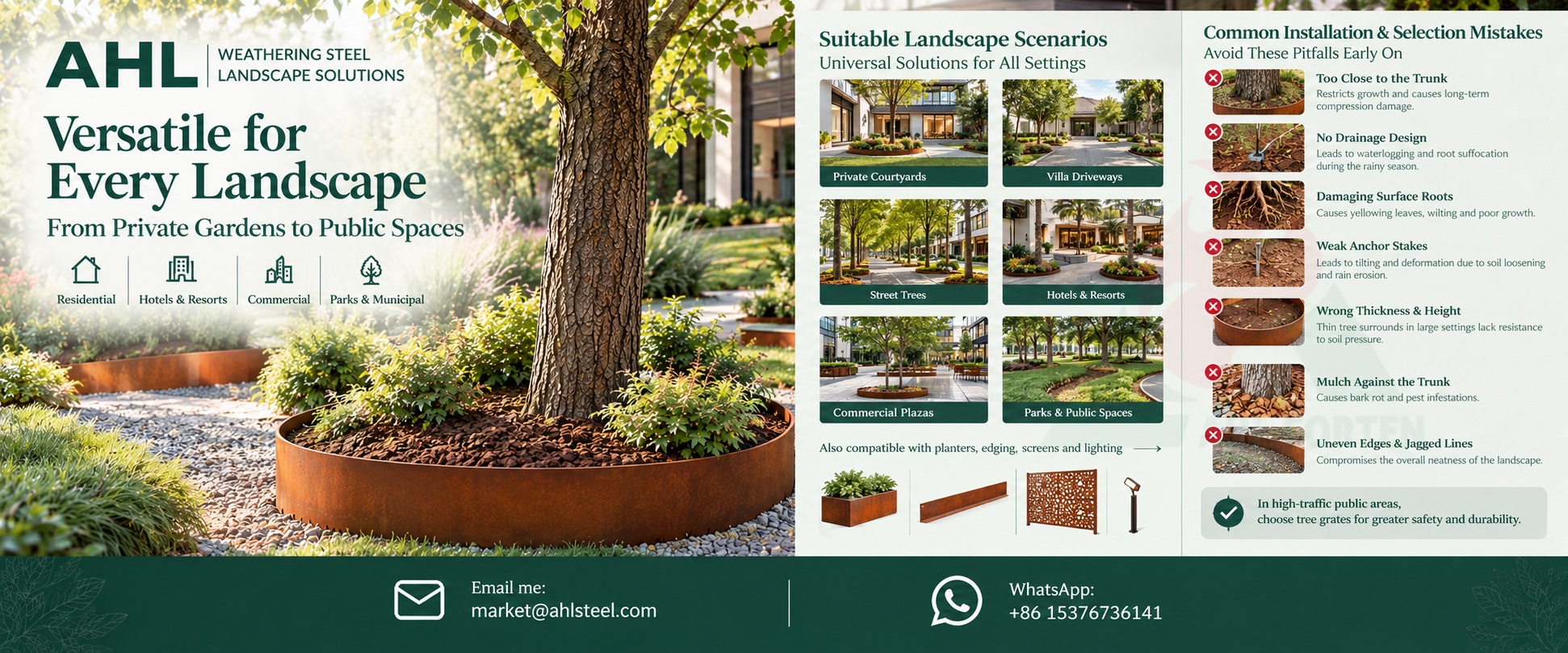
Suitable Landscape Scenarios: Universal Landscaping Solutions for All Settings
Weathering steel tree rings are suitable for virtually all outdoor tree landscaping scenarios, offering exceptional versatility and adaptability.
Private residential courtyards, solitary trees on lawns, and landscape trees in small gardens
Villa driveways, courtyard entry paths, and tree edging along vehicular roads
Landscape paths, tree-lined avenues, and neatly arranged street trees
Outdoor landscaping for hotels, bed-and-breakfasts, and resorts
Commercial districts, plazas, and planting beds at sales offices
Municipal parks, public green spaces, and landscape renovation projects
Additionally, it can be paired with AHL weathering steel planters, landscape edging strips, partition screens, and landscape lighting to create a systematic outdoor landscape with a unified style and texture.
Common Mistakes in Installation and Selection: How to Avoid Them Early On
Many cases of poor landscape aesthetics and subsequent problems stem from mistakes made in the early stages. The following errors should be avoided at all costs:
❌ Placing edging too close to the tree trunk, which restricts growth and causes long-term compression damage to the trunk
❌ Lack of drainage design on-site, leading to waterlogging and root suffocation during the rainy season, which weakens tree growth
❌ Damage to the surface root system during trench excavation, causing yellowing leaves, wilting, and poor growth
❌ Use of flimsy anchor stakes, leading to tilting and deformation of the tree surround due to soil loosening and rain erosion
❌ Inadequate thickness and height selection; using thin tree surrounds in large-scale settings results in insufficient resistance to soil pressure
❌ Mulch piled directly against the tree trunk, causing bark rot and the proliferation of pests and diseases
❌ Uneven edges and jagged lines around walkways compromise the overall neatness of the landscape
In high-traffic public areas, prioritize tree grates over open-style tree surrounds to enhance safety and durability.
Want the Latest Catalog for Corten Steel Trees? Contact Us!
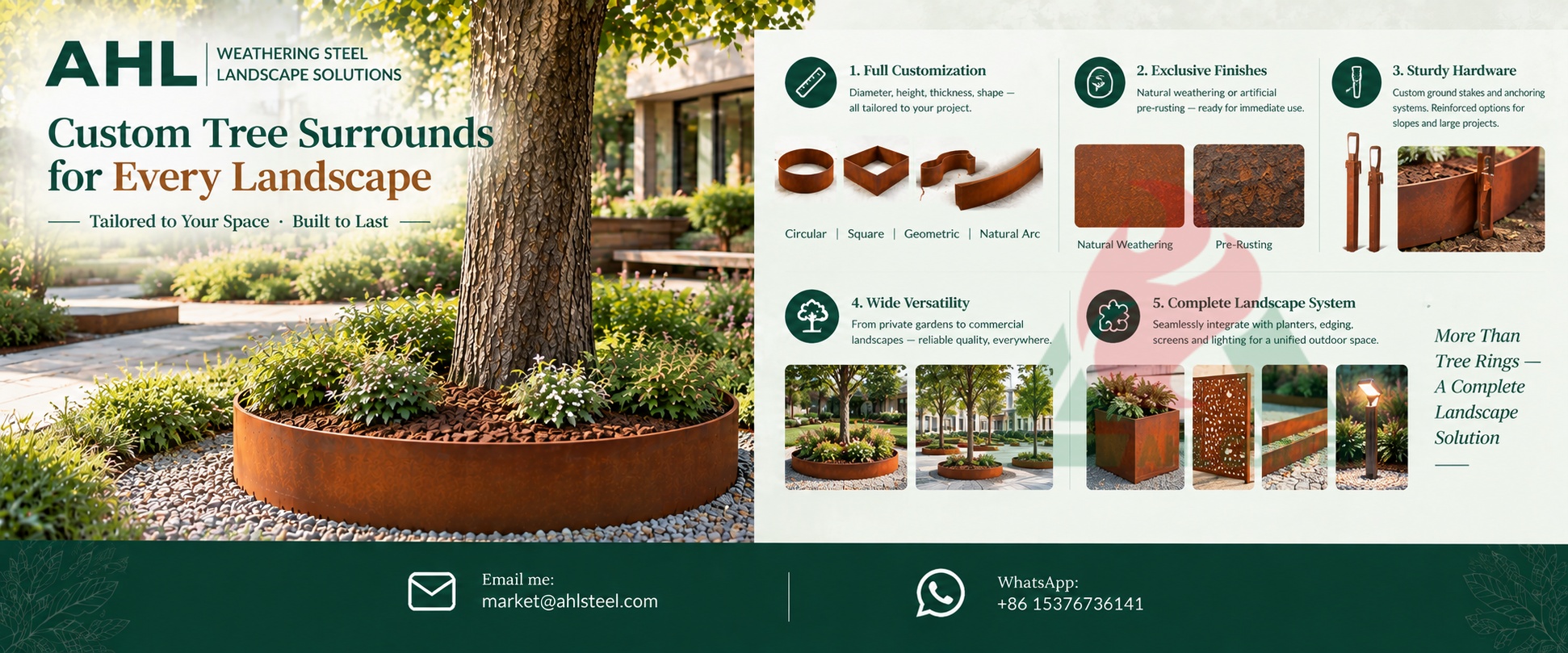
Key Advantages of Choosing AHL’s Custom Tree Surrounds
AHL specializes in custom weathering steel landscape components. Unlike off-the-shelf products, our solutions are fully tailored to your site and landscape design requirements.
1. Comprehensive Customization Services
We support custom specifications for diameter, height, thickness, and shape—including circular, square, geometric, and natural arcs.
2. Exclusive Surface Treatments
We offer two surface treatments: natural on-site weathering and artificial pre-rusting. This allows for immediate installation without waiting for natural rusting.
3. Sturdy Mounting Hardware
Comes standard with custom ground stakes and anchoring systems; reinforced solutions are available for sloped terrain and large-scale edging installations.
4. Versatility Across All Settings
Suitable for both lightweight decorative applications in private gardens and large-scale, heavy-duty commercial landscape projects, with consistent and reliable quality.
5. Landscape System Integration
Can be seamlessly integrated with our full range of weathering steel landscape products to create a unified, cohesive outdoor landscape system.
Use AHL Garden Tree Rings to create clean, durable, and architecturally textured tree landscape borders. If you need custom tree rings, curved edging, pre-rusted products, or a complete landscape solution, please feel free to contact us at any time.
Want the Latest Catalog for Corten Steel Surrounds? Contact Us!
Frequently Asked Questions
Q: Can Landscape Tree Rings Be Installed Around Mature, Large Trees?
Yes. Simply avoid the main roots and surface roots, and allow adequate space for growth; this will not affect the tree’s normal growth.
Q: What Is the Optimal Distance Between the Tree Ring and the Trunk?
We recommend leaving a gap of 20–50 cm based on the trunk’s size—narrower for smaller trees and wider for larger ones—to ensure proper aeration and growth space for the roots.
Q: What Is the Optimal Thickness for a Tree Surround?
For residential yards, 1.6–2 mm is recommended. For commercial, large-scale, or sloped sites, the 3 mm thickened version is preferred for greater stability and resistance to deformation.
Q: Will a Weathering Steel Tree Surround Damage the Tree’s Roots?
Proper installation will not damage the root system. Avoid digging deeply into the soil or installing the surround too close to the trunk to ensure the tree’s health.
Q: Will Weathering Steel Stain or Discolor Surrounding Paving?
Minor rust runoff may occur during the initial weathering phase, but once stabilized, there will be no staining issues. If installed near stone paving, apply a protective barrier in advance.
Q: Should I Choose An Open Tree Surround or a Tree Grate?
Select a tree surround for garden landscaping and low-traffic areas; in high-traffic areas such as parks and plazas, prioritize slip-resistant tree grates.
Conclusion
Weathering steel tree borders offer a cost-effective, high-quality, and long-lasting solution for enhancing your landscape. They not only protect the health of trees but also tidy up the garden landscape, significantly enhancing the overall refinement and sophistication of your yard.
If you need custom-sized tree borders, bespoke design concepts, or professional installation guidance, feel free to contact the AHL team at any time to receive a tailored landscape solution and an accurate quote.
Contact Us