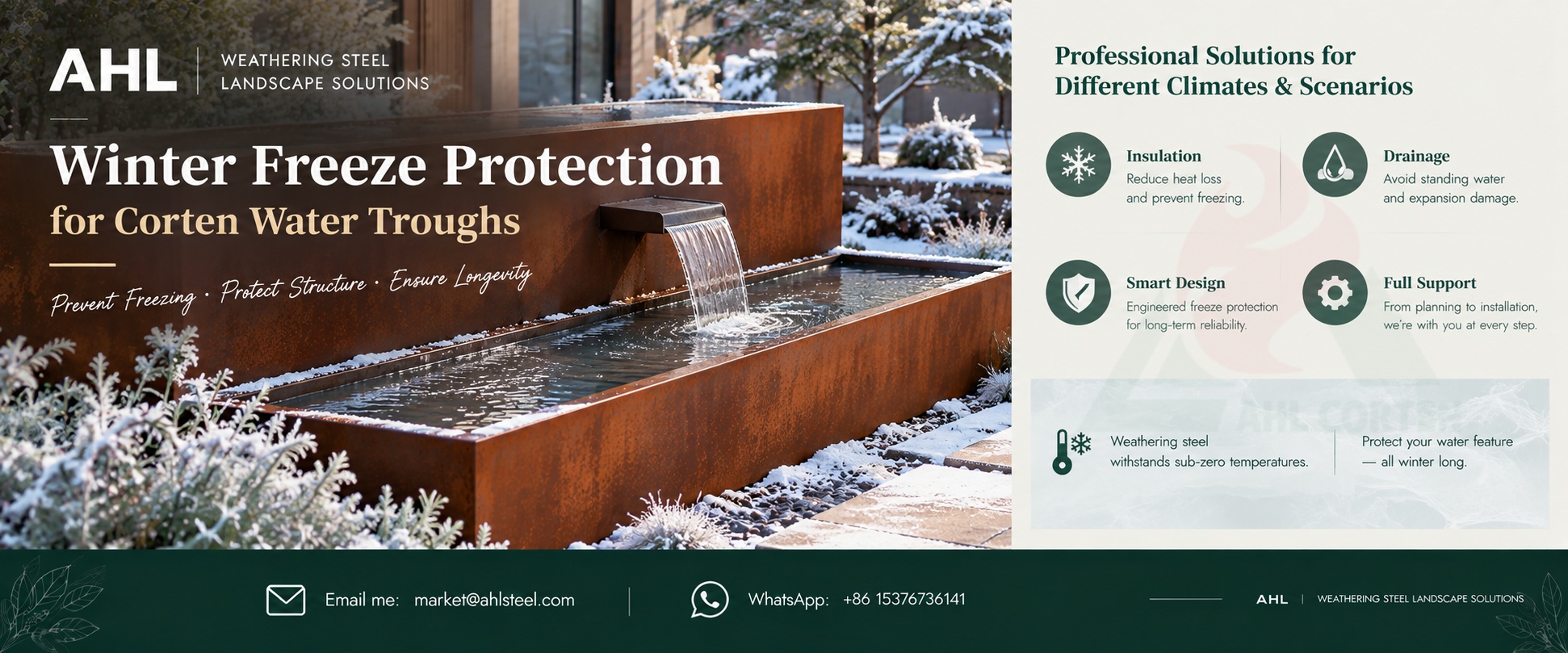
Many courtyard and landscape professionals have a misconception: that weathering steel is inherently resistant to low temperatures and requires no special maintenance in winter. In fact, weathering steel can withstand sub-zero temperatures and will not crack or deteriorate due to the cold itself.
The vast majority of winter damage to corten water troughs is not caused by the steel’s inability to withstand freezing temperatures, but rather by the expansion of frozen water. When water freezes, its volume expands by 9%, creating immense water pressure inside sealed welds, pipes, and pump housings, which leads to structural damage.
Minor freeze damage may result in deformation of the trough or water seepage through welds, while severe cases can cause welds to burst, pipes to crack from freezing, and water pumps to burn out, resulting in high repair and replacement costs.
This article will outline a comprehensive set of standardized winter freeze-protection solutions tailored to different climates and usage scenarios, while also explaining professional, engineering-level freeze-protection design concepts to help you ensure the long-term protection of your weathering steel water feature installations.
Want the Latest Catalog for Corten Steel Water Features? Contact Us!
Quick Answer: How to Protect a Corten Water Trough From Freezing?
| Winter Condition |
Recommended Protection |
| Occasional Light Frost |
Reduce the water level, monitor for ice formation, and protect the pump. |
| Short Cold Spells Below 0°C |
Switch off the pump and drain exposed components. |
| Repeated Freezing Nights |
Fully drain the trough, pipes, and pump. |
| Prolonged Hard Freeze |
Complete winterisation and use a breathable protective cover. |
| Winter Operation Required |
Use continuous circulation, an approved de-icer, or a suitable water-feature heater. |
| Water Feature Near a Pond or Drainage System |
Add automatic drainage and overflow protection. |
Why Frozen Water Is a Risk
1. The Core Mechanism of Damage Caused by Frozen Water
Ordinary low temperatures do not damage corten steel sinks, but the volumetric expansion that occurs when standing water freezes can create extremely high hydrostatic pressure in confined, narrow spaces.
With no outlet for this pressure, it continuously compresses the sink’s structure, welds, and built-in fixtures, making it the primary cause of all winter-related failures.
2. High-Risk Areas for Freeze Damage in Water Tanks
Freeze damage does not occur uniformly; it is mostly concentrated in hidden, hard-to-reach corners—areas that are most easily overlooked during routine maintenance:
Welded corners of the water tank, sealed gaps along folded edges, built-in water supply pipes, and U-shaped traps
Submersible pumps, filter housings, valve chambers, overflow pipes, and drainage chambers
Cavities between double-layered steel plates, decorative water channels, and sealed housings of underwater LED lights
3. Detailed Consequences of Freeze Damage to Various Components
Weather-resistant steel basin: Accumulated water freezes and exerts pressure, causing the panel surface to bulge and undergo localized deformation, which compromises the overall smoothness of the basin’s shape.
Welded seams: Stress concentration leads to cracks and leaks in the welds, resulting in permanent water leakage issues.
Pumps and filtration equipment: Ice can block the impeller or crack the housing, directly burning out the motor and rendering the equipment completely inoperable.
Pipes and Valves: Pipes burst and sealing gaskets rupture, causing leaks and failure of water control systems.
Underwater Lighting Systems: Water ingress and freezing can cause lampshades to crack and circuits to short-circuit, posing safety hazards.
4. Key Design Conclusions
Weathering steel possesses excellent low-temperature resistance; however, the pipes, equipment, and welded joints of the entire water feature system are not freeze-resistant. Winter freeze protection must safeguard the entire system, not just the steel material alone.

Want the Latest Catalog for Corten Steel Water Troughs? Contact Us!
Winter Protection by Climate
| Climate Type |
Typical Risk |
Recommended Strategy |
| Mild Winter with Occasional Frost |
Temporary surface ice. |
Monitor conditions, reduce the water level, and protect the pump. |
| Moderate Freeze-Thaw Climate |
Repeated expansion and thawing. |
Drain exposed pipes and switch off the pump. |
| Cold Continental Climate |
Prolonged sub-zero temperatures. |
Fully drain the basin, pipes, pump, and related equipment. |
| Severe Frost Region |
Deep and persistent freezing. |
Complete winterisation, cover the feature, and inspect it before restarting. |
| Coastal Cold Climate |
Freezing conditions combined with salt exposure. |
Drain the system, use a protective cover, protect the patina, and inspect for corrosion. |
| Commercial Operating Site |
Frequent use and ongoing maintenance pressure. |
Specify automatic drainage, accessible service points, and a planned maintenance routine. |
Complete Drainage: The Most Reliable Method
1. Situations Where Standing Water Must Be Completely Drained
In areas with prolonged sub-zero temperatures, hidden cavities containing water, pumps not rated for freeze protection, long-term winter shutdowns, or repeated freeze-thaw cycles, partial drainage is completely ineffective.
Simply lowering the water level is insufficient to protect hidden components such as pipes and pump housings; residual standing water will still freeze, expand, and cause damage.
2. Comprehensive Drainage Checklist (No Blind Spots)
Many people only drain the surface water from the trough, neglecting hidden areas, which ultimately still results in freeze damage. A comprehensive drainage plan must cover:
The main trough cavity, pump compartment, return pipes, filter housing, valves, and isolation joints
Overflow pipes, low-lying areas where water accumulates in the piping, decorative water channels, and underwater lighting enclosures
3. Engineering-Grade Optimized Drainage Design (AHL Custom Solution)
Retrofitting drainage systems is costly and often ineffective. High-quality, outdoor water troughs come with built-in freeze-proof drainage design right out of the factory:
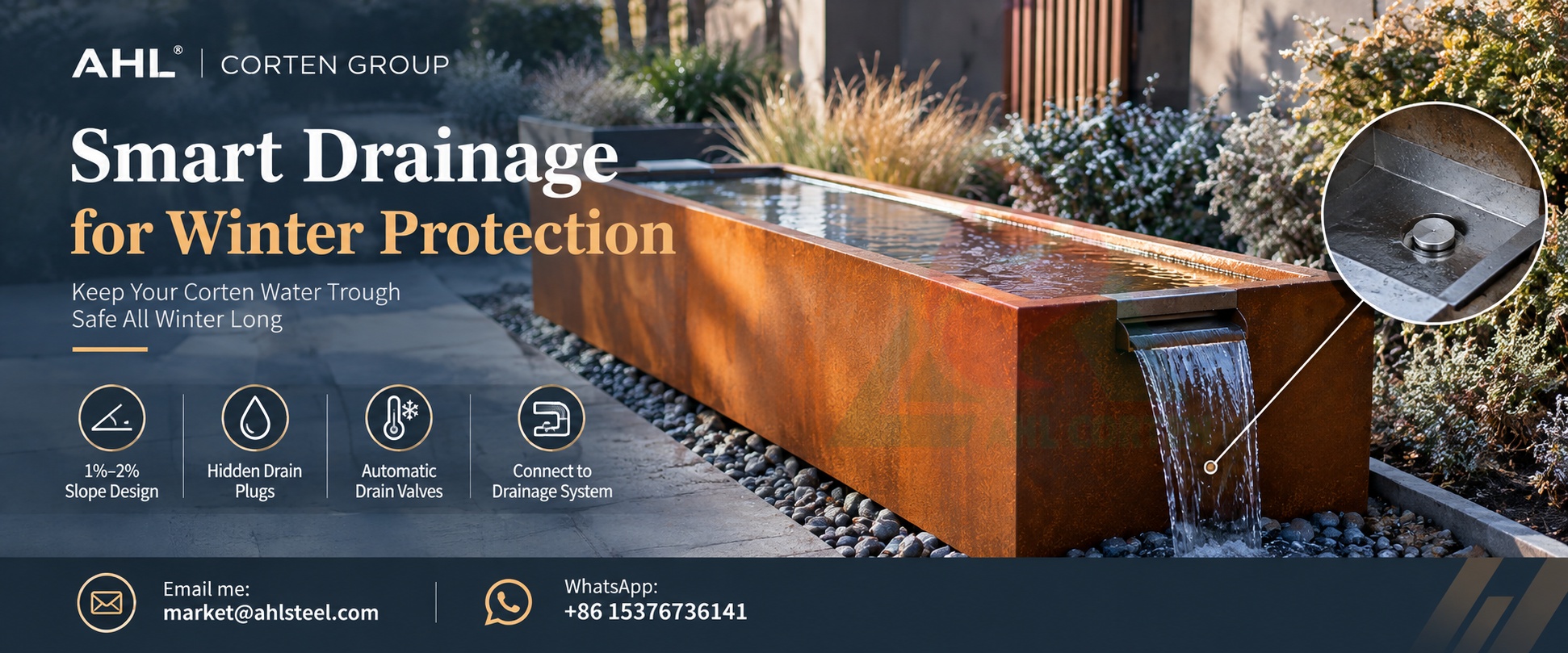
The bottom of the trough features a precise 1%–2% slope, eliminating low-lying areas where water can pool and enabling complete self-draining
Concealed drain plugs in low-lying areas allow for convenient drainage without compromising the aesthetic appeal of the landscape
Temperature-controlled automatic drain valves automatically activate drainage in cold environments, requiring no manual supervision
The drainage system can be connected to on-site drainage wells and drainage pipes, preventing surrounding areas from becoming muddy and waterlogged
Want the Latest Catalog for Rusted Steel Water Troughs? Contact Us!
Pump, Filter, and Pipe Protection
1. Turn Off the Pump Early
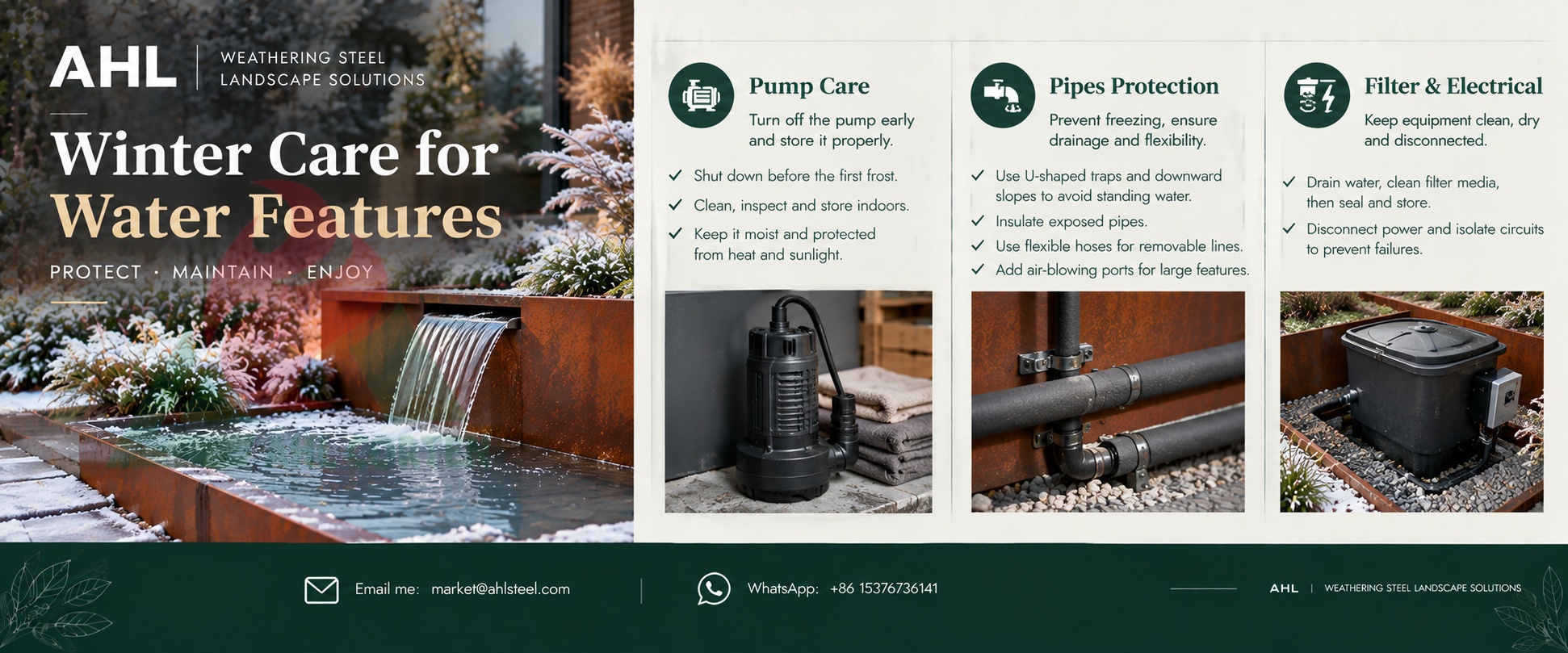
Turn off the power and shut down the pump well before the first frost. Never operate the pump in partially frozen water to prevent the impeller from seizing up and the motor from overloading and burning out.
After disassembling the pump, thoroughly clean out any silt and algae, inspect the seals and impeller for damage, and store the pump in a frost-free indoor area to dry.
For long-term storage, soak the pump in clean water to maintain moisture, preventing the sealing gaskets from drying out, cracking, or deteriorating. Keep it away from high temperatures and direct sunlight.
2. Pipe Frost Protection and Drainage Techniques
Modify U-shaped trap pipes and design all piping with a downward slope to prevent stagnant water in dead corners.
Wrap exposed pipes with insulation. For pipes that cannot be drained, replace them with flexible hoses for easy disassembly and storage.
Large Corten water features can be equipped with air-blowing ports to use compressed air to thoroughly blow out any residual water from the pipes.
3. Filter and Electrical Equipment Protection
Drain any accumulated water from the filter chamber, clean the filter media, and store the unit after ensuring it is dry and properly sealed.
During winter, disconnect the equipment from the main power supply and ensure electrical circuits are isolated to prevent circuit failures caused by low temperatures and humidity.
Want the Latest Catalog for Rusted Steel Water Troughs? Contact Us!
Lowering the Water Level for Mild Frost
1. Applicable Scenarios
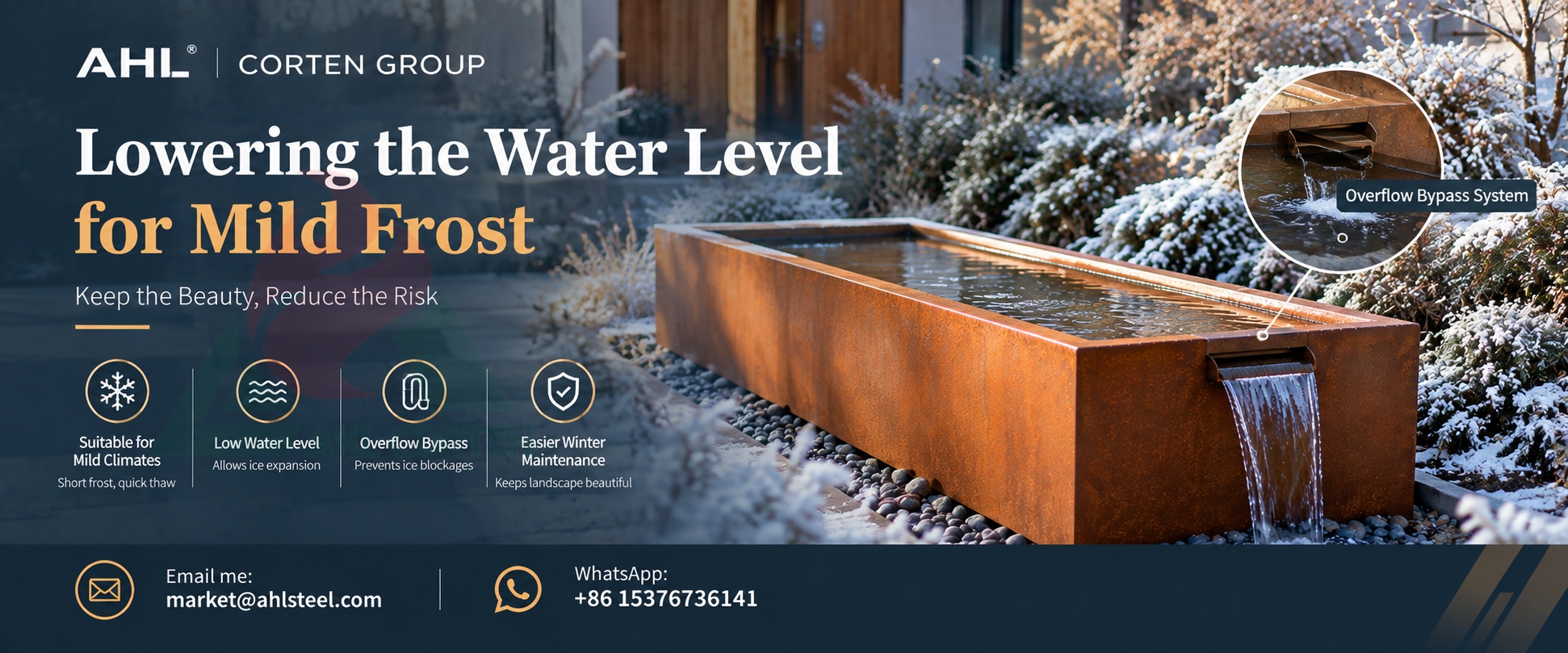
Large rusted water troughs are only suitable for mild regions where nighttime frost is brief and rapid thawing occurs during the day, as well as for water features that require continuous operation to maintain landscape aesthetics in winter.
Lowering the water level creates space for ice expansion, preventing the ice layer from compressing the trough’s side walls.
2. Key Limitations
Lowering the water level only protects the trough itself; it cannot drain residual water from pipes, pump chambers, or filters, so the risk of freeze damage remains.
During prolonged periods of severe cold, the ice layer will thicken overall and will still exert pressure on the Corten water trough, causing deformation and leaks.
3. AHL Customized Solutions for Low-Temperature Operation
To meet winter landscaping needs in mild climates, we have developed a customized low-level winter operation mode paired with an overflow bypass system.
This solution maintains the aesthetic appeal while preventing ice blockages in the overflow system, significantly reducing the difficulty of winter maintenance.
Want the Latest Catalog for Metal Water Troughs? Contact Us!
Keeping Your Water Feature Operating in Winter
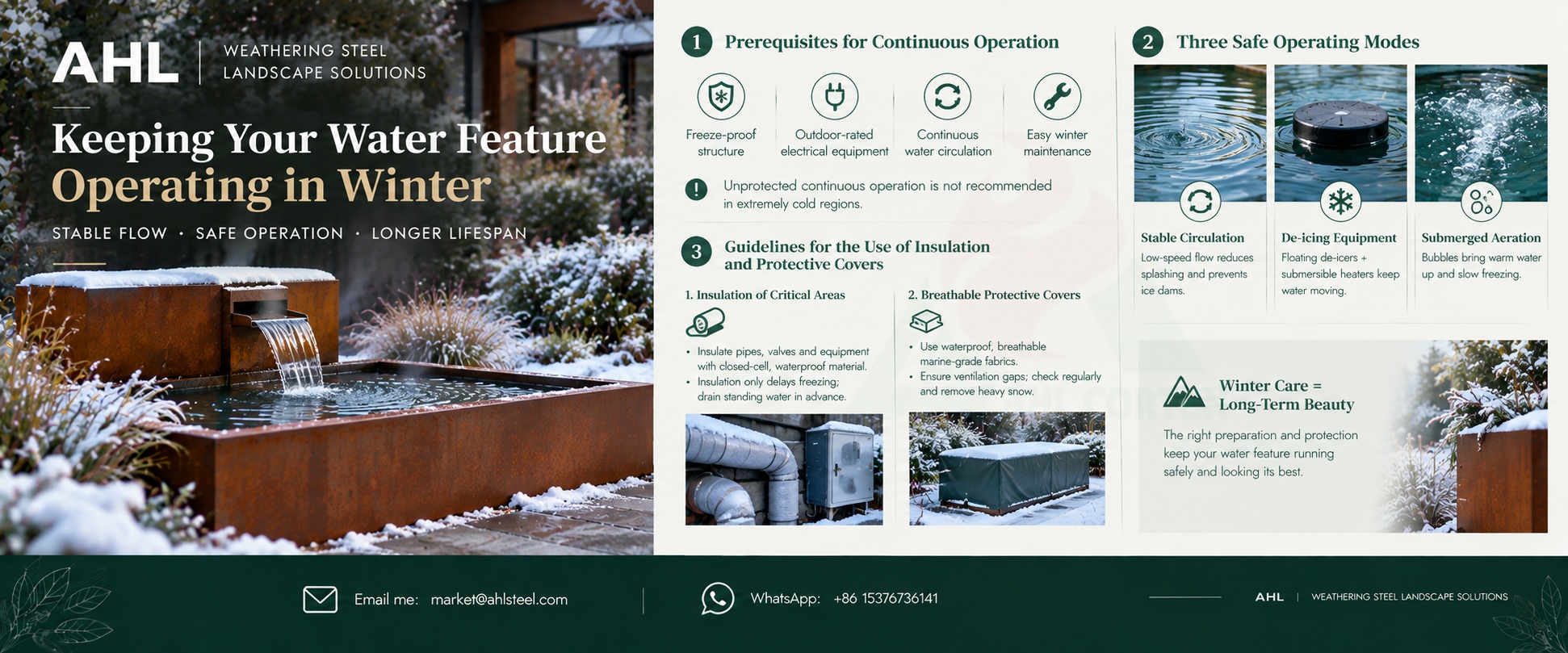
1. Prerequisites for Continuous Operation
The metal water trough must feature a freeze-proof structural design; electrical equipment must be suitable for outdoor low-temperature environments; the site must allow for continuous water circulation; and convenient winter maintenance conditions must be available.
Unprotected continuous operation is not recommended in extremely cold regions, as it can easily lead to sudden equipment failure.
2. Three Safe Operating Modes
Stable Water Circulation: Low-speed, steady water flow reduces splashing and prevents ice formation along the edges or ice dams from blocking the drainage outlets.
Professional De-icing Equipment: Use floating de-icers with ground protection and submersible heaters to maintain localized flowing water on the surface and balance internal pressure.
Submerged Aeration: Bubbles agitate the water, causing warm water from the bottom to rise to the surface, thereby slowing the overall freezing rate.
Guidelines for the Use of Insulation and Protective Covers
1. Insulation of Critical Areas
Apply closed-cell, waterproof insulation to exposed pipes, valves, and equipment compartments to slow heat loss.
Insulation can only delay freezing; it cannot completely prevent it. Standing water must be drained in advance; do not rely on insulation as a substitute for drainage.
2. Key Points for Installing Breathable Protective Covers
After draining accumulated water in winter, specialized breathable protective covers must be installed to prevent contamination from snow, fallen leaves, debris, and de-icing salt.
Prioritize waterproof, breathable marine-grade fabrics; do not use non-breathable plastic sheeting for sealing. A sealed environment traps moisture, causing uneven coloration in the steel’s paint finish and rust layer, and accelerating localized corrosion.
Protective covers must include ventilation gaps; regularly inspect their secure fit and promptly remove heavy snow accumulation.
Want the Latest Catalog for Metal Water Troughs? Contact Us!
Rust Layer Protection and Standardized Pre-Winter Maintenance
1. Prohibitions Regarding the Protection of Weathering Steel Rust Layers
Do not use chemical de-icing agents such as road de-icing salt or calcium chloride, as chloride ions will damage the self-passivating protective layer of weathering steel, causing pitting corrosion.
Do not use wire brushes or hard objects to chip away ice, as this will scratch the steel’s surface, damage welds, and compromise both the aesthetic quality and structural stability.
2. Pre-Winter Cleaning Procedures
Thoroughly remove organic matter—such as silt, algae, and fallen leaves—from channels to prevent winter decay and contamination of the steel.
Clear all drains and overflow channels, and wipe away residual moisture from concealed areas such as welds, interlayers, and equipment compartments.
3. Pre-Winter Structural Inspection
Conduct a comprehensive inspection of welds for micro-cracks, check for panel deformation, ensure fittings are secure, and verify that drainage is unobstructed. Address potential issues in advance to prevent winter freeze damage from exacerbating malfunctions.
Specialized Anti-Freeze Solutions for Commercial and Landscape Projects
1. Hotels and High-End Landscapes
Balancing winter landscape aesthetics, visitor safety, and low operational and maintenance costs, these projects adopt a low-level winter operation mode, concealed piping, and a quick-release pump compartment design.
This reduces the frequency of manual maintenance and prevents exposed equipment from detracting from the overall landscape aesthetic.
2. Municipal Squares and Public Parks
Equipped with low-temperature freeze alarms, anti-icing and overflow systems, slip-resistant perimeter paving, and anti-theft fittings to ensure public safety.
Standardized winter startup/shutdown, snow removal, and maintenance procedures are established to align with the park’s routine operations.
3. Large-Scale Architectural Water Features and Cascading Water Structures
Multi-tiered cascades and elongated water features require the drainage of accumulated water in layers and sections, with a multi-point drainage system in place.
Concealed lighting and complex piping systems require advance freeze protection planning to prevent damage from localized frozen water, ensuring the long-term stability of large-scale landscapes.

Want the Latest Catalog for Corten Water Troughs? Contact Us!
Proactive Frost Protection Design: Eliminating Winter Hazards at the Source
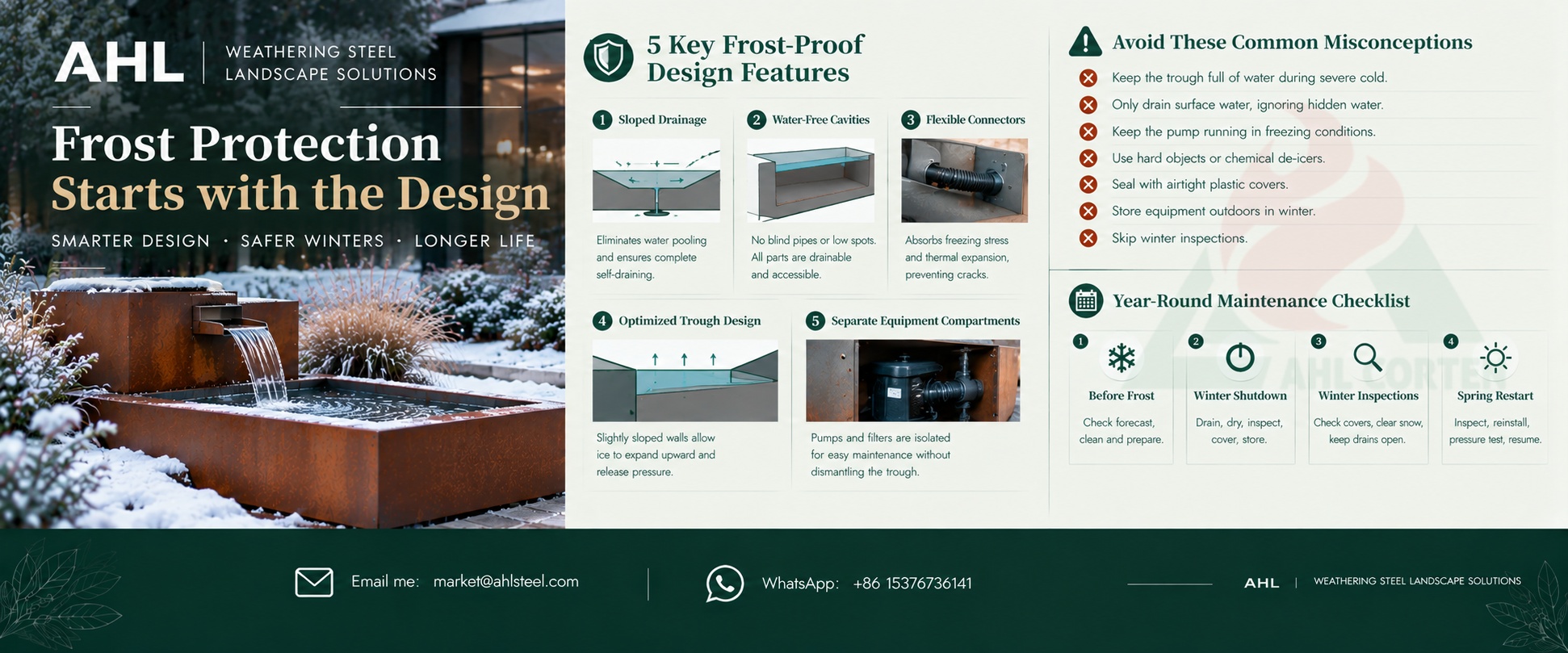
The most effective frost protection involves integrating frost-proof design into the custom water trough manufacturing phase, which is far more efficient and cost-effective than retrofitting or maintenance later on.
- Sloped Drainage Design: The trough is sloped toward the lowest point, eliminating any dead corners where water can pool and enabling complete self-draining.
- Water-Free Cavity Structure: Eliminates enclosed cavities, blind pipes, and low-lying recesses; all structural components are drainable and accessible for maintenance.
- Flexible Connectors: Pipes use flexible joints to cushion stress caused by freezing and thermal expansion and contraction, preventing cracks.
- Optimized Trough Design: Slightly sloped trough walls allow ice to expand upward and release pressure, preventing lateral compression of weld seams.
- Separate Equipment Compartments: Pumps and filtration equipment are housed in separate compartments, allowing for disassembly, drainage, and maintenance without dismantling the entire trough.
Common Misconceptions About Winter Freeze Protection (How to Avoid Pitfalls Effectively)
Many cases of freeze damage to troughs are not due to inadequate maintenance, but rather to falling into incorrect freeze-protection habits:
❌ Leaving the trough full of water during severe cold weather, relying on the steel’s freeze resistance while ignoring the expansion pressure of frozen water
❌ Draining only surface water while neglecting hidden water in pipes, pump compartments, and filtration equipment
❌ Continuing to operate the pump in freezing conditions, leading to impeller seizure and motor burnout
❌ Using hard objects to chip away at ice or applying chemical de-icing agents, which damages the steel’s rust layer and structural welds
❌ Sealing with airtight plastic covers, causing moisture to trap and leading to discoloration and corrosion of the steel
❌ Storing mechanical and electrical equipment outdoors in winter, resulting in freezing damage and scrapping
❌ Neglecting to inspect welds before winter sets in, allowing existing minor defects to crack completely due to freeze-thaw expansion
Want the Latest Catalog for Corten Water Troughs? Contact Us!
Year-Round Frost Protection Maintenance Checklist (Implemented in Phases)
1. Before Frost Sets In
Monitor low-temperature forecasts, clear debris from gutters, unclog drainage channels, and determine whether to shut down equipment for the winter or keep it running.
2. Winter Shutdown Phase
Disconnect power, dismantle equipment, thoroughly drain all standing water from the entire system, dry concealed cavities, inspect structural welds, cover with breathable protective covers, and store equipment indoors.
3. Routine Winter Inspections
Check the secure fastening of protective covers, promptly clear heavy snow accumulation, keep drainage outlets unobstructed, and do not use hard objects to chip away ice.
4. Spring Restart Phase
Once the frost season has completely ended, remove the protective covers; conduct a comprehensive inspection of the basin, equipment, and piping for freeze damage; reinstall the equipment; fill with water for pressure testing and check for leaks; then resume normal operation.
Why Choose AHL Custom Weathering Steel Water Troughs?
AHL weathering steel water feature equipment integrates winter freeze protection design into the manufacturing process rather than relying on retrofitted solutions, thereby reducing winter maintenance complexity and the risk of damage at the source.
Factory-Integrated Frost Protection Design: Standard features include a sloped basin bottom, low-level drainage, automatic drain valves, protected piping, and a separate equipment compartment.
Low Maintenance Advantages: Equipment is removable, drainage has no dead zones, and maintenance does not require dismantling or altering the entire landscape.
Full-Scenario Customization Capabilities: Supports personalized customization of dimensions, water depth, cascading structures, lighting, and drainage systems to suit all scenarios, including courtyards, hotels, municipal projects, and commercial plazas.
Exclusive Project Adaptation Solutions: We provide one-on-one matching of freeze-protection configurations and maintenance plans based on local climate, winter cold duration, and operational conditions.
Are You Ready to Choose a High-Quality Corten Water Trough?
The key to winter freeze protection for weathering steel troughs lies not in the steel itself, but in preventing water from pooling. By selecting appropriate solutions—such as drainage, insulation, water circulation, and equipment storage—based on local climate, you can completely eliminate winter freeze damage.
Standard water basins rely on post-installation maintenance, while professionally customized basins rely on proactive freeze-protection design. High-quality structural design can significantly reduce year-round winter maintenance costs and extend the service life of water feature equipment.
If you are unsure which freeze-protection solution is suitable for your site or need a custom weathering steel water basin designed for winter freeze protection, please contact the AHL team for one-on-one professional guidance on selection, design, and maintenance.
FAQ
Can a Corten Water Trough Stay Outside In Winter?
Yes, the Corten steel body can generally remain outdoors, but the water system must be protected. In freezing climates, drain the basin, pipes, pump, filters, and other components to prevent ice expansion damage.
Should I Drain My Corten Water Trough Before Freezing Weather?
Yes, complete drainage is the safest option when temperatures are expected to remain below freezing. Remove all visible and trapped water from the basin, pipes, pump chamber, and filters.
Will Freezing Water Damage Corten Steel?
The steel itself may tolerate cold temperatures, but water trapped inside the system can expand when frozen and place pressure on welds, panels, fittings, and pipes.
Can I Leave the Pump Running During Winter?
Only if the water feature is specifically designed for winter operation and the pump, electrical system, and heating or circulation setup are suitable. Do not run a pump in partially frozen water.
How Should I Store the Pump?
Clean the pump and store it indoors in a frost-free location. Follow the manufacturer’s guidance regarding whether it should remain submerged in clean water to protect seals.
Can I Use a Heater or Floating De-Icer?
A suitable outdoor-rated heater or floating de-icer may help maintain an open area of water in mild or moderate freezing conditions. It must be correctly sized, safely connected, and compatible with the trough and water system.
Should I Cover The Water Trough?
A breathable waterproof cover can reduce snow, ice, leaves, and salt exposure. Avoid sealing the feature in a way that traps condensation, and do not allow the cover to place excessive pressure on the structure.
Can I Break The Ice Manually?
Avoid hitting the ice or steel with hard tools. Shock and impact can damage the basin, welds, patina, or internal components. Use controlled thawing or follow the manufacturer’s winter procedure.
Does Lowering the Water Level Prevent Freezing Damage?
Lowering the water level may help during short or mild frost periods, especially if it remains below the overflow pipe. It does not remove water from pipes, pumps, or hidden cavities and may not be sufficient during prolonged freezing.
How Can I Design a Corten Water Trough for Cold Climates?
Specify positive internal slopes, accessible drain valves, automatic drainage, removable pumps, protected pipework, overflow control, flexible connections, and service access. Cold-climate projects should be designed around complete winterisation rather than relying on the steel body alone.